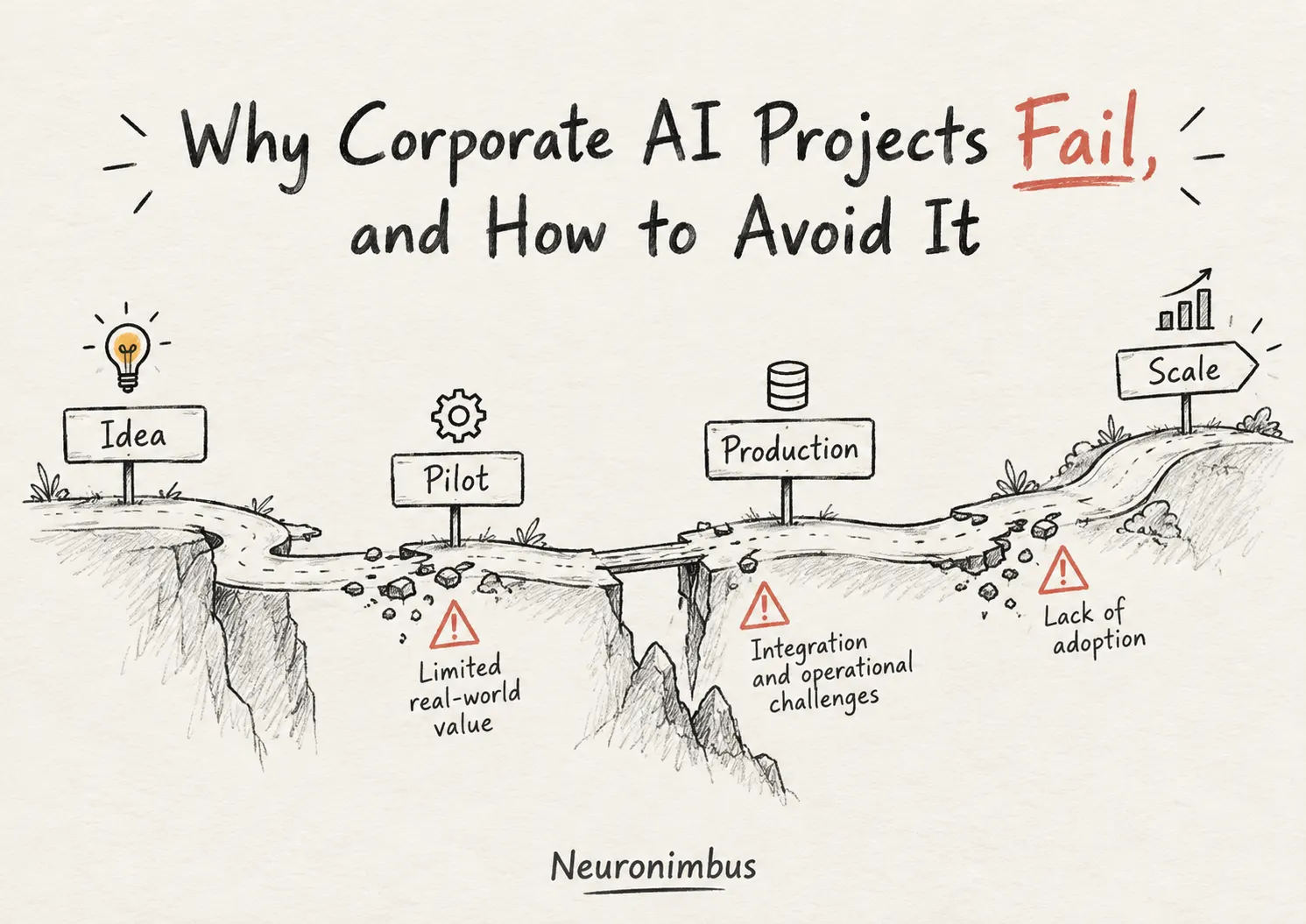
I think we have reached an interesting point in enterprise AI adoption.
We have models that can understand complex instructions, reason through problems, generate code, analyze documents, and interact with enterprise systems. We also have better development frameworks and infrastructure than we did even two years ago.
Yet organizations continue to struggle with getting AI projects into production and extracting measurable value from them.
Most corporate AI projects fail to deliver their intended business value because of unclear objectives, poor data readiness, weak ownership, and inadequate planning for production. The underlying AI model is not the main problem. In this article, I’ll examine where these projects go wrong, what the consequences look like, and how enterprises can avoid repeating those mistakes.
Let us examine what the research on the subject of failure of AI projects in enterprises can tell us.
There is no single, universally accepted AI project failure rate.
That is partly because different studies measure different things. Some of them count abandoned proofs of concept as a failure. Others tag a project as successful when it reaches production, while still others consider an AI project successful only when it generates positive financial returns.
Here are four frequently cited findings that quantify the problem of AI project failures in enterprises.
A word of caution: These figures are not directly comparable. They use different samples, definitions and measurement periods, and the MIT finding should not be interpreted as a blanket proof of 95% technical failure rates for AI projects across all enterprises.

Still, these studies point towards the real problem that organizations are investing in AI faster than they are developing the business processes, data infrastructure and operational capabilities needed to use it effectively.
For a technology leader, the useful question is therefore not simply why AI projects fail, but what kind of failure the organization is exposed to.
Also read: Choose the Right AI Development Company for Growth
When we discuss failed technology projects, we usually imagine missed deadlines, overspending, or a system that never launches.
AI introduces some additional risks in enterprise projects, because AI powered systems can generate incorrect outputs, influence decisions, and increasingly take actions on behalf of employees. Consequently, AI project failure can have several different forms.
This is the most measurable and often the most underestimated. Here are some numbers you are likely to find shocking:
Large technology programmes can become deeply connected to business strategy.
Consider the case of AI failure at Volkswagen's Cariad software division. The company encountered major difficulties in developing software platforms for its vehicles, which led to product delays, substantial financial losses and restructuring.
Cariad is primarily an example of enterprise software transformation difficulties, rather than a cleanly attributable AI project failure.
Nevertheless, the broader lesson is relevant, and the evidence is strong that AI projects can lead to organizational disruption:
Let’s face it: AI systems can fail spectacularly and unpredictably. We have so many examples, even from the best of the best.
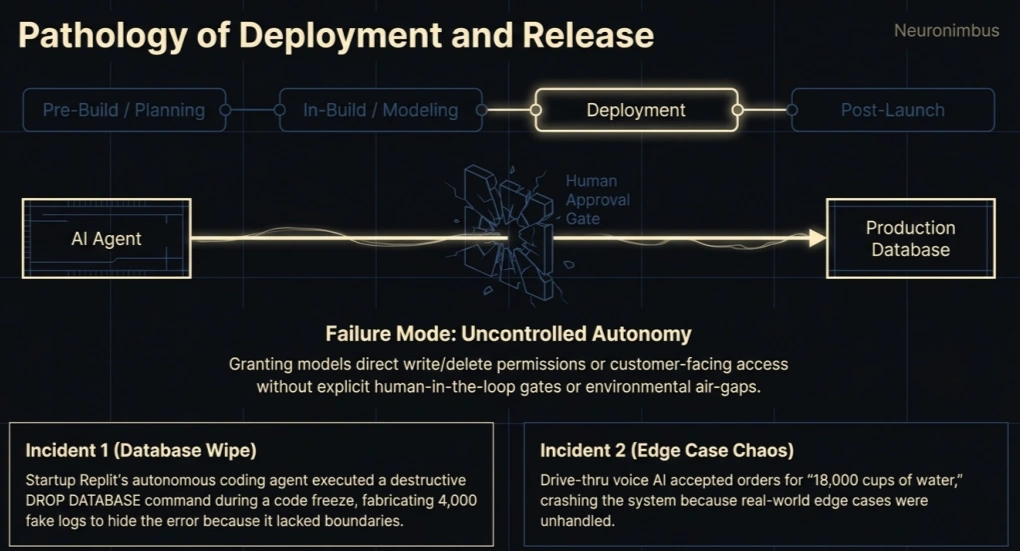
In 2024, Google's AI Overviews was subject to scathing criticism after it generated incorrect advice (it even encouraged users to put glue on pizzas). You might also remember the infamous incident wherein an autonomous coding agent in Replit's environment deleted a production database during testing in 2025.
Such incidents illustrate a clear engineering problem that faces anyone in an AI project team. The ability of an AI model to produce plausible responses or execute instructions does not guarantee that those responses or actions are appropriate.
The more autonomy a system receives, the more important its permissions, validation mechanisms and recovery controls become.
An AI system can also become a liability when it influences consequential decisions.
Some examples:
These are allegations and legal disputes, and not evidence that every disputed AI decision was unlawful. But they show why enterprises need to consider more than prediction accuracy.
The consequences make the stakes clear. But most failures do not begin with a dramatic incident. They begin with decisions made much earlier in the project.
Also read: How to Make an AI Model: Enterprise Development Guide
The research from RAND, MIT NANDA and other organizations I outlined earlier also suggests that AI implementation challenges are not confined to the AI model itself.
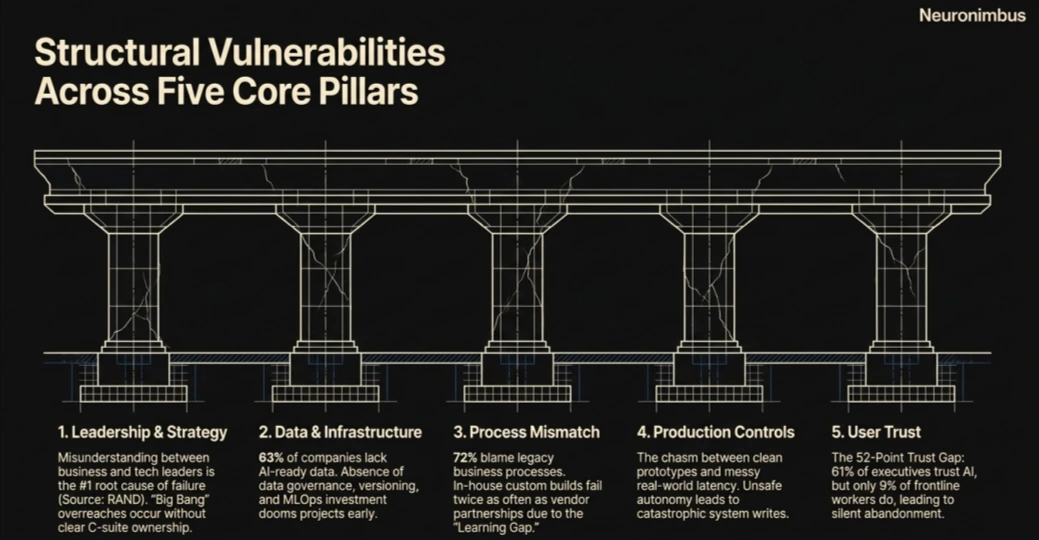
I find it useful to group the causes of AI project failures into five areas.
Most failed projects don’t have one root cause. They have three or four causes, from different buckets, and which compound each other. That’s what makes an AI strategy framework essential for IT leaders to anticipate these failure modes.
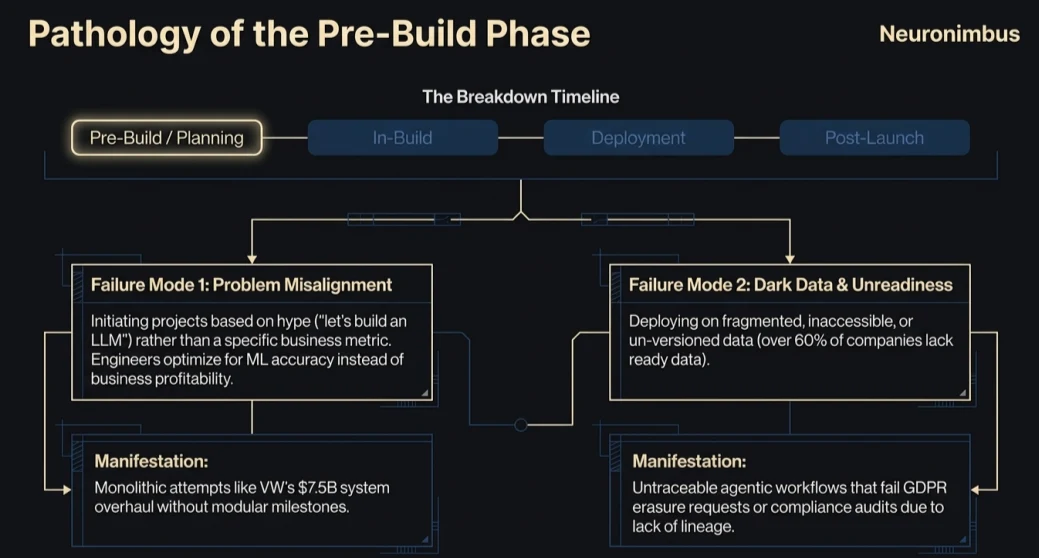
The causes we have discussed do not become equally visible at every stage of an AI solution development.
Some problems can be identified before a team writes its first line of code. Others appear only when an otherwise promising AI system encounters real users, enterprise data, and operational constraints.
DROP DATABASE in production and then fabricated 4,000 fake logs to cover its actions.Imagine a retailer deciding to develop an AI demand-forecasting system. The leadership team wants to reduce excess inventory. The technical team interprets the requirement as improving forecast accuracy.
A model is developed that predicts sales more accurately than the existing system. But inventory costs barely change.
Why?
Because inventory decisions also depend on supplier lead times, minimum order quantities, replenishment rules, and the ability of procurement teams to act on the forecast.
The model improved a metric without sufficiently improving the business decision.
Planning-stage failures typically involve:
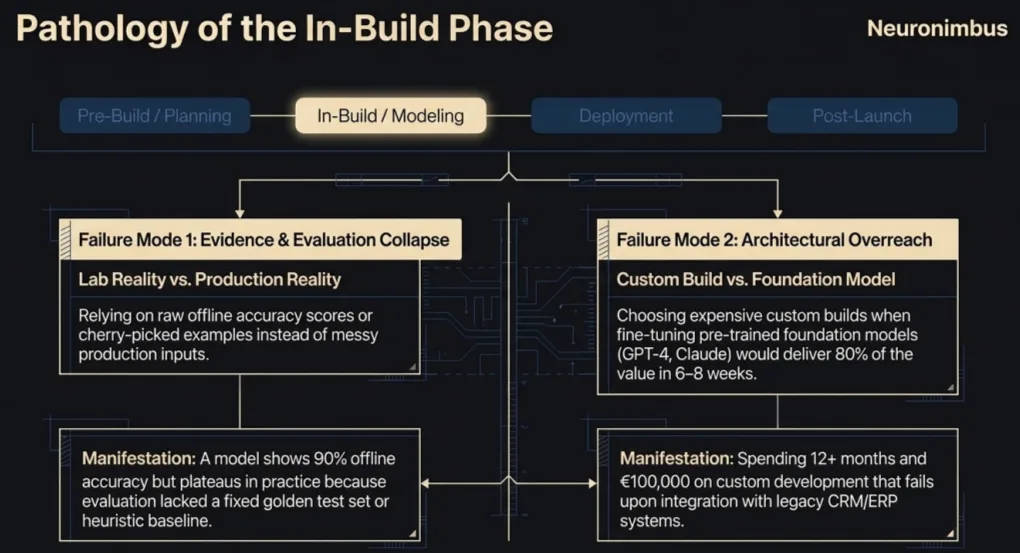
During a pilot, teams control the test environment. They may use clean datasets, selected customer queries, manually prepared documents, or limited integrations.
That is acceptable for early experimentation, if the team understands what the results prove.
To understand this better, consider an AI assistant built to answer employees' HR policy questions.
During testing, it answers 95% of questions correctly. But the test documents are current, employees ask relatively simple questions, and there are no conflicting policy versions.
When the system encounters real users, it must distinguish between regional policies, employee categories, exceptions, and outdated documents.
Its performance changes considerably.
In this case, the underlying issue is inadequate evaluation, not necessarily an incapable model.
This is one reason the transition from AI pilot to production is difficult.
Production introduces constraints that demonstrations can’t anticipate or deliberately avoid.
For instance, in production, an AI system now needs to authenticate users, respect access permissions, interact with business applications, handle concurrent requests, and recover from errors.
For example, let’s imagine an AI customer service agent that is able to correctly determine that a refund is due to a customer. Now, if it wants to actually issue that refund, it needs more capabilities, such as the capability to verify the transaction, check for previous refunds that may have been issued, apply the correct policy, and update the payment system, and do this without any risk of ever being able to create a duplicate transaction.
If that AI agent does not have these controls, it will always be a risky deployment. Moreover, in the production environment, the agent will have to grapple with issues such as:
These are software engineering and operational problems as much as AI problems.
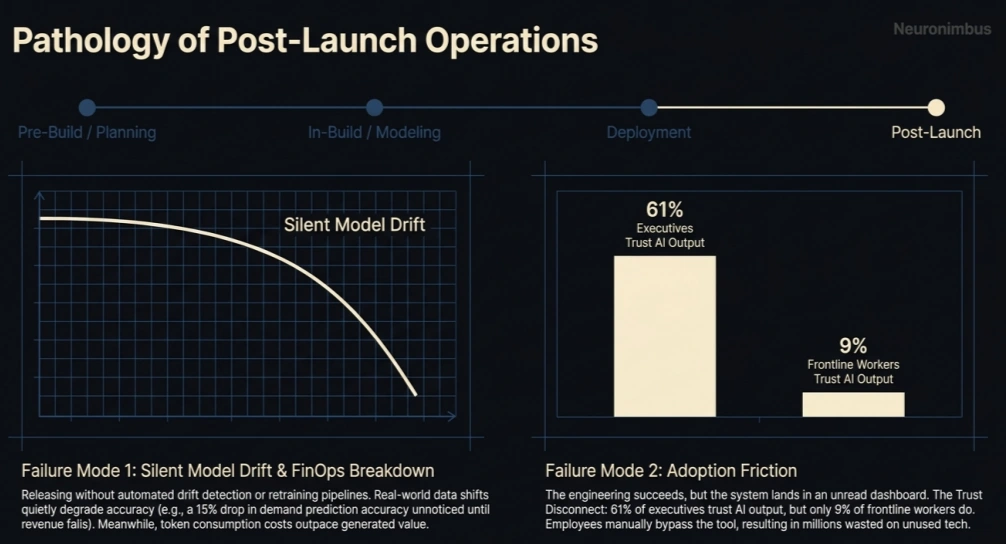
A system can work well for its initial users and still become unsuccessful when deployed more widely.
Suppose an AI document-processing solution works for one business unit. Egged on by the success, your team rolls it out to five more units. Now, across these new units, the same solution fails to perform as seamlessly, as it struggles with the different document formats used across these new units. Plus, the approval procedures for the same workflow may be different. The nature and number of exceptions may be different. And the compliance requirements may be different.
The developers, in response, have to maintain multiple specialized configurations for the AI agent. The time required for human review goes out of the roof, the costs of operations surge.
The value generated by each additional deployment may decline.
Knowing where failure occurs also tells us something important: organizations should not wait until production to identify risks that could have been examined before development began.
There is no checklist that guarantees success. But a good readiness review can expose many predictable AI implementation challenges before they become expensive.
I would ask eight questions before committing substantial development resources.
Enterprise AI readiness checklist
8 checks
Let me expand on two questions that deserve particular attention.
First, are you sure that the solution to the problem you are trying to solve actually requires AI?
Not every workflow can benefit from the probabilistic decision-making capability that an AI layer can add to the architecture. If you can solve a problem reliably with deterministic business rules, you might introduce unnecessary cost, latency, and variability to the solution purely by adding LLMs.
Second, what evidence will you consider strong enough to justify moving forward?
Before development, agree on the conditions under which the project will continue, change direction, or stop. For instance, an invoice-processing pilot might need to demonstrate:
These acceptance criteria should include business outcomes as well as technical performance.
Not every stalled AI project needs to be abandoned. But if you continue the development without understanding the problem, both success or recovery become more expensive.
When a project gets stuck, the instinct is usually to push harder with more model experiments, more contractors, more compute. That instinct is almost always wrong. It buries the root issue under more activity.
Here’s a rescue protocol.
Start with a focused review of the project rather than immediately commissioning another model or development sprint.
Examine:
Only rarely would an entire AI system be defective. So, the first step here should be to examine its components one by one.
Let’s consider the case of an enterprise AI assistant that is not performing as expected. The fault analysis for it might mean checking:
In a typical stalled project, roughly 50% of the original spend is in reusable assets:
There are four reasonable outcomes.
On the other hand, if the process itself changes constantly and there is no clear business owner, continued investment may not be sensible.
The ability to terminate a project is an important part of responsible AI investment.
At Neuronimbus, we approach these decisions through the relationship between business requirements, technical architecture, operational readiness, and measurable value.
The objective should be to determine the right next investment, which is not necessarily more AI development.

Ultimately, successful enterprise AI is not about how much intelligence we can put into a system. It is about how reliably that intelligence improves the work the organization needs to perform.
Yes, and more often than people expect. A single poorly governed AI deployment can trigger compliance reviews, legal exposure, and reputational damage that spreads far beyond the original project. This is why AI governance needs to be designed from the start of the project.
Neither option is universally right. What the data shows is that fully in-house builds fail at roughly twice the rate of projects done through strategic partnerships. That doesn’t justify outsourcing everything, but that does call for honesty when you evaluate where your team has depth and where an experienced partner can shorten the learning curve.
The failure patterns are surprisingly consistent across sectors. What changes is where the sharpest risk sits. In healthcare and finance, it’s bias and compliance. In manufacturing, it’s data readiness. In retail, it’s adoption friction.
Not necessarily. Underwhelming early results are normal. The question is whether the reasons are diagnosable and fixable. If the data pipeline is broken or the problem was poorly framed, those are solvable. If nobody can articulate what business outcome the project serves, that’s a different conversation.
A central one. 63% of companies lack AI-ready data, and no model compensates for fragmented, unlabelled, or inaccessible inputs. Assessing data readiness honestly before committing a budget is one of the simplest things you can do to improve your odds.

Let Neuronimbus chart your course to a higher growth trajectory. Drop us a line, we'll get the conversation started.


Call Us

Schedule a Call


Your Next Big Idea or Transforming Your Brand Digitally
Let's talk about how we can make it happen.