
An IT leader can easily identify how traditional software could fail in a workflow.
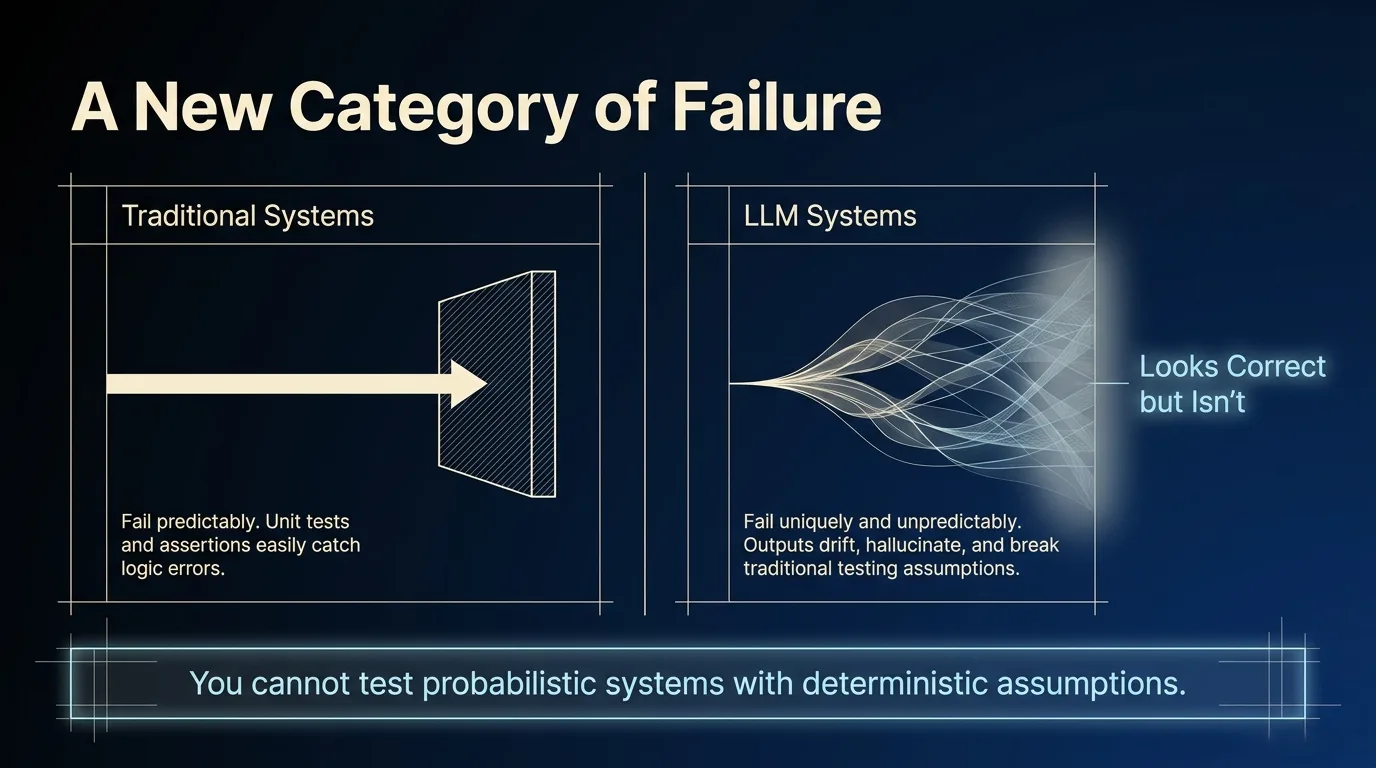
LLMs fail in somewhat unique ways that are hard to anticipate.
This is the core reliability challenge with production LLMs.
AI evals (systematic, repeatable methods for measuring LLM behavior) are the engineering discipline that addresses this problem.
AI evals are frameworks for measuring how an LLM-based system performs across the dimensions that matter in production, such as accuracy, relevance, safety, policy compliance, and task completion.
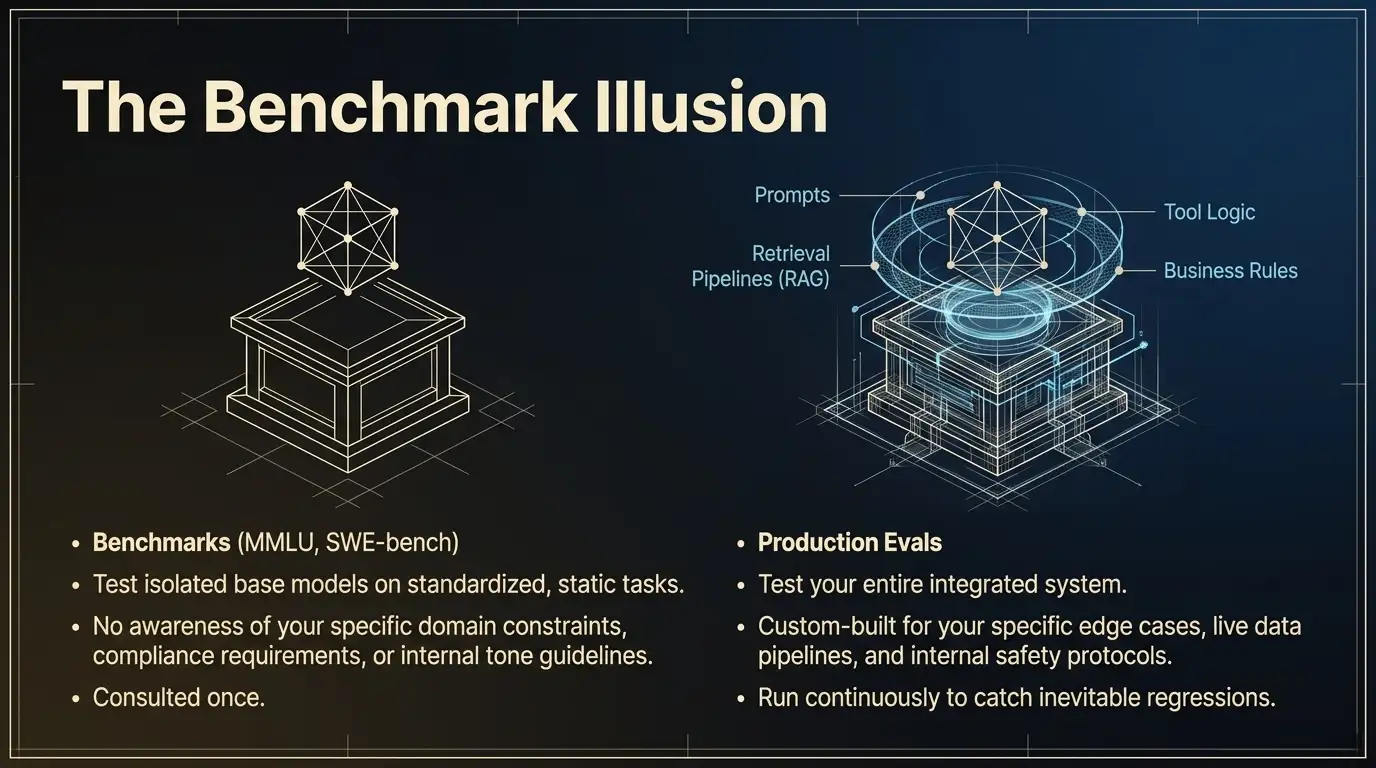
Most teams begin their evaluation efforts with model benchmarks such as MMLU, SWE-bench, and HumanEval. All of these are valuable tools for understanding a base model's raw capabilities on standardized tasks. But there is a meaningful gap between knowing an LLM model's benchmark score and knowing whether your LLM-powered application will behave reliably in production.
A production LLM application is not a base model running in isolation. It is a model operating inside an architecture, with carefully written prompts, retrieval layers pulling from your specific data, tool-calling logic, and business rules layered on top. Benchmarks are not designed to evaluate any of this. An LLM model's score on a general reasoning test can tell you very little about how it will handle your particular retrieval pipeline or your particular edge cases.
Every organization has its unique compliance requirements, tone guidelines, and domain-specific constraints that no public benchmark is designed to test. A model that scores well on a general knowledge benchmark can still violate your disclosure rules.
An LLM model continues to change even though the decision to use it may have been made. A proper LLM evaluation framework is therefore required to run continuously to catch the regressions that these changes inevitably introduce.
Also read: LLaMA 4 vs GPT-5 vs Claude 4 | LLMs for Business
If LLM evaluation were as straightforward as writing unit tests, every team shipping LLM features would already have strong evaluation coverage. LLMs break several assumptions that traditional software testing depends on, which means standard testing practices don’t apply to them.
In conventional software, the same input reliably produces the same output. This property is what makes assertions and regression tests possible. LLMs do not offer this guarantee.
The most common attempt to control for this is setting the model temperature parameter to zero. In theory, this should make outputs deterministic. In practice, it does not.
Research and practitioner experience have shown that hosted API environments frequently exhibit meaningful variation across identical runs, even at model temperature zero. This instability from infrastructure-level factors:
The consequence is that you cannot evaluate an LLM by asserting an expected output and checking for an exact match. Your evaluation approach has to be tolerant of legitimate variation while still reliably detecting meaningful degradation.
Most of the tasks that make LLMs valuable in production do not have a single correct answer. Multiple responses can be equally valid.
This makes traditional evaluation metrics unreliable. Exact Match, for instance, would flag a factually perfect response as a failure simply because it was phrased differently from a reference answer. That is not a useful signal.
Evaluating LLM systems on open-ended tasks requires methods that can assess semantic quality rather than surface-level string similarity. Defining what "correct" looks like for these tasks is itself a design exercise that demands domain expertise and careful decomposition of quality into measurable criteria.
Beyond the question of correctness, LLMs introduce categories of failure that have no equivalent in traditional software.
An LLM can generate a response that reads as authoritative and well-reasoned but is fabricated. What makes hallucination detection particularly challenging is that the output looks correct on the surface. Catching the hallucination requires purpose-built evaluation methods that incorporate grounding checks against source documents, LLM-based scoring with carefully designed rubrics, or specialized classifiers.
Jailbreaks are adversarial inputs designed to bypass a model's safety guardrails through techniques like role-playing scenarios, prompt injection, or semantic manipulation. Defending against these is an ongoing effort.
Toxicity and bias are inherited from training data and can surface in subtle ways that simple keyword filters will miss entirely. Detecting these requires granular evaluation rubrics and consistent monitoring.
With these challenges in view, a practical question follows: when you know what can go wrong, how do you choose the right type of evaluator for each failure mode?
Also read: Python vs Scala: Best Choice for AI & Data Leaders HTML
There is no single evaluator that covers every dimension of LLM evaluation.
Different failure modes require different measurement approaches, and the right choice depends on what you are assessing and the level of risk involved.
Production systems that handle evaluation well tend to use a layered strategy where they combine three evaluator types.
The guiding principles are straightforward.
The evaluator type is one decision. The other is when each evaluation should run, and that question leads to a fundamental distinction between two complementary evaluation contexts.
Offline and online evaluations serve different purposes, and a reliable system needs both of them.
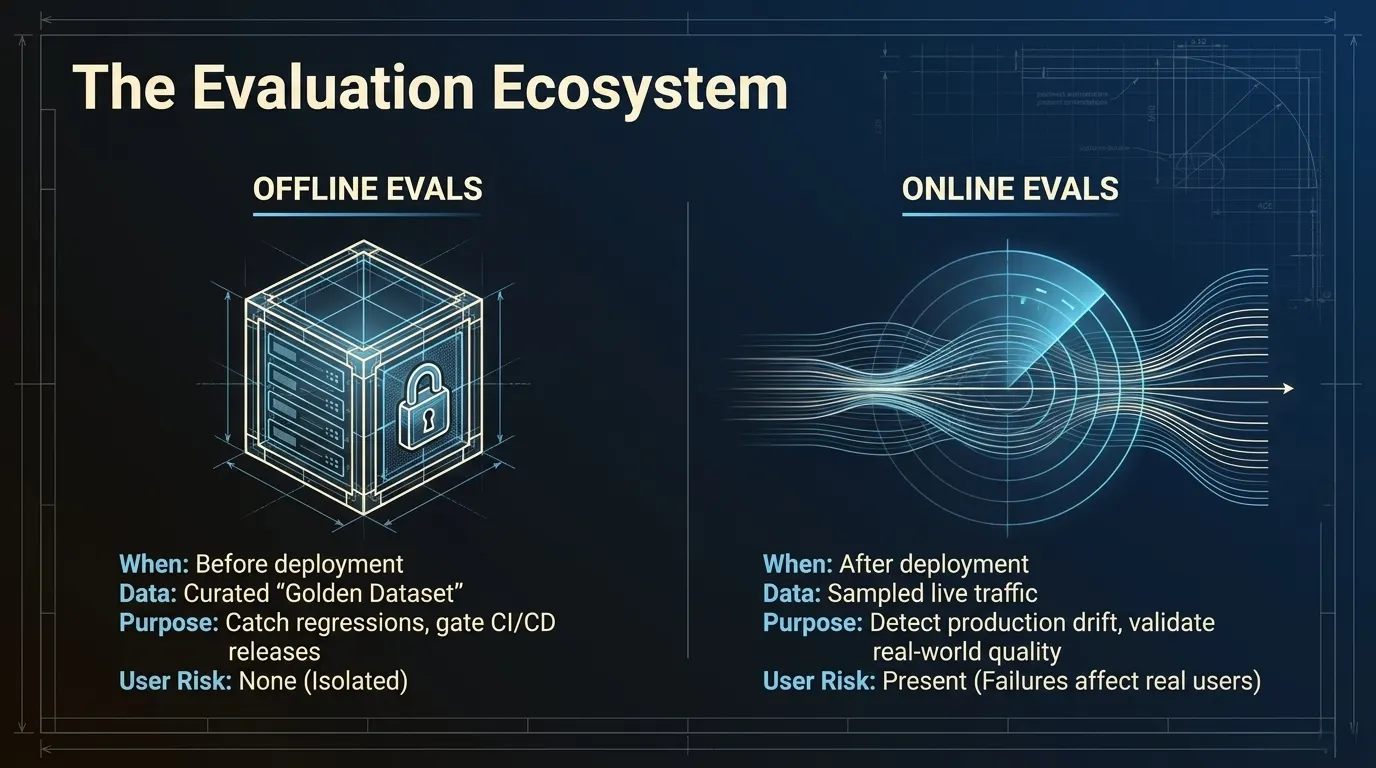
Offline evals run before deployment, against a fixed dataset, in an isolated environment. Their purpose is regression testing, that is, verifying that a change to your system (a new prompt, a model swap, an updated retrieval index) has not made things worse.
The foundation is what practitioners call a "Golden Dataset", which is a curated set of test cases with known-good expected behaviors. This dataset does not need to be large. Twenty to fifty high-signal cases covering your core user journeys and historically problematic inputs are enough.
Online evals run after deployment, against live production traffic. Their purpose is observability, that is, confirming that the quality you measured offline is the quality of outcomes under real conditions.
Offline evals without online monitoring means you are blind to production drift. Online monitoring without offline regression testing means you are catching problems only after users have experienced them.
The two become most powerful when they are connected, which brings us to how production failures feed back into your evaluation system.
The most valuable test cases in your Golden Dataset can be the ones your users discovered for you.
When a failure occurs in production, that incident represents an authentic edge case drawn from real input distributions. The feedback-loop flywheel is the practice of systematically converting these incidents into permanent regression tests.
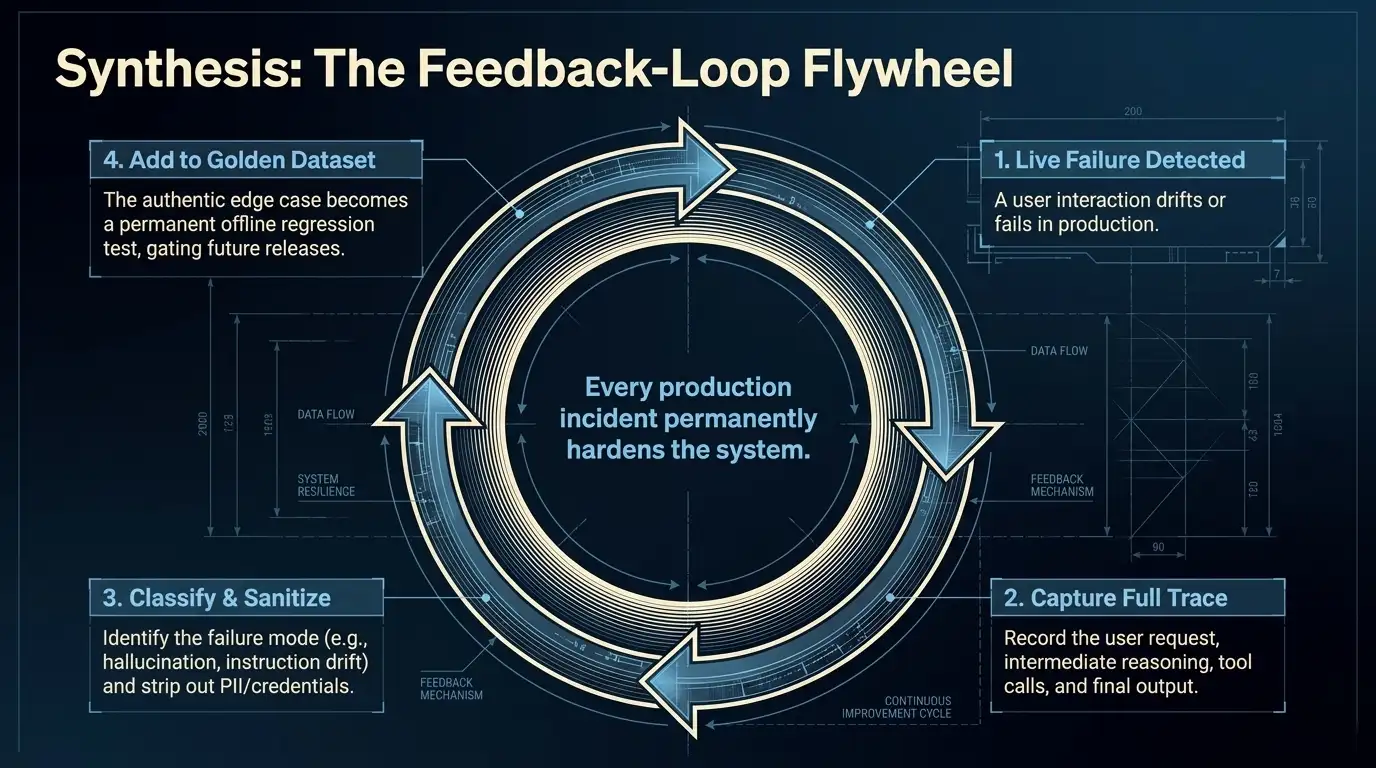
The process works as follows:
Once this loop is running, your evaluation system gets stronger with every production incident.
Single-turn evaluation methods tend to break down when applied to AI agents that operate across multiple conversational turns. Understanding the best practices for AI agent evaluation starts with recognizing that failures in these systems are compounding. A small misunderstanding in turn two becomes a completely derailed task by turn five.
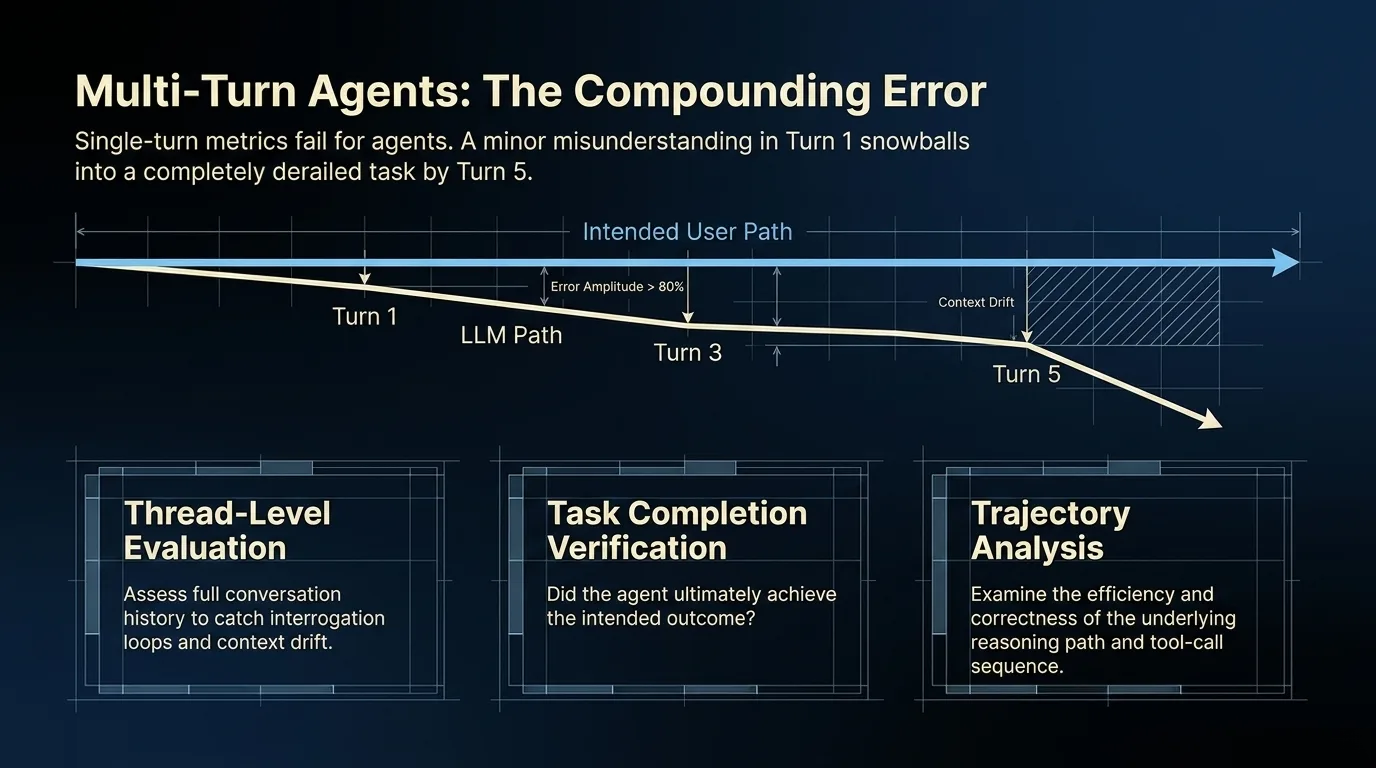
Specific evaluation techniques are available for multi-turn AI agents:
Thread-level evaluation — assesses the full conversation history rather than individual responses. This catches patterns like interrogation loops (repeatedly asking for information the user already provided) and context drift (losing sight of the original goal mid-conversation).
Task completion verification — checks whether the agent actually achieved the intended outcome.
Trajectory analysis — examines the reasoning path and tool-call sequence for efficiency and correctness. Did the agent take a reasonable path to the solution, or did it thrash through circular reasoning before arriving at an answer?
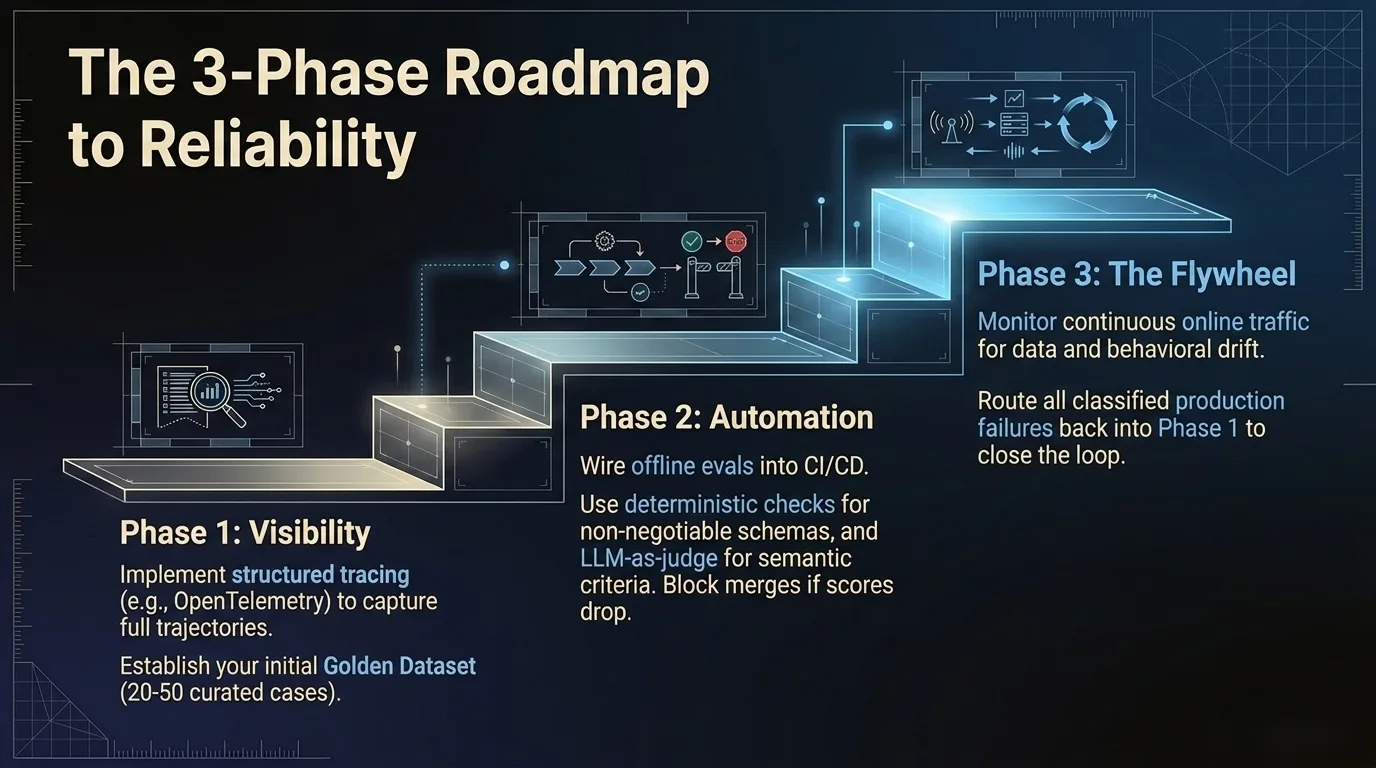
The first step in understanding how to evaluate an LLM system is making its internal behavior visible.
Implement structured tracing using standards like OpenTelemetry to capture full request trajectories.
Curate 20–50 high-signal test cases from your core user journeys and known failure points.
Define what a "correct" looks like in plain, checkable terms before selecting any automated scorer.
This is among the most important best practices for AI agent evaluation.
Wire your offline evaluation suite into your CI/CD pipeline.
Every prompt change, model update, or retrieval modification should trigger an automated test run against your Golden Dataset.
If scores fall below defined thresholds the build is considered to have failed and the merge is blocked.
Use deterministic checks for non-negotiable requirements first, and reserve LLM-as-judge scoring for semantic criteria.
Run online evals on sampled production traffic to catch what offline testing cannot.
Monitor for data drift, model drift, retrieval drift, and behavioral drift.
Most importantly, close the flywheel: every production failure gets classified and added back to your Phase 1 Golden Dataset.
Building production LLM systems that your team and your users can rely on is not a one-time effort — it is a continuous engineering discipline. If you are navigating this transition and want a structured approach to AI evals that fits your architecture and your risk profile, reach out to Neuronimbus to discuss how we can help.
Benchmarks measure a base model's general capability. AI evals measure whether your complete system behaves correctly for your specific use case.
It is the practice of using a calibrated LLM to score another model's outputs against a defined rubric, and is useful for semantic criteria like relevance and faithfulness that deterministic code cannot assess.
Offline evals should run on every system change. Online evals should run continuously on sampled production traffic to detect drift and silent failures.
RAG evaluation requires testing retrieval and generation separately. First, measure whether the retrieval layer surfaces the right source documents for a given query. Then evaluate whether the model's response is actually grounded in those retrieved documents rather than drawing from its own parametric knowledge.
Guardrails are real-time filters that block or modify harmful outputs before they reach users — they are a safety net. AI evals are measurement systems that assess quality across many interactions to inform system-level decisions. Guardrails act on individual requests. Evals act on patterns and trends over time.


Let Neuronimbus chart your course to a higher growth trajectory. Drop us a line, we'll get the conversation started.






Call Us

Schedule a Call


Your Next Big Idea or Transforming Your Brand Digitally
Let's talk about how we can make it happen.