Today, data plays a major role in business decisions. Choosing the right programming language is important for big data, machine learning, and AI projects.
Among many options, Python and Scala are two of the most popular choices. Each language has its own strengths and is designed for different needs.
Python is well known for its simple syntax and easy learning curve. It also offers a huge collection of libraries for AI, machine learning, and data science. This makes it a popular choice for research, rapid development, and AI applications.
Scala is known for its strong performance and functional programming features. It works closely with Apache Spark, making it a great choice for large-scale data processing and enterprise data engineering projects.
Choosing between Python and Scala depends on your business goals, project size, team skills, and performance needs.
In this guide, we'll compare both languages in terms of:
Understanding the main differences between Python and Scala helps you select the right language for your project.
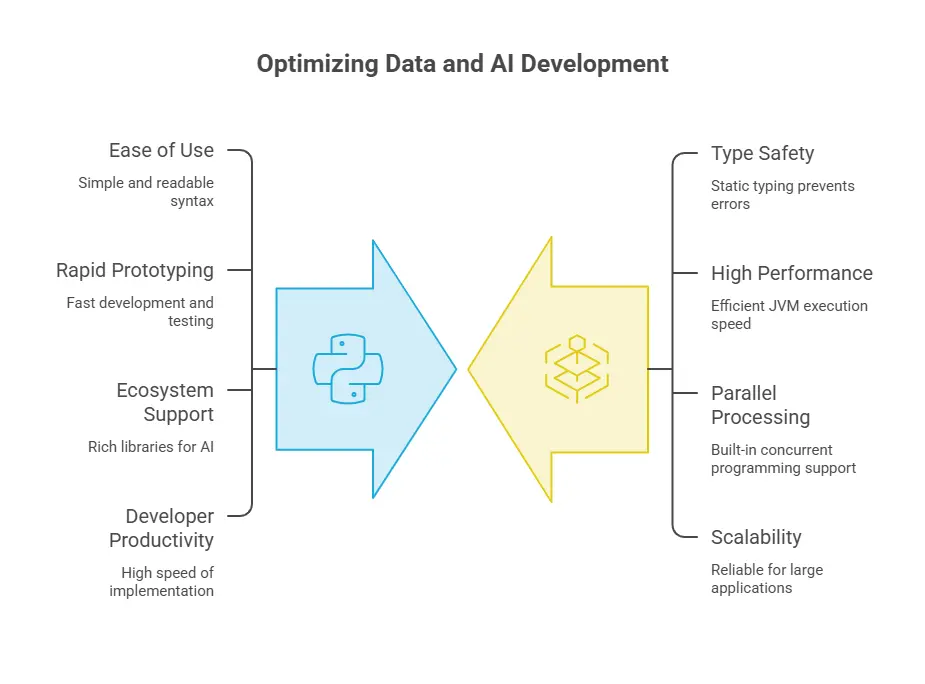
Python is famous for its clean and readable syntax. It follows an object-oriented and imperative programming style, making it easy for beginners and experienced developers alike.
Some key advantages of Python include:
Python uses dynamic typing. This allows developers to write code quickly. However, some coding errors are only found when the program runs.
Scala supports both object-oriented and functional programming. It uses static typing, which helps detect many errors during compilation instead of runtime.
Benefits of Scala include:
The syntax is more compact than Python but can be difficult for developers who are new to functional programming.
Scala generally delivers better performance than Python.
Since Scala runs on the Java Virtual Machine (JVM), it compiles into bytecode before execution. This allows applications to run faster and integrate easily with Java libraries.
Scala also supports:
Python is an interpreted language, so it is usually slower for CPU-intensive tasks.
However, Python improves performance by using optimized libraries such as:
Many heavy computations are executed in C or C++, making Python much faster for AI and scientific computing than its core language speed suggests.
Modern tools like PyPy and Just-in-Time (JIT) compilers have also improved Python's performance, although Scala still performs better in many large-scale processing tasks.
Handling multiple tasks at the same time is important in modern data engineering.
Scala provides built-in support for concurrent programming through technologies like:
These tools make it easier to build applications that process large amounts of data efficiently.
Python also supports concurrency using:
However, Python's Global Interpreter Lock (GIL) limits true parallel execution for CPU-heavy applications.
Frameworks like Ray and Dask help overcome this limitation by distributing workloads across multiple machines or processes. While effective, they also increase development complexity.
Scala has a strong connection with Apache Spark because Spark itself is written in Scala.
This gives Scala developers several advantages:
Python users can work with Spark through PySpark, which provides a Python interface to Spark.
PySpark makes Spark easier for Python developers to use. However, communication between Python and the JVM adds some overhead, which may slightly reduce performance in large production environments.
Python is one of the easiest programming languages to learn.
Its simple syntax helps developers:
This makes Python a favorite among startups, researchers, and data science teams.
Scala has a steeper learning curve because it combines object-oriented and functional programming concepts.
Developers usually need experience with:
Although learning Scala takes more time, it offers long-term benefits for large enterprise projects where maintainability and scalability are important.
Both Python and Scala offer excellent development tools.
Python provides popular tools such as:
These tools make experimentation, testing, and AI development much easier.
Scala developers commonly use IntelliJ IDEA and other JVM-based IDEs.
These tools provide features like:
They are especially useful for managing large enterprise applications.
A programming language is more than just its syntax. The tools, libraries, and community around it also play a major role in project success.
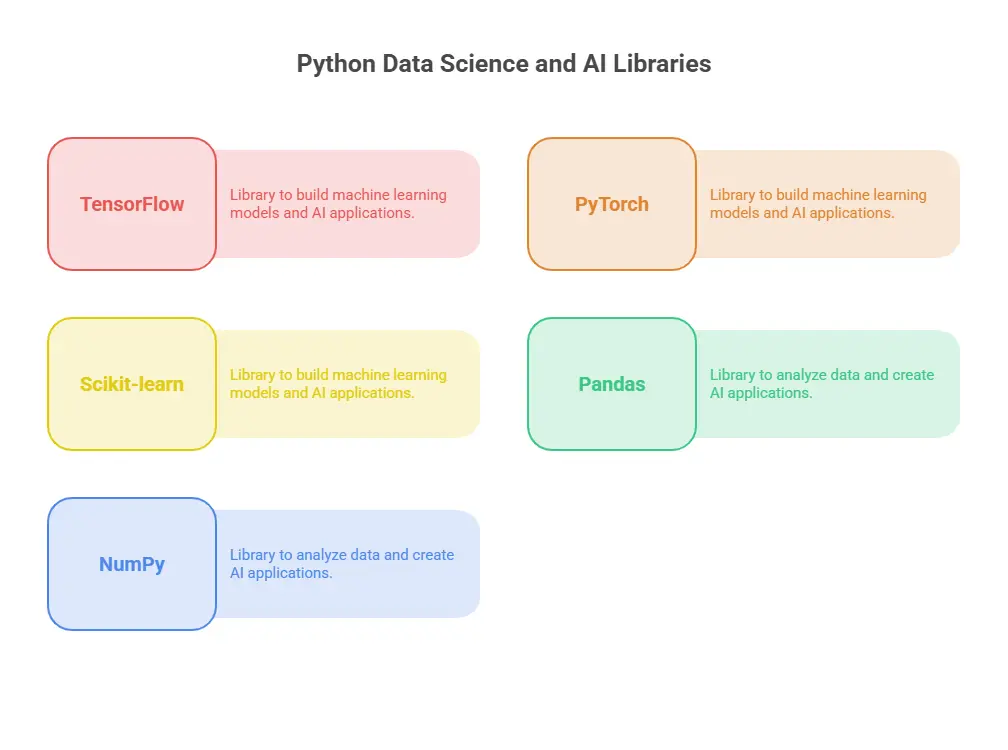
Python is the leading language for AI and data science because of its rich collection of libraries.
Some of the most popular Python libraries include:
These libraries help developers build machine learning models, analyze data, and create AI applications quickly.
Python is also widely used in research and education. As a result, there are thousands of tutorials, open-source projects, and community resources available.
Scala is stronger in big data processing than AI development.
It works well with tools like:
These tools are built for processing large amounts of data across multiple systems.
Scala also supports AI development through Java-based machine learning frameworks and libraries like DeepLearning.scala. While these options are useful, they are not as popular or extensive as Python's AI ecosystem.
Python offers many frameworks that speed up application development.
Some popular choices include:
These frameworks are easy to use and help developers build AI-powered applications quickly.
Scala focuses on high-performance applications.
Popular Scala frameworks include:
These tools are ideal for enterprise systems that require speed, reliability, and scalability.
Python has one of the largest programming communities in the world.
Developers can easily find:
This makes solving problems and learning new skills much easier.
Scala has a smaller but highly experienced community.
Many Scala developers specialize in:
Although the community is smaller, it provides high-quality resources and expert guidance for advanced projects.
Python is used by startups, research organizations, and enterprises across many industries.
It integrates well with:
Many organizations choose Python because skilled developers are easy to find.
Scala is popular among industries that process large amounts of data, such as:
Many enterprise systems built on the Java ecosystem also prefer Scala because it works smoothly with existing JVM applications.
Python fits naturally into modern cloud environments.
It works well with services like:
Python also supports containerization, automation, and CI/CD pipelines, making deployment simple.
Scala integrates well with enterprise DevOps tools and JVM-based infrastructure.
It is often chosen for:
The best language depends on your project goals, team skills, and business requirements.
Python is the first choice for data scientists.
It is ideal for:
Its simple syntax allows teams to test new ideas quickly.
Scala is less common during the research phase. However, it becomes valuable when machine learning models must run within large production data pipelines.
Scala is one of the best languages for big data engineering.
It works especially well with Apache Spark to build:
Python can also perform these tasks using PySpark.
However, communication between Python and the JVM may reduce performance for very large production workloads.
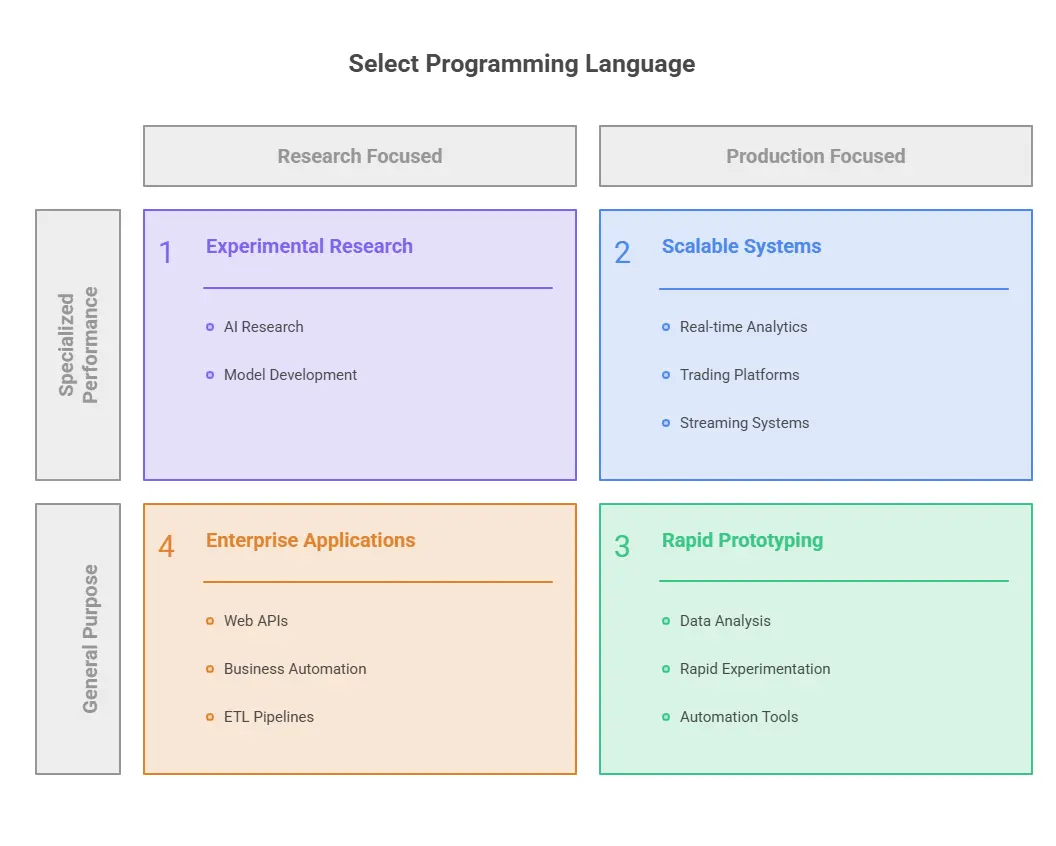
Large organizations often need software that is reliable, scalable, and easy to maintain.
Scala's static typing helps reduce coding errors and improve long-term stability.
This makes Scala a good fit for industries like:
Python remains a strong option for organizations developing AI products, business automation tools, and research-based applications.
Python dominates these AI fields.
Developers have access to many ready-to-use models and libraries for:
Scala supports these applications but usually works alongside Java libraries instead of offering its own large AI ecosystem.
Python makes it easy to create AI-powered websites and APIs.
Frameworks like Flask and Django help developers quickly launch intelligent web applications.
Scala's Play Framework is better suited for applications that require:
Python developers are easier to hire because the language is widely taught and used.
Benefits include:
Scala developers are more specialized.
While experienced Scala developers can build highly reliable systems, finding skilled professionals may take more time.
When speed is the highest priority, Scala often performs better.
It is commonly used for:
Python is better suited for:
Many organizations use both languages together to take advantage of their strengths.
Choosing between Python and Scala is not always simple. Every business has different goals, technical requirements, and budgets.
Neuronimbus helps organizations make the right technology decisions and build scalable AI and big data solutions.
Our experts evaluate factors such as:
Based on these factors, we recommend Python, Scala, or a hybrid approach.
For organizations that need large-scale data processing, we build high-performance Spark applications using Scala.
For AI and machine learning projects, we develop Python-based solutions using leading cloud platforms such as AWS SageMaker and Microsoft Azure Machine Learning.
We also provide ongoing support through:
By partnering with Neuronimbus, businesses gain a trusted technology partner that helps them build secure, scalable, and future-ready AI solutions while maximizing the strengths of both Python and Scala.
Python is generally the better choice for AI and machine learning because it offers a rich ecosystem of libraries such as TensorFlow, PyTorch, Scikit-learn, and Pandas. Scala is better suited for large-scale data processing and production environments that rely on Apache Spark.
Scala is preferred for big data because Apache Spark is built using Scala. It provides faster execution, better concurrency, and seamless integration with the Java Virtual Machine (JVM), making it ideal for processing large datasets and building scalable data pipelines.
Yes. Python supports big data development through frameworks like PySpark, Dask, and Ray. While it may have slightly lower performance than Scala in some large-scale production environments, Python remains an excellent choice for data analysis, machine learning, and rapid application development.
In most performance-intensive applications, Scala is faster than Python because it is a compiled language that runs on the JVM. However, Python can achieve high performance for AI and scientific computing by using optimized libraries written in C and C++.
The right choice depends on your project requirements. Choose Python if your focus is AI, machine learning, data science, or rapid development. Choose Scala if you need high-performance big data processing, enterprise-grade scalability, or extensive use of Apache Spark. Many organizations use both languages together to leverage the strengths of each.


Let Neuronimbus chart your course to a higher growth trajectory. Drop us a line, we'll get the conversation started.






Call Us

Schedule a Call


Your Next Big Idea or Transforming Your Brand Digitally
Let's talk about how we can make it happen.