Most enterprises today face an interesting challenge. They are not short on ideas around AI agents and many have already adopted agentic AI in one way or another. Still, most of them are short on ways to make those agents work together.
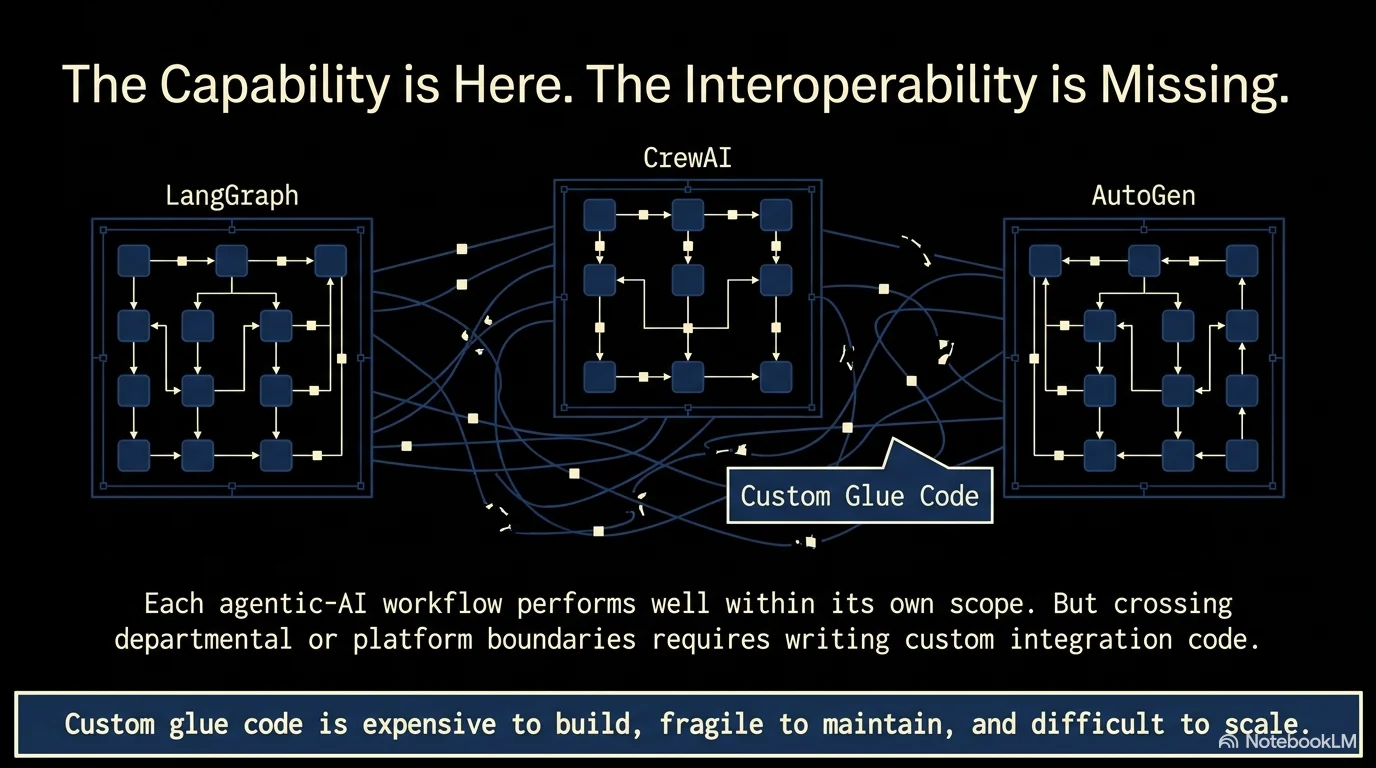
Each agentic-AI powered workflow performs well within its own scope. But the moment a workflow needs to cross departmental or platform boundaries (say, a support ticket that triggers a logistics check and a billing adjustment) the system falls apart.
This is more an interoperability problem than a capability problem, and it is one of the most persistent barriers to building truly autonomous enterprise workflows.
The Agent2Agent protocol (A2A) was designed to address this directly. It is an open standard that gives AI agents a common way to discover each other, exchange tasks, and collaborate on shared outcomes, regardless of the framework, vendor, or infrastructure each agent was built on.
Announced by Google in April 2025 and now governed by the Linux Foundation, Agent2Agent protocol (A2A) is sometimes described as "HTTP for AI agents."
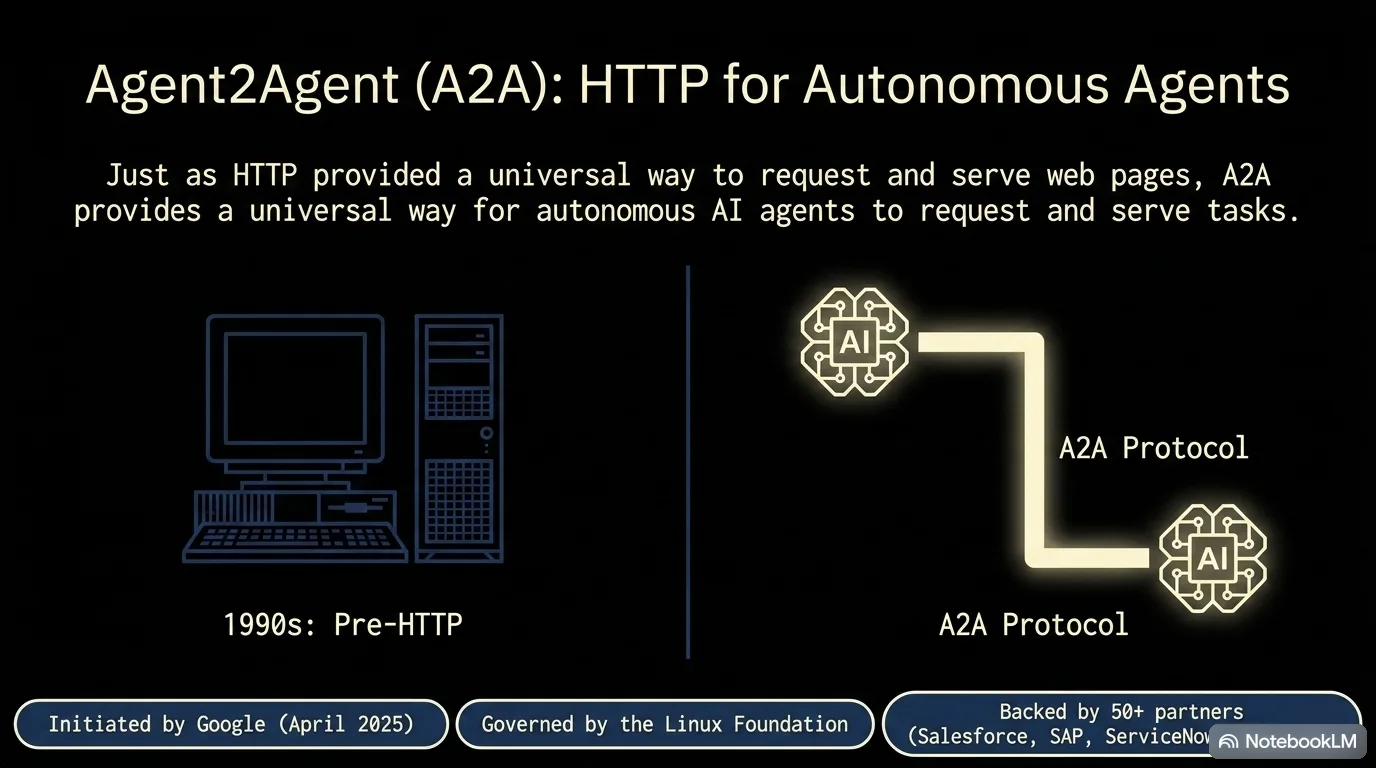
I find the analogy extremely useful. HTTP gave us a universal way to request and serve web pages. Now Agent2Agent protocol provides a universal way for autonomous AI agents to request and serve tasks.
Google initiated the A2A protocol, but it did not build the protocol in isolation.
The specification launched with more than 50 contributing partners including Salesforce, SAP, ServiceNow, and Deloitte. That breadth of involvement is worth noting because it signals something about the protocol's purpose.
Agent2Agent protocol is not a proprietary framework but a shared infrastructure built to solve a problem that every large organization building with AI agents eventually runs into. That problem is agent interoperability.
Today, frameworks like LangGraph, CrewAI, AutoGen, and Google's own ADK each produce capable agents. But those agents are designed to operate within their respective ecosystems. An agent built on CrewAI has no native way to collaborate with one built on LangGraph.
In practice, this means engineering teams end up writing custom integration code for every cross-platform interaction. That glue code is expensive to build, fragile to maintain, and difficult to scale.
The A2A protocol replaces that approach with a standardized interface. Any agent that implements the spec can advertise its capabilities, accept task requests, and return results, no matter what it was built on.
The protocol is anchored by five design principles, each of which is worth reviewing carefully because of the direct implications for how the protocol fits into your architecture and governance model.
If you are evaluating the A2A protocol for enterprise workflows, these five principles are a practical checklist. They speak directly to questions around vendor flexibility, data governance, and security posture.
Understanding the architecture requires knowing the two roles the protocol defines.
The interaction between them follows three distinct phases of discovery, task management, and collaboration. Each phase addresses a different part of the problem of getting independent agents to work together reliably.
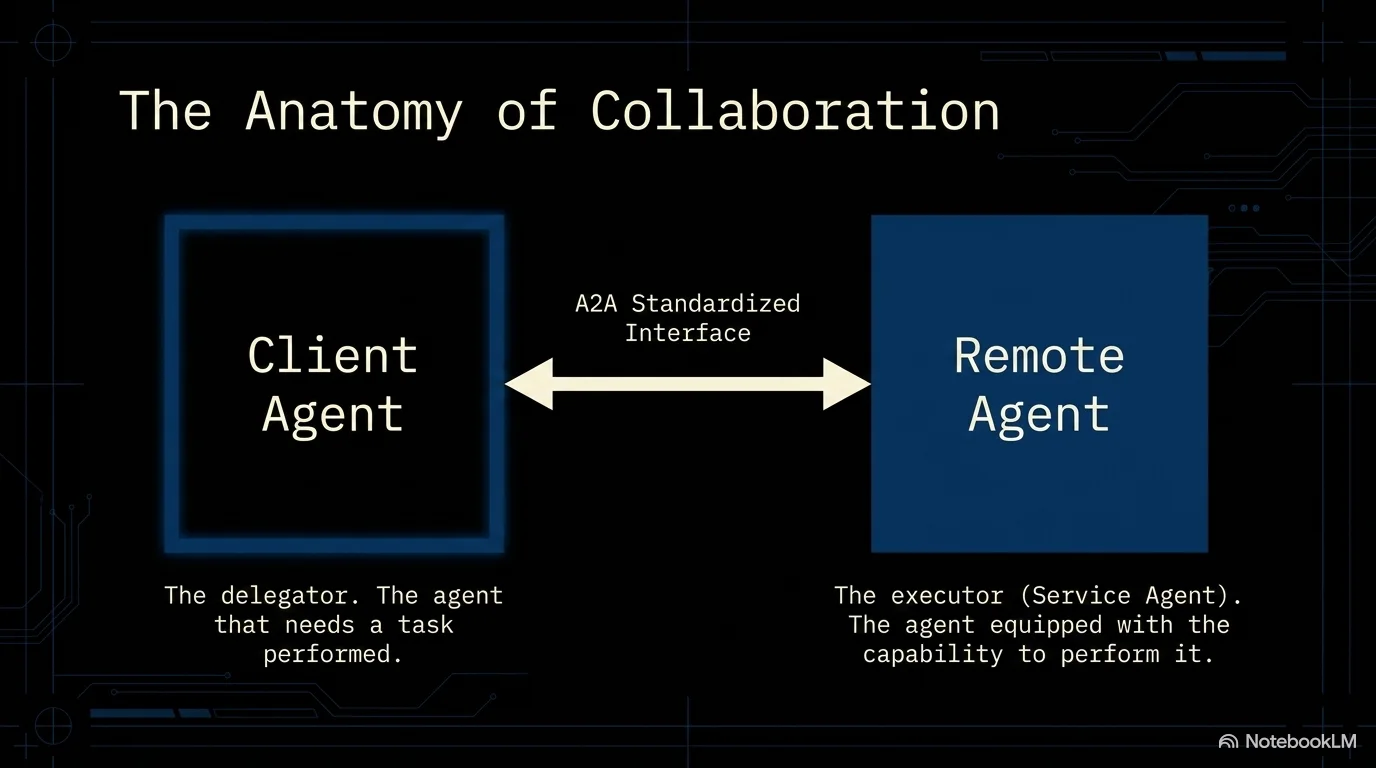
Before two agents can collaborate, the Client Agent needs to understand what the Remote Agent is capable of and how to communicate with it.
This is handled through Agent Cards.
An Agent Card is a JSON metadata document that a Remote Agent hosts at a well-known URL path:
https://your-domain.com/.well-known/agent-card.json
The card contains everything a Client Agent needs to evaluate and initiate a working relationship, such as:
When a Client Agent retrieves this card, it can programmatically assess whether the Remote Agent's capabilities match the requirements of the task at hand, and proceed without any manual configuration or hardcoded integration.
This mechanism makes dynamic capability discovery possible, and it is a foundational requirement for building multi-agent systems that can scale without requiring custom integration work for every new agent added to the network.
Once a suitable Remote Agent has been discovered, the Client Agent delegates work by creating a task.
A task in the A2A protocol is not a simple request-response exchange. It is a formal object with a unique identifier and a clearly defined task lifecycle:
submitted → working → input-required → completed → failed
This structure exists because enterprise workflows are not instantaneous. A task might involve processing that takes minutes, hours, or in some cases days. The lifecycle model provides a reliable way to track progress asynchronously. It can also handle partial failures without losing state and pause execution when human judgment is needed.
The underlying transport uses HTTP with JSON-RPC for structured messaging, and Server-Sent Events (SSE) for real-time streaming of status updates. When a task reaches completion, the Remote Agent returns the output as a standardized Artifact (such as a document, dataset, code file, or any other structured deliverable).
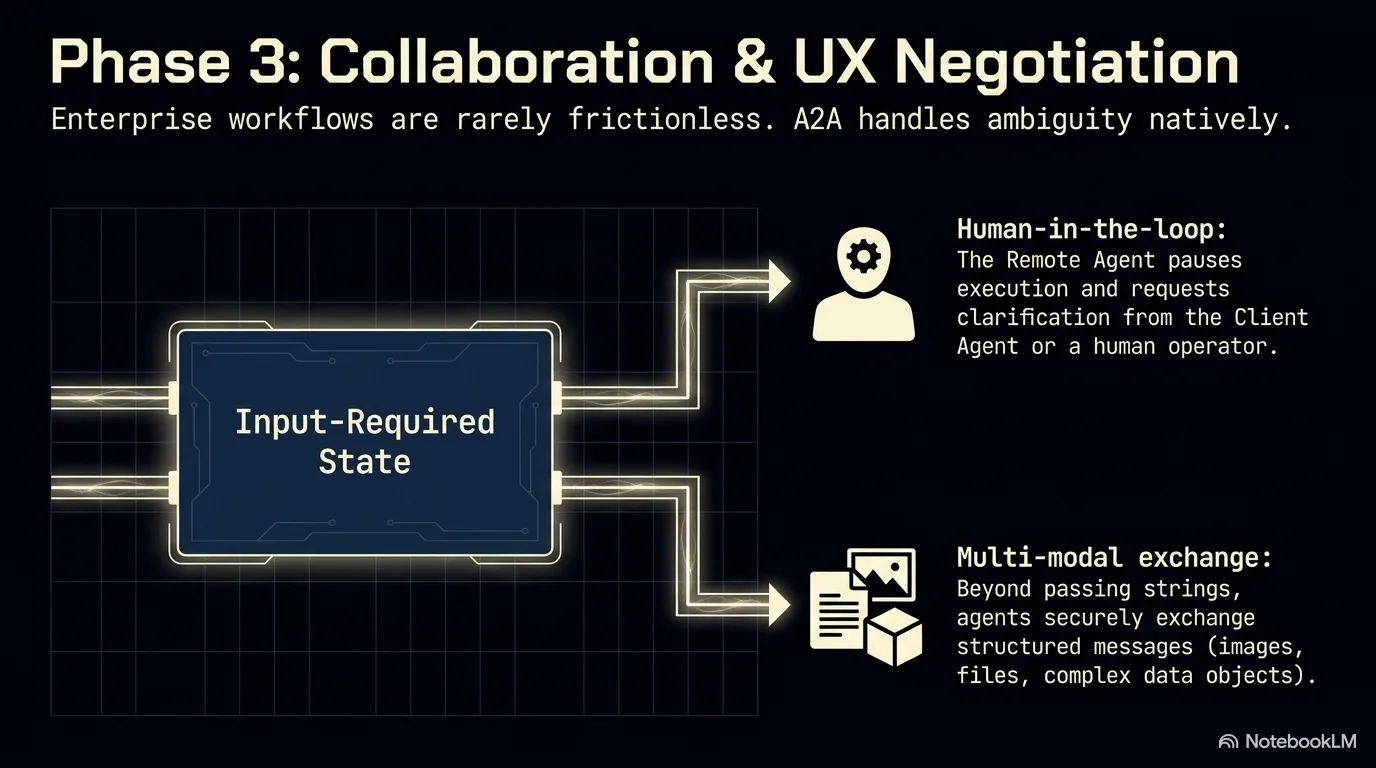
The third phase addresses a nuance that simpler protocols tend to overlook: what happens when the task is not straightforward.
The A2A protocol supports rich, multi-modal message exchange. Agents can send and receive structured messages containing text, images, files, and data objects. This means the collaboration between agents is not limited to passing strings back and forth.
More importantly, the input-required state in the task lifecycle enables a practical human-in-the-loop pattern. When a Remote Agent encounters ambiguity or a decision that exceeds its authority, it can pause the task and request clarification, either from the Client Agent or from a human operator.
Also read: Enterprise Agentic AI Strategy Guide for CTOs & Leaders
If you are building an agentic AI orchestration stack, you have almost certainly encountered both the A2A protocol and the Model Context Protocol (MCP). The question of how they relate to each other comes up consistently, so it is worth being precise.
These two protocols address different layers of the architecture entirely.
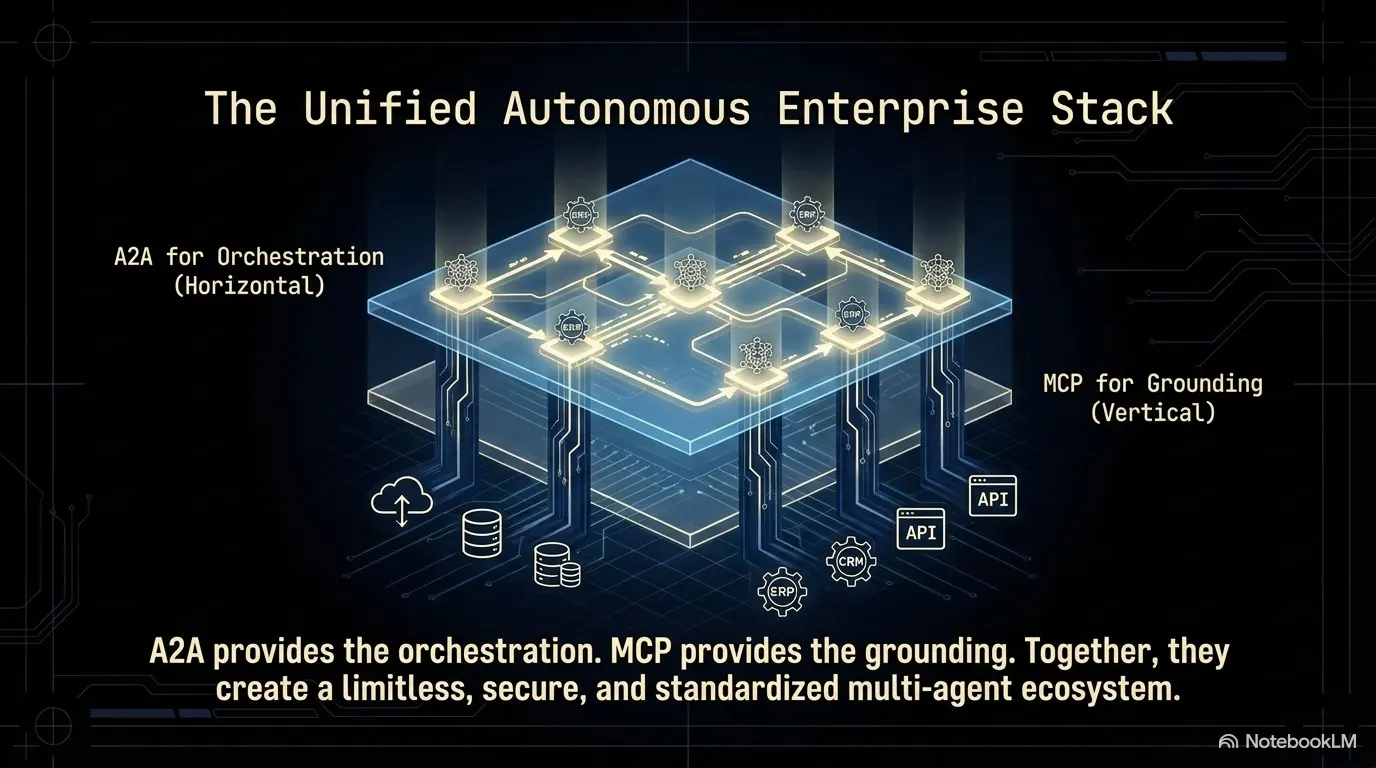
In a production-grade multi-agent system, these protocols typically work together.
An orchestrator agent might use A2A to delegate a subtask to a specialist agent running on a different platform. That specialist agent might then use MCP internally to invoke an API or retrieve context from a document store.
The architectural principles of the A2A protocol translate into a specific set of operational advantages. For enterprises evaluating the A2A protocol for autonomous enterprise workflows, these benefits matter most.
Because agents interact through a standardized interface, you can swap out individual agents without rewriting the integrations around them. If your HR agent was built on CrewAI and you later move to LangGraph, the rest of the system does not need to change.
The protocol's opaque design means agents share results but not internal details. Proprietary algorithms, training data, and reasoning logic can stay behind each agent's boundary. In multi-vendor or multi-tenant environments, this is a requirement.
Because every interaction in an autonomous enterprise workflow is wrapped in a formal task lifecycle, failures are trackable and recoverable. A task that fails midway does not disappear. It enters a failed state with context that downstream systems can act on.
As your agent network grows, Agent Cards let new agents join the ecosystem without manual registration or configuration. A newly deployed agent can become discoverable the moment its card is hosted.
Every task delegation, status transition, and result delivery is loggable. This creates a verifiable chain of custody across complex workflows which matters significantly for compliance in regulated industries.
The benefits become obvious when you look at how the A2A protocol applies to actual enterprise workflows.
Recruitment is a process that naturally spans multiple systems and teams. With A2A, a central orchestrator agent can coordinate the entire pipeline by delegating to specialized agents:
Each of these agents can run on a different platform but still work together as an autonomous enterprise workflow.
Customer support is another domain where multi-agent systems deliver measurable results. Customer inquiries can be made to move through specialized agents such as:
The same coordination pattern applies to supply chain operations, where procurement, logistics, and inventory agents need to collaborate across vendor boundaries.
Also read: Agentic AI in Customer Service: Use Cases & Architecture
Perhaps the most significant long-term value of A2A is its ability to connect agents across enterprise platforms like Salesforce, SAP, and ServiceNow, without custom middleware.
Because the protocol is framework-agnostic, a Salesforce-native agent and an SAP-native agent can exchange tasks through the same standardized interface. This is the kind of agent interoperability that eliminates the brittle integration layers most enterprises are currently maintaining.
If you are considering the A2A protocol for your organization, here is an evaluation path:
At Neuronimbus, we help enterprises design and implement multi-agent architectures that are production-ready from day one. If you are evaluating A2A, MCP, or broader agentic AI orchestration for your stack, talk to our team. We will help you move from proof of concept to production with clarity.
Yes. The specification is governed by the Linux Foundation and designed as an open standard with no vendor lock-in.
Yes. The protocol is model-agnostic. An agent powered by GPT, Claude, Gemini, or an open-source model can participate equally, as long as it implements the A2A specification and hosts a valid Agent Card.
The protocol assumes HTTPS-based communication, which favors network-distributed deployments. However, agents running on-premise can participate provided they expose accessible JSON-RPC endpoints within your network boundary.
The task lifecycle includes a failed state with contextual information. Well-implemented orchestrators can use stateful checkpointing to resume workflows from the point of failure rather than restarting entirely.
No. A2A is an integration layer, not a replacement. You add protocol compliance to your existing agents by hosting an Agent Card and implementing the JSON-RPC task interface alongside your current architecture.

Let Neuronimbus chart your course to a higher growth trajectory. Drop us a line, we'll get the conversation started.






Call Us

Schedule a Call


Your Next Big Idea or Transforming Your Brand Digitally
Let's talk about how we can make it happen.