Let’s start with some numbers that should give every CTO pause.
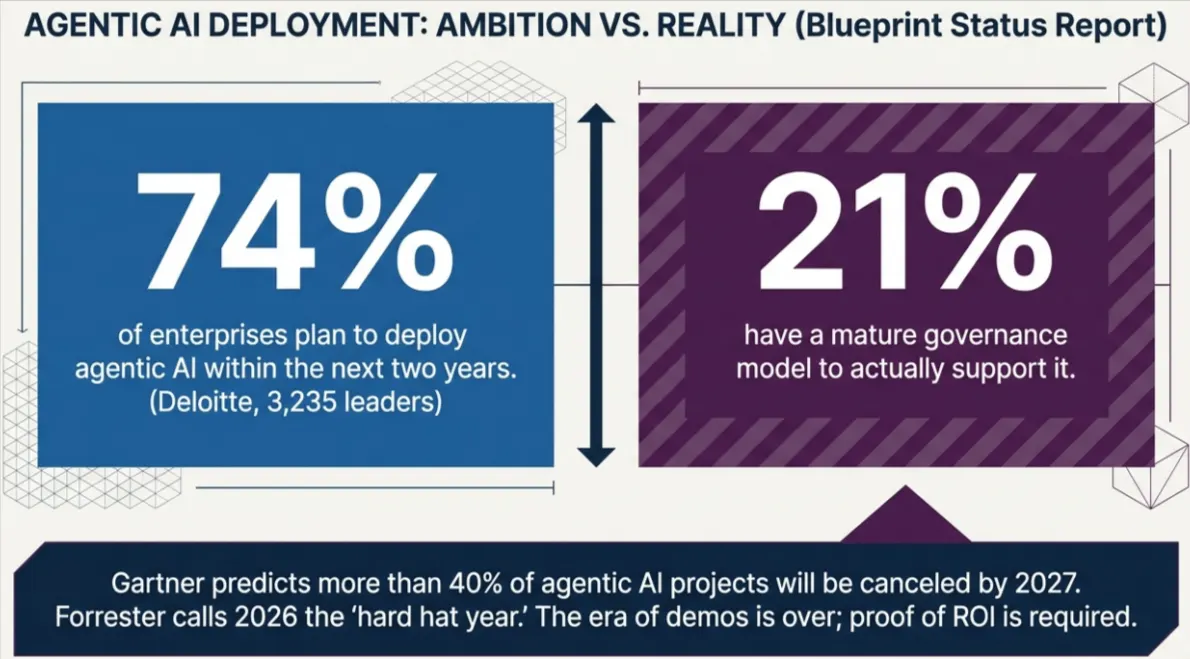
So when assessed together, these insights seem to suggest that enterprises are heading into the most significant shift in technology in a decade, at full speed, with most of them underprepared for what it actually takes to make it work.
So I’ve put together this guide for CTOs and IT leaders who are past the "should we do this?" question and are now asking the harder one: how do we do enterprise agentic AI right?
Let’s start with the basics.
Also read: Agentic AI in Customer Service: Use Cases & Architecture
The term agentic AI gets used loosely, so let me be precise.
There isn't one single universally agreed definition but the serious ones all point to the same thing.
MIT Sloan professor John Horton and his co-authors, in a 2025 research paper on the economic implications of AI agents, define them as:
"Autonomous software systems that perceive, reason, and act in digital environments to achieve goals on behalf of human principals, with capabilities for tool use, economic transactions, and strategic interaction."
Gartner defines AI agents as:
"Autonomous or semiautonomous software entities that use AI techniques to perceive, make decisions, take actions and achieve goals."
The key word or the key quality of agentic AI, as stated or implied by every agentic AI definition, is ‘the ability to act’. Not suggest. Not generate. Not run a process in the background. Act.
Anthropic draws a distinction that I find useful.
That capacity for dynamic and goal-directed decision-making is what makes enterprise agentic AI different from everything that came before it.
Here is how it compares to the prior waves:
Trigger
Decision-making
Multi-step planning
Memory
Output
Also read: AI-Driven Digital Transformation | Future-Proof Your Business
Let’s understand this with an example.
Salesforce spent the last year running its AI agent called Agentforce on itself before selling it to anyone else. The results from year one:
And Salesforce is not alone.
The implication for enterprise leaders is that agentic AI is not a feature upgrade to your existing AI strategy but a new operating model.
Let me walk you through what agentic AI for enterprises actually looks like as documented outcomes at organizations that have already crossed the line from pilot to operation.
This is where most enterprises start, and for good reason. The IT service desk is high-volume, well-documented, and the ROI is easy to measure.
McKinsey profiled a multinational enterprise that redesigned its IT support around AI intake agents and proactive monitoring. The outcome was that 80% of service requests were automated, 50% of service agent capacity was redeployed to higher-value work, and a customer satisfaction score of 4.8 out of 5 was achieved.
Reddit deployed Agentforce and deflected 46% of support cases, which helped it cut average resolution time from 8.9 minutes to 1.4 minutes.
Wiley reported 213% ROI on its deployment.
1-800Accountant hit 90% case deflection during tax week (their highest-pressure period).
OpenTable resolved 70% of diner and restaurant inquiries autonomously.
Walmart built an autonomous negotiation engine with Pactum AI and rolled it out to 2,000+ tail-spend suppliers. Average saving was 3% per contract.
Forrester predicts that by 2026, one-third of B2B payments will involve autonomous agents that will handle invoicing, reconciliation, or spend control.
Adecco automated 51% of candidate conversations outside business hours, which meant that the recruiting engine could keep running while the team was offline. IBM Watsonx Orchestrate ships pre-built HR agents for time-off requests, payslip queries, benefits questions, and onboarding workflows, all connected to HRIS systems.
Siemens built its Industrial Copilot with Microsoft. It's now deployed across 120,000+ engineers at 100+ companies including Schaeffler and thyssenkrupp. Engineers can generate panel visualisations in 30 seconds and produce code that requires only 20% human adaptation.
At a PepsiCo Gatorade facility, Siemens' AI agents delivered a 20% throughput increase, near-100% design validation, and 10–15% capex reduction, all within three months of deployment.
Deutsche Bank is working with Google Cloud to deploy enterprise agentic AI systems that monitor trading activity and flag anomalies across orders, trades, and communications. The bank has retired 200 legacy surveillance servers and cut false positives by more than 25%.
Bernd Leukert, Deutsche Bank's Chief Technology and Innovation Officer, put it plainly: "Before, it took a huge amount of time to collect data from different sources. The LLM can do the analysis and help recommend the route which the compliance officer can validate and then close the alert. The ultimate decision stays with the compliance officer."
That last sentence matters. Agents handle the scale problem. Humans handle the judgment call.
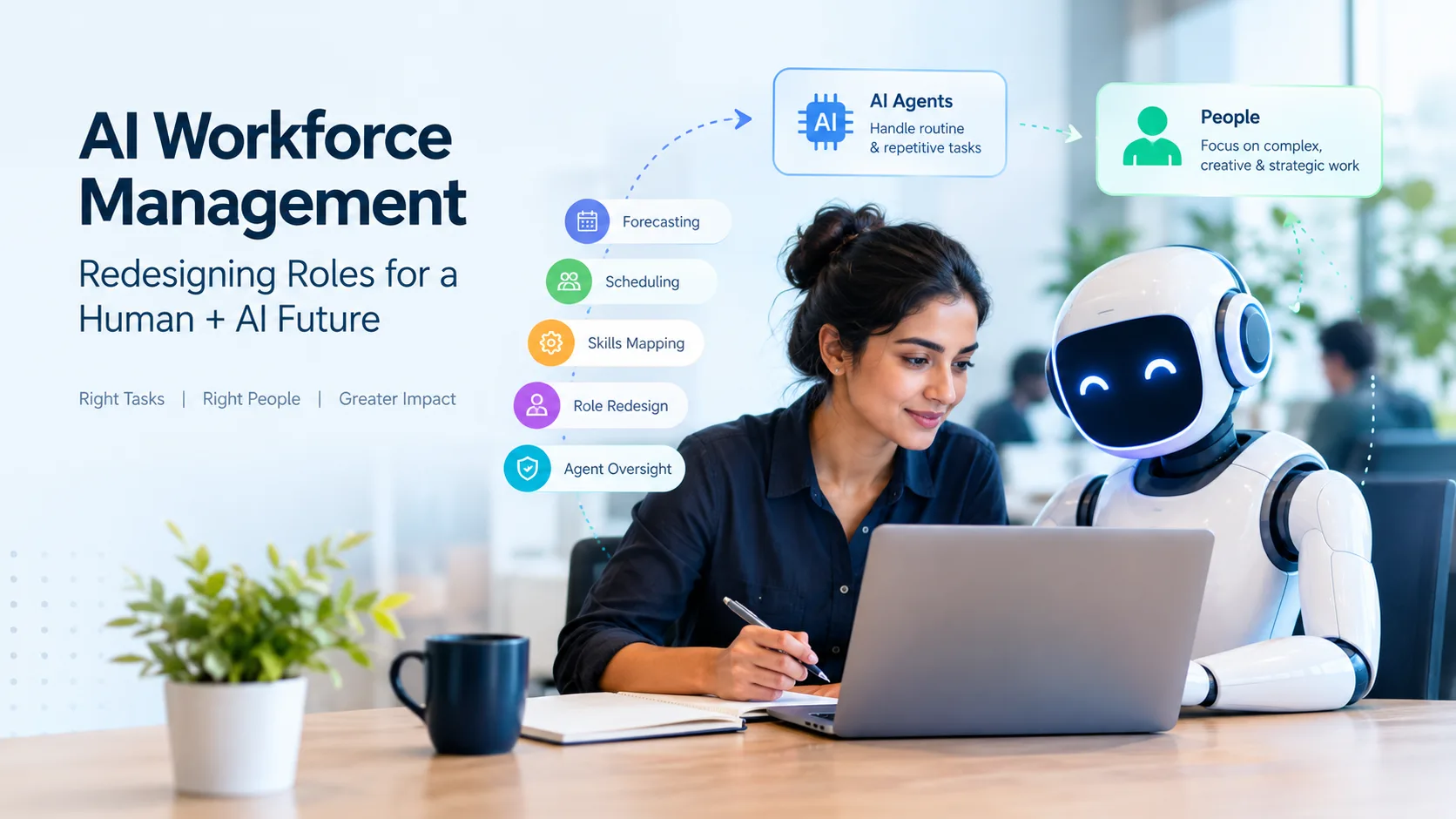
The pattern across all six functions is the same. AI Agents can take the high-volume, well-bounded work. People take the work that requires judgment, relationships, or accountability.
Now, delivering this at scale requires one thing most enterprises haven't built yet: the right architecture underneath it.
This is where a lot of enterprise deployments quietly fail.
The agent itself is not the hard part. The hard part is building an enterprise-ready agentic AI architecture where hundreds of agents can operate well.
The agentic AI architecture that makes that possible has five layers, and AWS Prescriptive Guidance, Salesforce, IBM, and ServiceNow have all converged on essentially the same model.
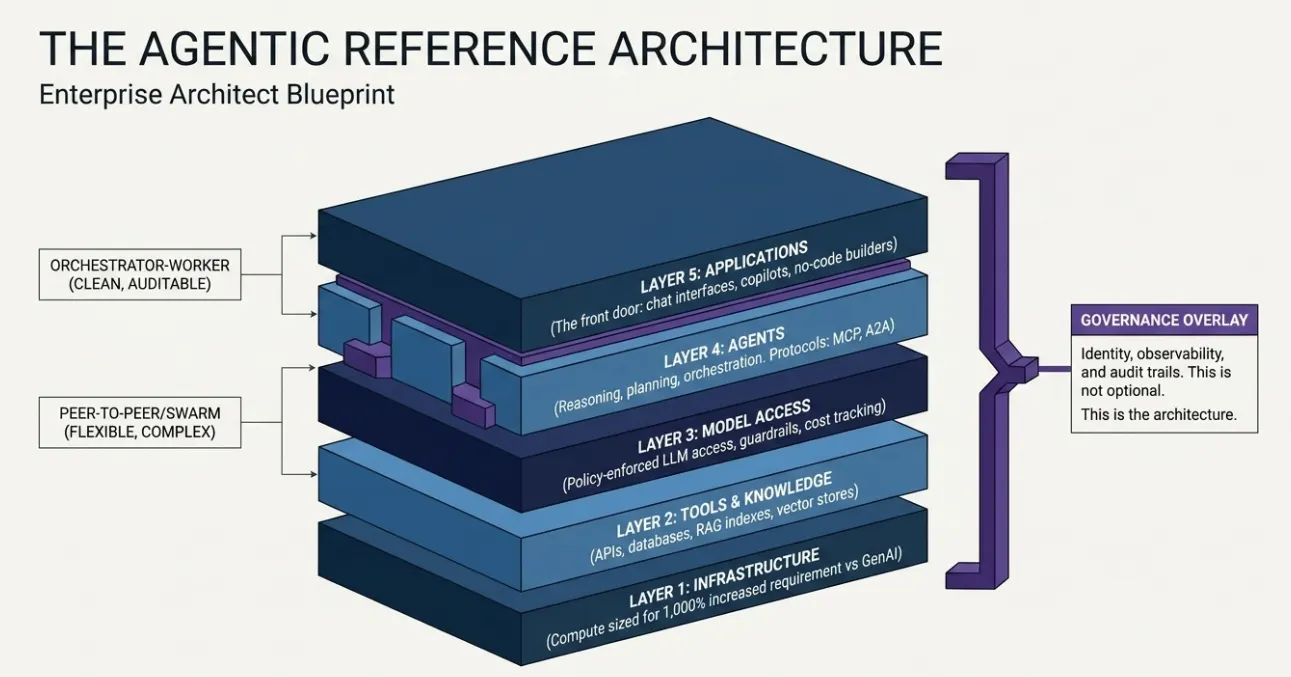
The Model Context Protocol (MCP), open-sourced by Anthropic and now adopted by Salesforce, ServiceNow, IBM, and Microsoft, has become the de facto standard for agent-to-tool communication. Google's Agent2Agent (A2A) protocol handles agent-to-agent. These two together are becoming the connective tissue of the agentic AI architecture.
The governance non-negotiables, regardless of which platform or pattern you choose:
Once this foundation is in place, the implementation itself becomes far more predictable and there is a roadmap that the best-performing enterprises are following.
Here is the 90-day roadmap that consistently shows up in successful deployments.
Don't start with technology. Start with data.
Use ticket clustering and process-mining tools to identify workflows that are:
Password resets, invoice triage, KYC pre-checks, and IT access provisioning consistently top this list.
Pick your orchestration layer based on your existing cloud footprint, not based on which vendor has the best deck. Wire MCP and A2A protocols. Define your agent identity scheme. Set HITL approval thresholds before any agent touches a system of record.
This is the week most enterprises skip. It's also the week that determines whether the deployment survives month six.
Deploy one or two agents in a non-production environment with full guardrails. Run adversarial testing (such as prompt injection, edge cases, conflicting instructions) before going live.
Measure journey completion rate, answer relevancy, and tool-call accuracy. These are the three dimensions IBM Watsonx Orchestrate's Agent Governance tracks before certifying an agent for production.
If it doesn't pass, fix the architecture. Don't loosen the thresholds.
Go live. Measure against the baselines you set in week one. The most important KPIs are:
This is the decision most CTOs agonise over unnecessarily.
MIT NANDA's research across 300 deployments gives you the answer empirically: partnered deployments succeed roughly 67% of the time. Internal builds succeed roughly 33% of the time.
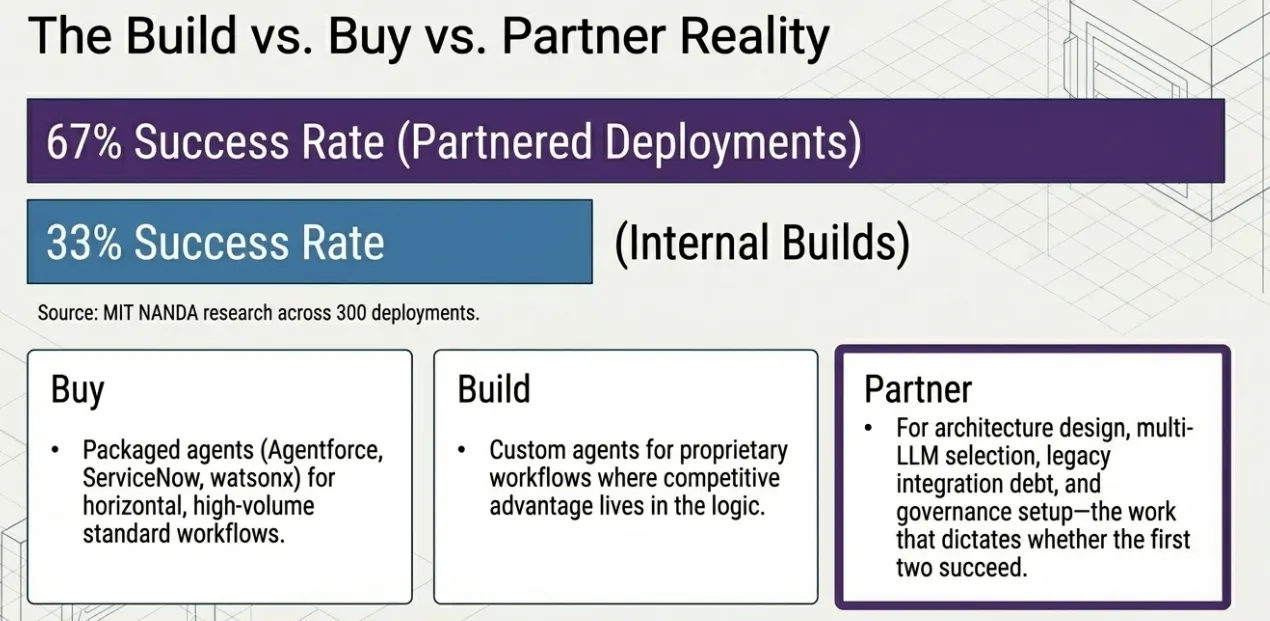
The logic is straightforward:
I want to address the instinct to wait. It's a reasonable instinct.
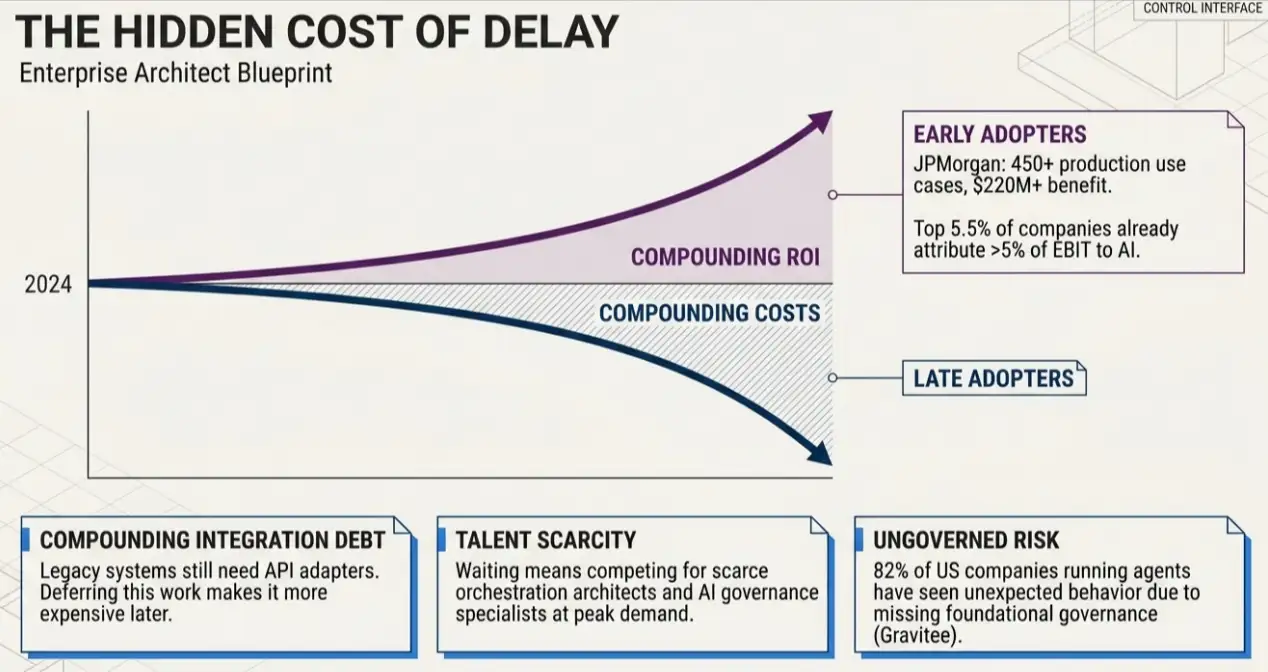
The technology is moving fast, vendors are overselling, and Gartner just warned that 40% of projects will be cancelled.
Why not let the market mature a little before committing?
Here's why that logic breaks down.
McKinsey's 2025 State of AI survey identified a cohort of AI high performers (about 5.5% of companies) for whom more than 5% of EBIT is now directly attributable to AI. These companies are 3.6x more likely to be using AI for transformative, not incremental, change.
Forrester forecasts that 25% of planned AI spend will be pushed from 2026 into 2027 under CFO pressure. That sounds like prudence. But the data readiness work, the integration debt cleanup, the identity governance foundation — none of that can be deferred. If you skip it now, it just means you will pay for it later, at higher urgency and lower leverage.
McKinsey flags agent orchestration architects, MLOps engineers, and AI governance specialists as the binding constraint in enterprise agentic-AI adoption. Deloitte's 2026 survey found that perceived readiness on talent dropped year over year, alongside technical infrastructure and data management readiness.
The companies building these capabilities now will have them when it matters. The companies waiting will be competing for the same scarce people at a worse moment.
The risk of moving slowly, or not moving at all, is massive. Which brings us to the practical question: what does a sound enterprise agentic AI strategy actually look like?
There is a version of this that sounds complicated and a version that is actually actionable. I'll give you the latter.
This is the single most common mistake I see. Enterprises build the agent, see it work in a demo, and then try to retrofit governance before production. It doesn't work that way.
The governance architecture has to come first:
Forrester predicts that 30% of large enterprises will mandate AI literacy training in 2026. Walmart is training all 2.1 million associates on AI tools, with role-specific certifications built with OpenAI and Google. That's the benchmark.
Agents do change how people work. If you don't invest in helping your teams understand what agents can and can't do, adoption will stall regardless of how good the technology is.
An example:
Q1
Q2
Q3
Q4
This sort of a sequence works because each quarter builds the capability and confidence for the next. You're not betting everything on a single large deployment. You're compounding small, proven wins into an enterprise-wide operating model.
The MIT NANDA research I cited earlier is worth restating here, because it's the clearest empirical signal in the research literature.
Partnered agentic AI deployments succeed roughly 67% of the time. Internal builds succeed roughly 33% of the time.
That gap comes from underestimating three things:
At Neuronimbus, we've spent 20+ years building enterprise technology. That background also shapes how we approach agentic AI, specifically.
Here's what we deliver
In a year where Forrester says 25% of AI spend will be deferred, Gartner says 40%+ of agentic projects will be cancelled, and Deloitte says only 21% of enterprises have mature governance, the question isn't whether you can afford a partner.
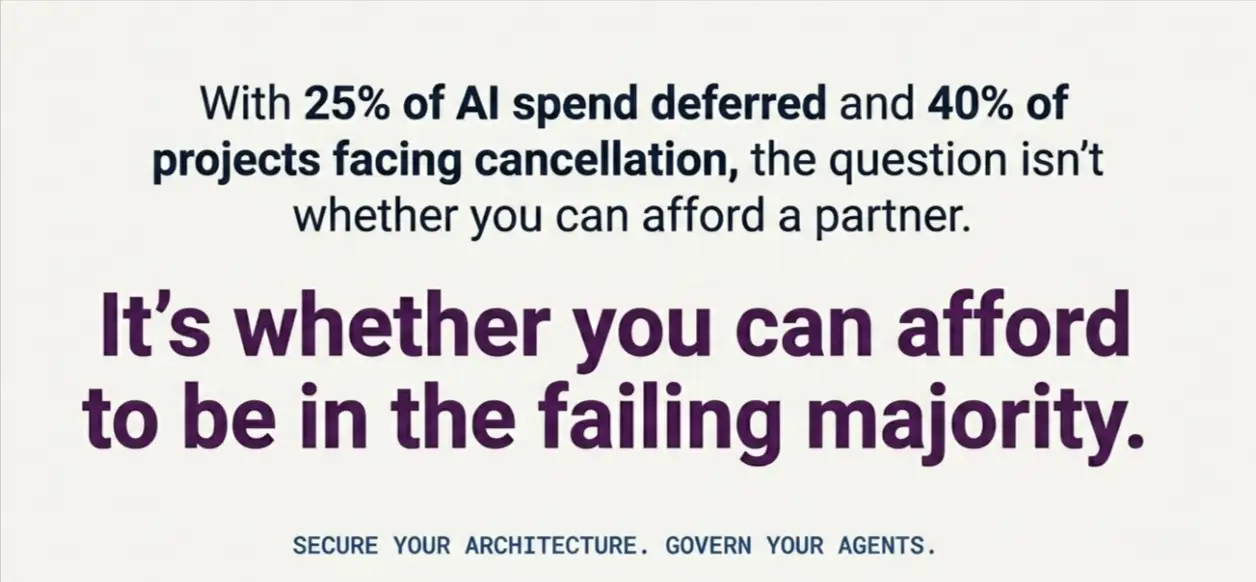
It's whether you can afford to be in the failing majority.
If you're at the point where you want agentic AI to be done right for your enterprise, ask us for a no-obligations conversation.
Agentic AI refers to autonomous AI systems that can reason, plan, make decisions, and take actions to achieve specific goals with minimal human intervention.
Traditional automation follows fixed rules and predefined workflows, while agentic AI can dynamically adapt, make decisions, use tools, and manage multi-step tasks autonomously.
Agentic AI helps enterprises improve operational efficiency, automate repetitive tasks, reduce costs, enhance customer service, and accelerate decision-making at scale.
Common challenges include weak governance models, poor data readiness, legacy system integration, lack of AI talent, security concerns, and unclear deployment strategies.
The best approach is to start with high-impact use cases, establish governance early, deploy pilots with measurable ROI, and scale gradually using a structured roadmap.

Let Neuronimbus chart your course to a higher growth trajectory. Drop us a line, we'll get the conversation started.






Call Us

Schedule a Call


Your Next Big Idea or Transforming Your Brand Digitally
Let's talk about how we can make it happen.