In all industries, technology leaders seem to agree on two things:
One, enterprise AI adoption is no longer optional.
Two, the traditional model of buying AI software and expecting it to work inside complex enterprise environments is not delivering results at the pace or scale that was promised.
The evidence is well documented:
These numbers do not surprise most technology leaders. In the early phase of any paradigm shift, a small number of organisations do asymmetrically well while the majority struggle to keep pace.
An example of successful AI adoption in healthcare is Merck, who compressed a 6-month R&D cycle to 6 hours using embedded AI engineering — a result that most healthcare organisations cannot replicate yet.
Also read: Exploring Generative AI Role in Modern Healthcare
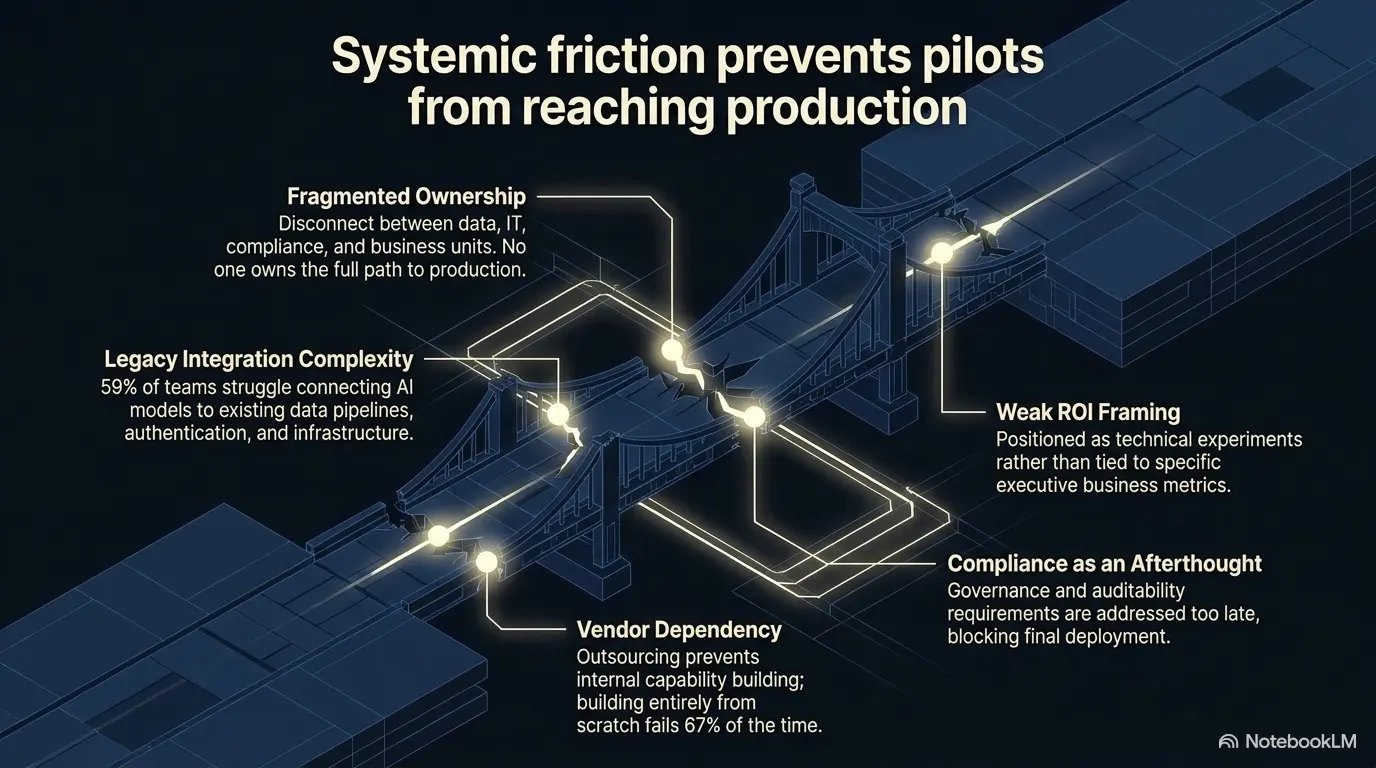
For the majority that are struggling, the causes are no secret:
Forward deployed engineering was built to close exactly this gap.
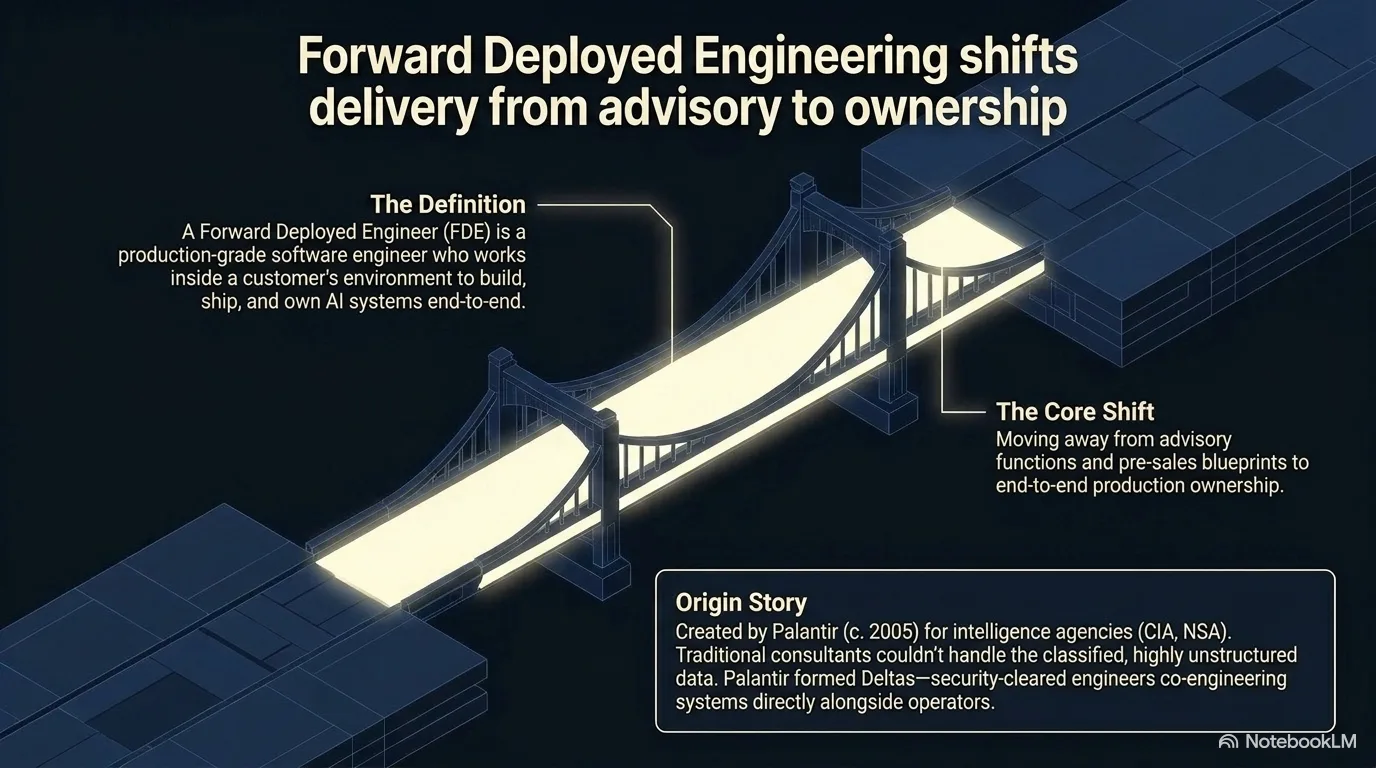
A forward deployed engineer (FDE) is a production-grade software engineer who works inside a customer's environment to build, ship, and own AI systems end-to-end.
This is neither an advisory function, nor a pre-sales support. A forward deployed engineer handles the full arc of delivery. The core responsibility of a forward deployed engineer is to:
Palantir Technologies created the Forward Deployed Engineer role around 2005 to solve a unique problem that they could not address with their existing enterprise delivery model.
By 2020, this model had become Palantir's primary go-to-market engine. Today, OpenAI and Anthropic are also using the same model.
A solutions architect produces architectural blueprints and reference designs.
A consultant delivers recommendations and strategy.
A forward deployed engineer writes, debugs, and ships the actual software that runs inside the client’s environment.
Also read: AI-Driven Digital Transformation | Future-Proof Your Business
The factors that cause AI projects to stall or underperform are well understood by now:
Forward deployed engineering is an elegant response to most of these problems simultaneously.
An embedded FDE team bridges organisational silos by holding end-to-end ownership. They handle legacy integration and compliance from day one, not as a retrofit. They transfer knowledge systematically so the client builds capability, not dependence. And they anchor every deployment to measurable business outcomes — which sustains executive sponsorship over time.
For Neuronimbus, extending our on-site AI solutions delivery model into a structured FDE practice was a natural step. We refined it by studying Palantir's original playbook and the approaches now being adopted by Microsoft, AWS, and Google Cloud.
What became clear through that process is that true forward deployed engineering is not the same as placing a senior consultant on-site and calling them an FDE. A genuine FDE model has a foundation + pillars architecture that supports the lofty ceiling of business outcomes.
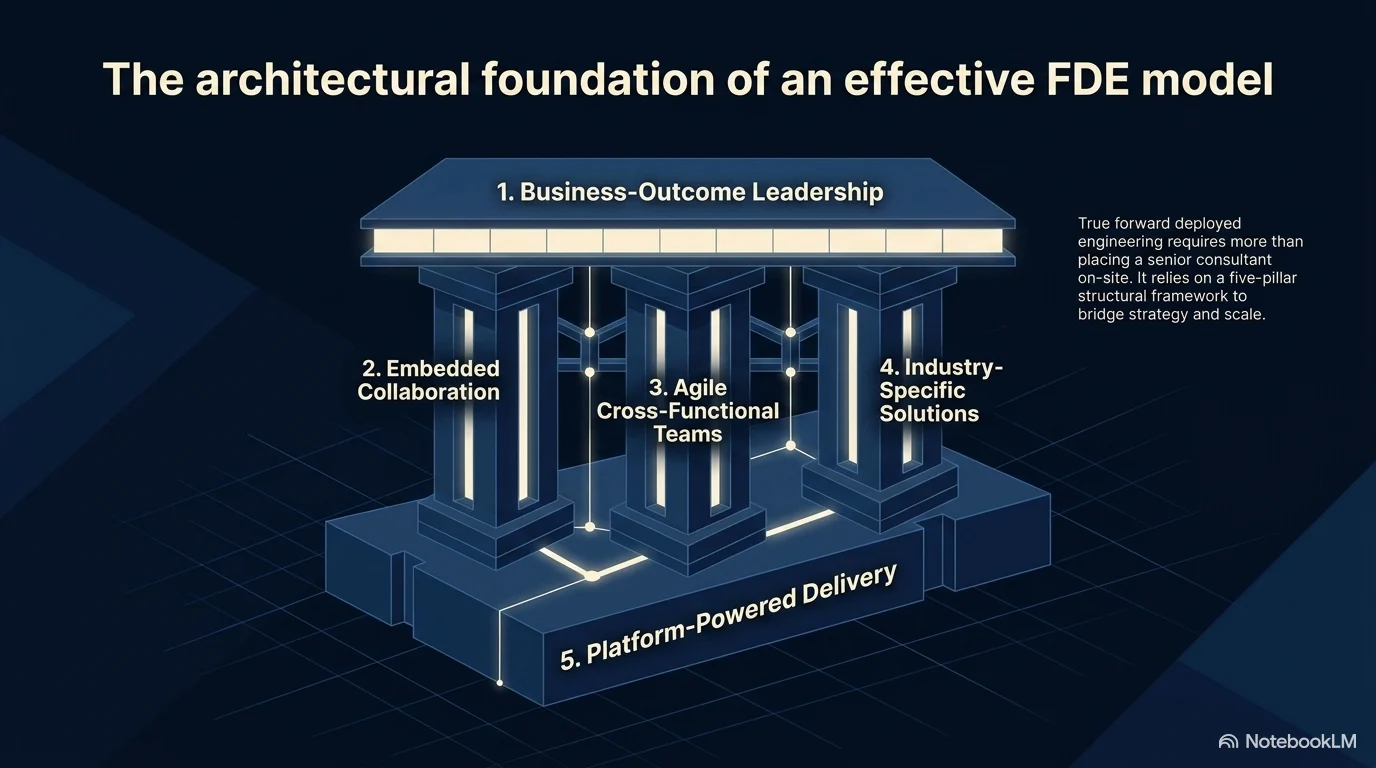
Every FDE engagement should begin with a business problem articulated as a desired business outcome. For example:
In practice, the forward deployed engineer operates as something close to a fractional CTO for a single account. They need the technical depth to build production systems and the business fluency to articulate value in terms that a CFO or COO would find credible.
The value of forward deployed work comes from proximity to the problem and the people grappling with the problem. Physical and deeply integrated virtual presence within the customer's operational environment are crucial for the FDE model to deliver its promised value.
This embedding enables things that remote engagement cannot:
High-performing FDE teams are small and multi-disciplinary. In every FDE team we have deployed on-site, we have included engineers, data specialists, and a strategy or product owner with the authority to redesign workflows as needed.
The key characteristic is ownership of the full loop, right across problem identification, solution design, build, deployment, and impact measurement.
Organisations building FDE functions should look for what practitioners call "T-shaped" engineers, who are people with deep technical skill and broad enough range to engage directly with customers in a business context.
Effective forward deployed engineering programmes build vertical solutions tailored to sector needs. Palantir's Foundry platform, which is crucial to its FDE model, is based on a semantic map of business entities and processes meant to capture industry-specific logics that appears repeatedly across deployments. Microsoft Frontier organises its 6,000-person workforce around industry verticals for the same reason.
FDE work should be built on a shared platform that includes a common data layer, AI services, governance controls, and deployment infrastructure. The reason is straightforward: when every engagement starts from the same foundation, each deployment benefits from the work done in previous ones.
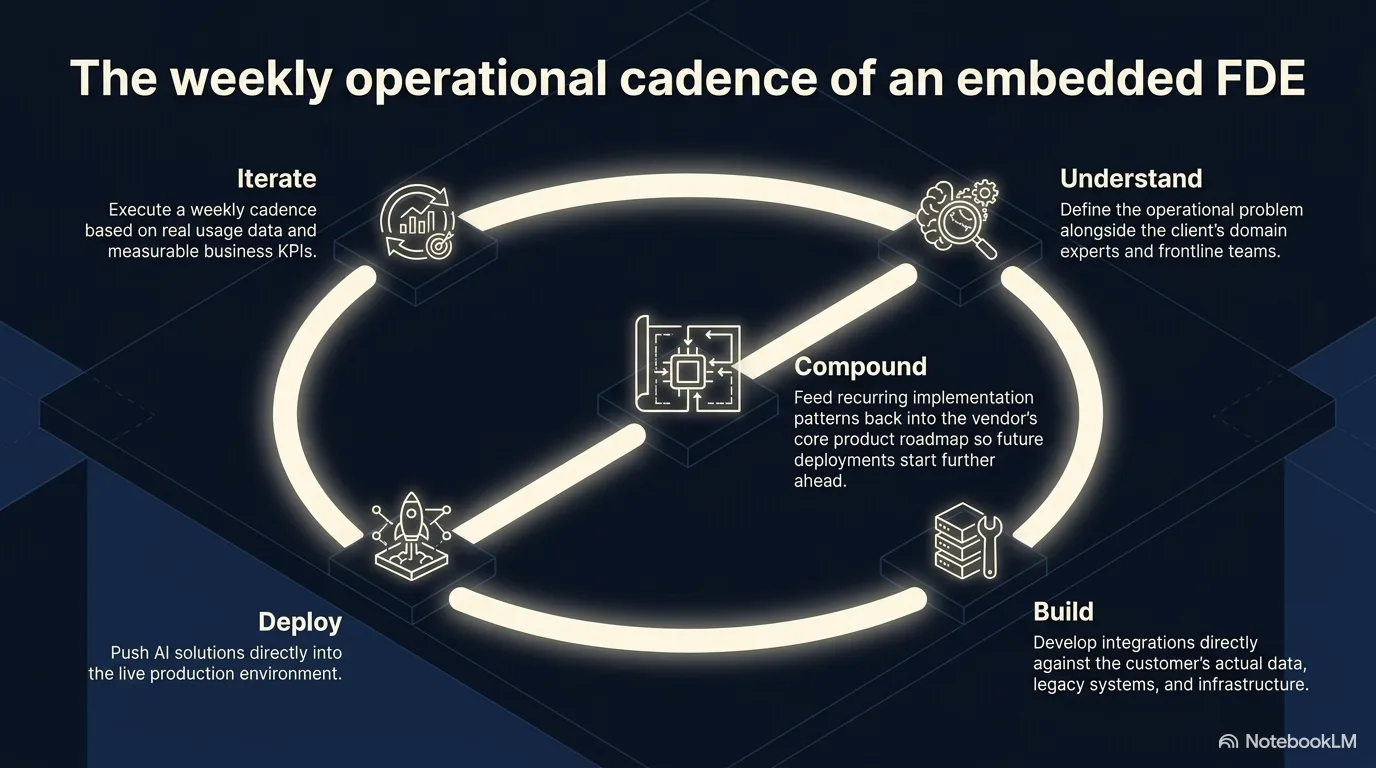
Here is how that works in practice. When an FDE builds a custom integration for one client, and the same need appears at a second and third client, the vendor's product team takes that pattern and builds it into the platform as a standard feature. The next client gets it out of the box.
The forward deployed engineering model is no longer a Palantir-only approach. Over the past 18 months, hyperscalers, services firms, and AI-native companies have all made significant investments in building their own FDE capabilities.
Palantir continues to be the reference FDE implementation. Their modern FDE workflow centres on building a customer-specific ontology within the first 48 hours of an engagement. This semantic map can ground an LLM’s reasoning in the customer's actual vocabulary and data structures.
Palantir accelerates the delivery through intensive three-to-five-day sprints called "AIP Bootcamps", where FDEs ingest real customer data and build working production workflows. Once the value is proven, more use cases and data domains are layered in.
The three major hyperscalers have each launched dedicated FDE-style organisations:
Global systems integrators are evolving their traditional consulting bench into specialised FDE pods:
In a move that signals just how central the FDE model has become, OpenAI launched its Deployment Company (DeployCo) with $4 billion in capital.
Organisations typically use one of three pricing approaches:
The critical insight we have discovered is that buyers should insist on a pricing model that positions FDE investment as a revenue multiplier, not a service cost. The entire premise of the FDE model is that embedded engineering accelerates platform adoption and expands usage over time, which means the vendor's own economics depend on delivering outsized returns for the client, not on billing hours. If the engagement is not structured around that shared upside, the buyer is likely paying consulting rates for what should be a value-driven partnership.
If you are evaluating whether to develop an internal forward deployed engineering function or partner with an existing provider, here is how to think about each path.
Building an internal FDE function:
Enterprises with mature engineering teams and a strong platform foundation choose to develop FDE capability in-house. This means identifying engineers within your organisation who have both the technical depth and the customer-facing instinct to work embedded on high-priority AI deployments.
The key decisions are:
Buying FDE capability from a provider:
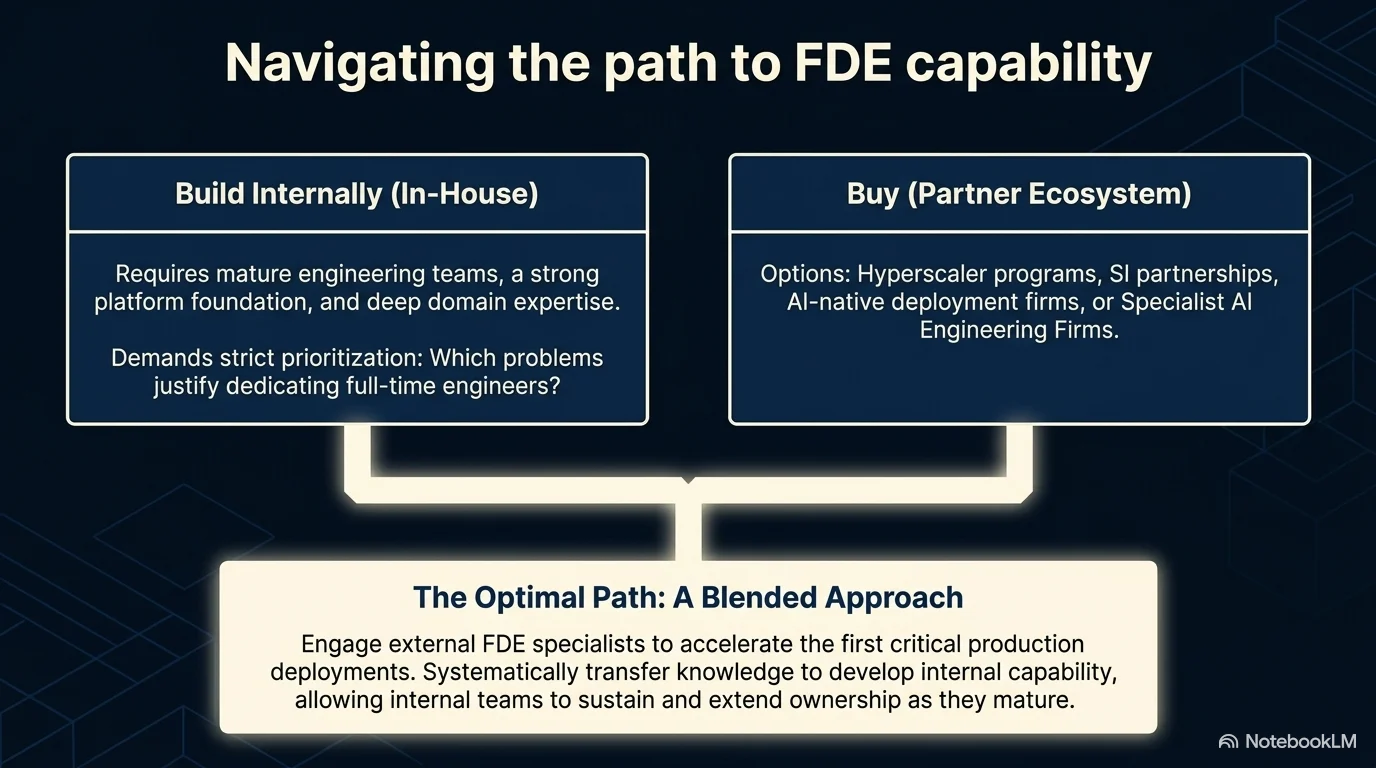
The most sustainable approach is usually to blend both: engage an external provider to accelerate your first production deployments while developing internal capability to take over ownership as your team matures.
If you are exploring what the right FDE approach looks like for your organisation, we are happy to have a no-obligation conversation. At Neuronimbus, we have been delivering on-site AI solutions for enterprise clients, and extending that into a FDE model has been a natural evolution of that work. Reach out, and we can walk through your situation together.

Strong production engineering ability, comfort with ambiguous client environments, and the business fluency to translate operational problems into working software. FDEs need to be builders who can also listen — which is why they command a 25–40% compensation premium over traditional software engineers.
Fully loaded costs range from $220,000 to $400,000+ per year depending on seniority and domain. For vendor-provided FDE engagements, milestone-based pricing — tied to deployment success rather than hours — tends to align incentives best for the buyer.
Industries with high regulatory complexity, large legacy estates, and high-value processes — financial services, healthcare, defence, and manufacturing lead current adoption. The greater the distance between a working AI model and a deployed production system, the stronger the case for FDE.
No. A solutions architect designs reference architectures and supports pre-sales evaluation. A forward deployed engineer writes, deploys, and owns production code inside the client's environment — and is measured on business outcomes, not design quality or deal closure
Most structured engagements run three to six months for an initial deployment, with extensions as new use cases are identified. The goal is not indefinite presence — it is to deliver production systems and transfer enough knowledge that the client's own teams can sustain and extend the work.


Let Neuronimbus chart your course to a higher growth trajectory. Drop us a line, we'll get the conversation started.






Call Us

Schedule a Call


Your Next Big Idea or Transforming Your Brand Digitally
Let's talk about how we can make it happen.