I’m not the first one who has tried to compile a list of the most noteworthy deployments of AI chatbots from real businesses.
During my research I’ve skimmed through more than a dozen such compilations, and what I’ve found is that most “chatbot examples” articles show you a screenshot and a stat, and leave you none the wiser about whether the thing would actually work for your business.
So I’ve strived to make this post different. In this guide, I will introduce you to 12 chatbot examples from real companies. These examples span support, sales, booking, and internal HR and knowledge bots.
What makes a good business chatbot example?
Before the list, it’s worth being clear about what makes a good business chatbot example. There are thousands of AI chatbot examples floating around, and most are demos dressed up as deployments.
So, I applied four tests to every example I could collect. Every example here had to pass at least three of the four tests to be included in my list. The tests are as follows:
It’s a named, real business with a source you can check.
The bot has one clear job.
It runs where people already are, for instance, in their messaging app, their banking app, their Teams workspace.
It has a result attached.
With the test clear, here are the twelve AI chatbot examples from real businesses.
1. Sephora — a retail customer service chatbot example
Business: Sephora, beauty and cosmetics retail.
Job of the bot: Guide product selection and convert browsing into a booked in-store makeover.
Channel: Facebook Messenger and Kik.
How it works: This is a guided-flow bot layered with a recommendation engine, not an open-ended LLM. It walks you down a decision tree of quick-reply questions related to skin type, shade, occasion, and feeds those answers into a product-matching model. The interesting piece is "Sephora Virtual Artist," which pulls in facial-recognition and AR try-on so the recommendation is rendered on your own face before you buy. Booking sits on top, writing into the appointment system.
Result: A reported 11% lift in makeover booking rates (vendor-reported).
The lesson is architectural restraint. Sephora needed a constrained flow that reliably moves one decision forward. One of the cleaner customer service chatbot examples precisely because it stays in its lane.
2. Domino's — ordering done where the customer already is
Business: Domino's Pizza, quick-service food.
Job of the bot: Take orders, remember preferences, and track delivery.
Channel: Website, mobile app, Messenger, Twitter, Google Assistant, and Amazon Alexa.
How it works: “Dom” reads what you type or say, works out what you want, and places that order in Domino’s system. So “the usual, but add wings” becomes the right item on the right account, because the bot remembers each customer’s saved order. The same bot runs on every channel, including app, web, Messenger and Alexa, because they all connect to one shared backend. The live tracking you see is Dom relaying updates from the order system as they happen.
Result: More than half of Domino's digital orders now run through it (brand-reported).
What makes Domino's one of the best chatbots for business to study is that one intent engine serves every channel. Build the logic once, expose it everywhere.
The pattern worth noting: Sephora and Domino's both win by automating a transaction people were already trying to complete and by keeping the conversational layer separate from the system that fulfills the order.
3. Bank of America — a chatbot wired into core systems
Business: Bank of America, banking and financial services.
Job of the bot: Act as a transactional personal financial assistant.
Channel: The Bank of America mobile banking app.
How it works: “Erica” is plugged straight into Bank of America’s core banking systems, and that connection is the hard part. It understands a spoken or typed request, then reads your transaction history to flag things worth knowing, such as a charge billed twice, a bill coming due, or a change in your spending. Every action it takes, from checking a balance to paying a bill, is a secured, identity-verified call into the bank’s systems under strict financial-compliance rules. Understanding the question is the easy part. Doing it safely inside a bank is the real work.
Result: Over 10 million users in the first year, 100M+ requests handled, and roughly a 30% drop in call-centre volume (brand-reported).
Erica is one of the strongest AI chatbot examples because the value lives in integration, not dialogue. A bot that can't touch core systems can only advise; one that can actually does the task.
4. KLM — absorbing growth without adding headcount
Business: KLM Royal Dutch Airlines, aviation.
Job of the bot: Booking, check-in, flight status, and travel support.
Channel: Facebook Messenger and WhatsApp.
How it works: “BlueBot” understands the traveller’s request and is connected into KLM’s booking and operations systems, so it handles the routine, repetitive steps itself, such as choosing a seat, confirming a booking, and sending a boarding pass. When a question goes beyond what it can handle, a human agent steps into the same conversation, sees everything said so far, and carries on without the customer repeating themselves. The bot and the agent work one shared thread.
Result: Roughly twice the booking volume handled without adding agents; 4.7/5 on the App Store (vendor-reported).
This is the clearest version of the real promise: not replacing staff, but letting one team absorb far more volume because the bot and the human share state.
5. Lemonade — onboarding and claims in minutes
Business: Lemonade, insurance.
Job of the bot: Run underwriting onboarding and triage claims.
Channel: Web and mobile app.
How it works: “Maya” looks like a friendly chat, but each question is really collecting one specific piece of information the pricing model needs, so the conversation is structured data-gathering with a human face on it. The more interesting side is claims. The system checks a submitted claim against the policy, runs fraud checks, and can settle simple, clear-cut claims on its own. That works because the questions are narrow and every answer is a known field, which is what makes it safe to let software decide.
Result: Policy purchases and simple claims compressed from days to minutes (vendor-reported).
Source: Sprinklr.
Lemonade built the business around the bot rather than bolting a bot onto a legacy process, which is why the automation reaches all the way to the decision, not just the FAQ.
6. Lyft — meeting riders inside the messaging app
Business: Lyft, ridesharing.
Job of the bot: Let people hail and manage rides without the native app.
Channel: Facebook Messenger (and voice via Slack/Alexa integrations).
How it works: This is a light conversational layer over the ride system Lyft already had. The bot lets you request a ride, see the driver’s arrival time, and manage the trip inside a chat, while behind the scenes it calls the same system the main app uses, with your account verified. The value here is reach. It takes a service that already exists and offers it in a place where it is easier for people to start.
Result: A reported 25% rise in ride requests (vendor-reported).
The point here is distribution. When your core service already runs through a system other software can call, a bot is often the cheaper, lower-friction way to open that same door to more people.
7. Elisa — a support bot that knows when to step aside
Business: Elisa, telecommunications.
Job of the bot: Resolve routine contacts end to end and route the rest with context.
Channel: Website and voice/IVR replacement.
How it works “Annika” works across both chat and phone calls, and was trained on Elisa’s own record of real customer contacts. It works out what each person is contacting about, handles the standard cases such as a billing question or a plan change by looking the answer up in Elisa’s systems, and when it is not confident or the request is unclear, it passes the contact to the right human team along with everything gathered so far. The numbers show the design at work: it fully handles a third of contacts end to end and resolves many more on first contact.
Result: Up to 70% of inbound contacts managed (vendor-reported).
Annika is worth copying for how openly it respects its own limits. The handoff to a human is built into the core design from the start, which makes it one of the more realistic customer service chatbot examples here.
8. Marriott — turning conversations into direct bookings
Business: Marriott International, hospitality.
Job of the bot: Handle bookings, stay FAQs, and loyalty-account queries.
Channel: Facebook Messenger and Slack.
How it works: “ChatBotlr” connects a natural-language layer to Marriott’s Bonvoy loyalty and reservation systems, so it reads a member’s account and acts on it rather than giving generic answers. Routine requests such as extra towels or a late checkout become structured tickets routed to the right team at the property, which is what actually takes load off the front desk. The booking path stays inside the chat, so the guest completes the booking there and never bounces off to a third-party travel site.
Result: A reported 44% lift in direct bookings and 87% positive feedback (vendor-reported).
For any business losing margin to booking aggregators, the integration is the whole game. A bot wired into your reservation system keeps the booking, and the commission, in-house.
9. BAS World — a multilingual sales bot on WhatsApp
Business: BAS World, commercial vehicle sales.
Job of the bot: Qualify international buyers, quote, and book viewings.
Channel: WhatsApp Business.
How it works: This is a flow-based sales bot running on the WhatsApp Business platform, with multilingual handling so a buyer in any market is served in their own language. It qualifies the lead through a set of structured questions, pulls vehicle specifications from the inventory system, generates a price quote automatically, and writes the appointment into the sales calendar. The work here is in the integration and the language handling rather than in any clever open-ended conversation.
Result: A reported 70% drop in inbound call-centre volume (vendor-reported).
Source: Vendor case study.
Among sales chatbot use cases, this is the quiet win. It deflects the repetitive qualification calls, so your sales team spends its time only on buyers who are genuinely ready.
10. Defense and aerospace org — an internal bot behind a secure wall
Business: A leading defense and aerospace organisation (named in the source).
Job of the bot: Internal self-service for HR and policy questions.
Channel: Microsoft Teams, inside secure Azure GovCloud.
How it works: This is a retrieval-augmented generation (RAG) system, and the architecture is the whole story. When an employee asks something, the system finds the most relevant passages in the organisation’s SharePoint policy documents and passes only those to the AI, which answers from that retrieved text and nothing else. That is how you stop the model inventing policy. The strict constraint is that every part of this runs inside secure Azure GovCloud, so no data ever crosses the compliance boundary.
Result: Scaled from pilot to 10,000 monthly active users and 40,000+ requests (vendor-reported).
Source: AIM Consulting.
This is the first of two internal AI chatbot examples, and the point worth noting is that the chat was the easy bit. Running RAG inside a defence-grade compliance boundary was the real engineering.
11. US tech enterprise — cutting HR's routine load
Business: A US-based technology enterprise (named in the source).
Job of the bot: Answer employee HR questions in natural language.
Channel: Microsoft Teams.
How it works: This is a custom HR assistant built on an open, inspectable stack: LangChain to orchestrate the retrieval, FastAPI to serve it, and a database and vector store holding the indexed HR handbooks. An employee’s question on payroll, leave, benefits or policy is answered from the actual handbook passages the system retrieves, grounded so the answer points back to the real document instead of a plausible guess. Because it runs on RAG, updating a policy means re-indexing one document rather than retraining the model.
Result: A reported 41% cut in HR workload and 79% faster responses (vendor-reported).
Source: Modsen.
Note the channel again: Microsoft Teams. The best chatbots for business meet employees inside the tool they already have open all day, rather than asking them to go somewhere new.
12. Social welfare agency — a single source of truth
Business: A public-sector social welfare agency (named in the source).
Job of the bot: Turn years of scattered policy into one queryable knowledge hub.
Channel: Internal web portal / intranet.
How it works: “Insider” is a RAG-powered knowledge hub, and the real work went into the groundwork. Years of fragmented policies, procedures, benefits documents and role descriptions were gathered into one clean, well-organised, carefully tagged index. The quality of the answers depends entirely on that step, since the system can only retrieve what was prepared properly. Once it was in place, staff could ask a question in plain language and get an answer with its source attached, instead of opening six documents to find it.
Result: Research time cut by around 95% — from 45–60 minutes to 1–2 — and onboarding effort down ~60% (vendor-reported).
Source: Boosha AI case study.
That 95% figure is the most eye-catching on the list, and the one most worth labelling as vendor-reported. Even discounted heavily, the shape of the win holds. An internal bot’s value is the time it gives back to people who would otherwise be hunting for answers.
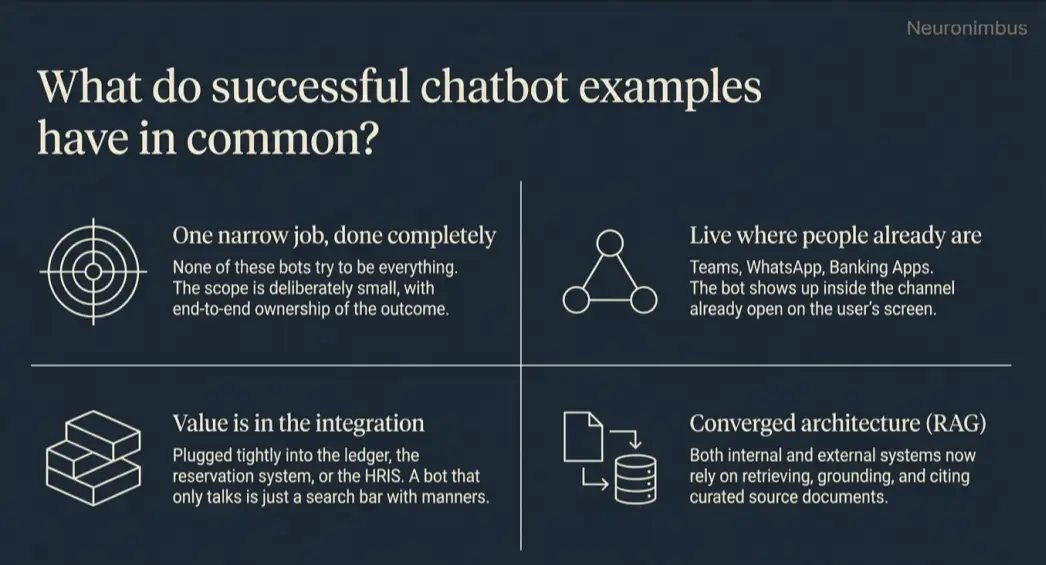
What do successful chatbot examples have in common?
Step back from the twelve and the same handful of decisions keep reappearing.
1. One narrow job, done completely.
None of these bots tries to be everything. Dom takes orders. Erica handles banking. Annika resolves telecom contacts. The scope is deliberately small, and the bot owns that scope end to end rather than half-handling ten things.
2. They live where people already are.
Messenger, WhatsApp, the banking app, Microsoft Teams. Not one of these chatbot examples asks the user to visit a new destination. The bot shows up inside the channel already open on their screen.
3. The value is in the integration, not the chat.
This is the one most people miss. The conversation is the easy part; the work is wiring the bot into the system that actually does something. Erica and ChatBotlr deliver because they're plugged into core systems.
4. Internal and external bots have converged on the same architecture.
Every internal example here runs on RAG over a curated document set. The pattern that powers the best AI chatbot examples inside the enterprise is now identical whether the user is a customer or an employee: retrieve the right source, ground the answer in it, cite it.
How to build a chatbot for your business
Across the credible frameworks, production chatbot development follows five sequential phases:
Scope & KPIs — audit 60–90 days of real interactions, cluster them by volume and complexity, and fix the metric you're moving.
RAG + integrations — choose retrieval-augmented generation over fine-tuning so knowledge stays current, and connect the backend systems that let the bot act, not just answer.
Conversation & escalation design — set the persona, the guardrails, and the confidence threshold for human handoff.
Evaluation & red-teaming — test retrieval and generation separately, and stress the bot with edge cases and prompt injection before launch.
Launch & optimize — instrument it, audit transcripts weekly, and re-index as your content changes.
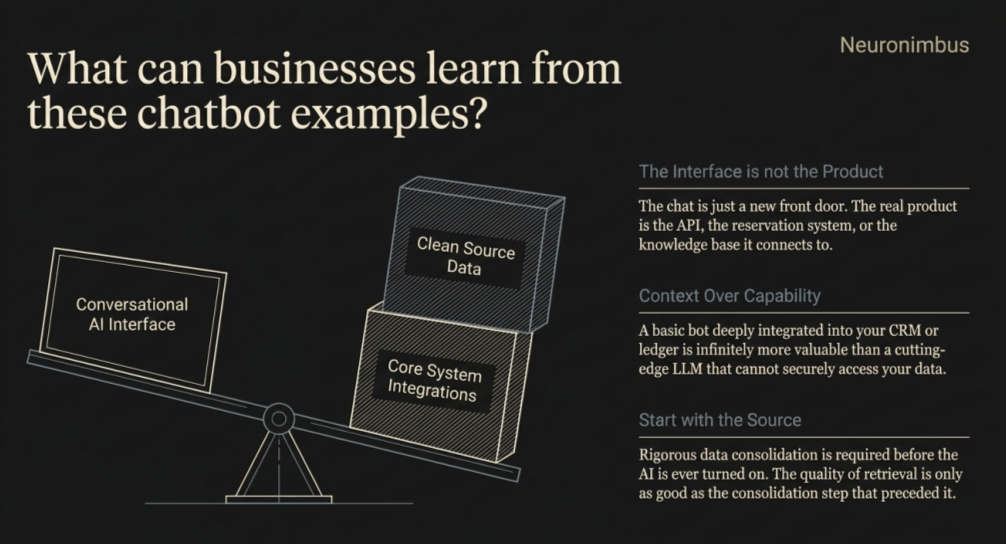
The pattern across every one of the best chatbots for business above is that phase two (integration and retrieval) is where the value and the difficulty both concentrate. That's the part where we at Neuronimbus spend most of our time.
If you are weighing a chatbot for a real use case and want it wired properly into your systems, that is exactly the work we do, and ourAI chatbot development service page is a good place to start the conversation.
Build an AI Chatbot That Delivers Real Business Value
From customer support and sales automation to internal knowledge management, develop AI chatbots that integrate with your business systems and streamline workflows.
There's no single winner. The right choice follows the job. For straightforward FAQ deflection, a platform like Intercom or Tidio is enough; for anything that must act on your own data or systems, a custom build pays off. Among the best chatbots for business, the fit matters more than the brand.
What is the difference between a rule-based and an AI chatbot?
A rule-based bot follows scripted decision trees. It is predictable, cheap, but brittle the moment a user goes off-script. An AI chatbot uses NLP and often RAG to understand intent and answer from your documents. Most of the strongest AI chatbot examples blend both: guided flows for structure, AI for the open questions.
What are the main types of chatbots?
By job, three dominate: support bots that resolve and route (Elisa), sales and booking bots that convert (Marriott, BAS World), and internal HR or knowledge bots that serve employees. The twelve above span all three, and they map neatly onto the common chatbot use cases most businesses start with.
Which businesses use chatbots most?
Retail, banking, travel, insurance and telecom lead on the customer-facing side — any industry with high-volume, repetitive queries. Internally, HR and knowledge management are growing fastest, which is why several customer service chatbot examples here are employee-facing rather than external.
How do I build my own chatbot?
Follow the five phases: scope and KPIs, RAG and integrations, conversation and escalation design, evaluation, then launch and optimisation.