Two years ago, roughly 30% of banks were actively running AI in production. Today, that number is 75%.
But an even more telling number is this: banks that tightly align their AI strategy to their actual profit pools are 25.8 percentage points more likely to report a 5%+ profit uplift from AI than those that don’t (84.1% vs. 58.3%).
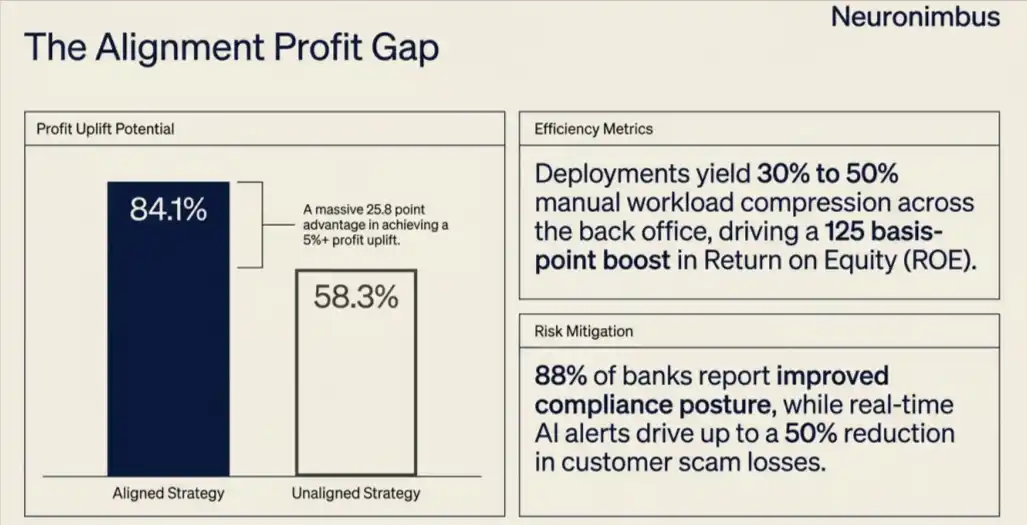
Which means that we should not see the landscape as that of banks that use AI and banks that don’t. The landscape is one of banks that deploy AI with strategic clarity and banks that deploy it as a collection of experiments.
In this guide, I will try to help you with a framework to get the sort of clarity that the winners have benefited from, in terms of the ROI of their AI investments.
AI in banking today spans six primary areas.
A few patterns are evident from this comparison of AI in banking use cases.
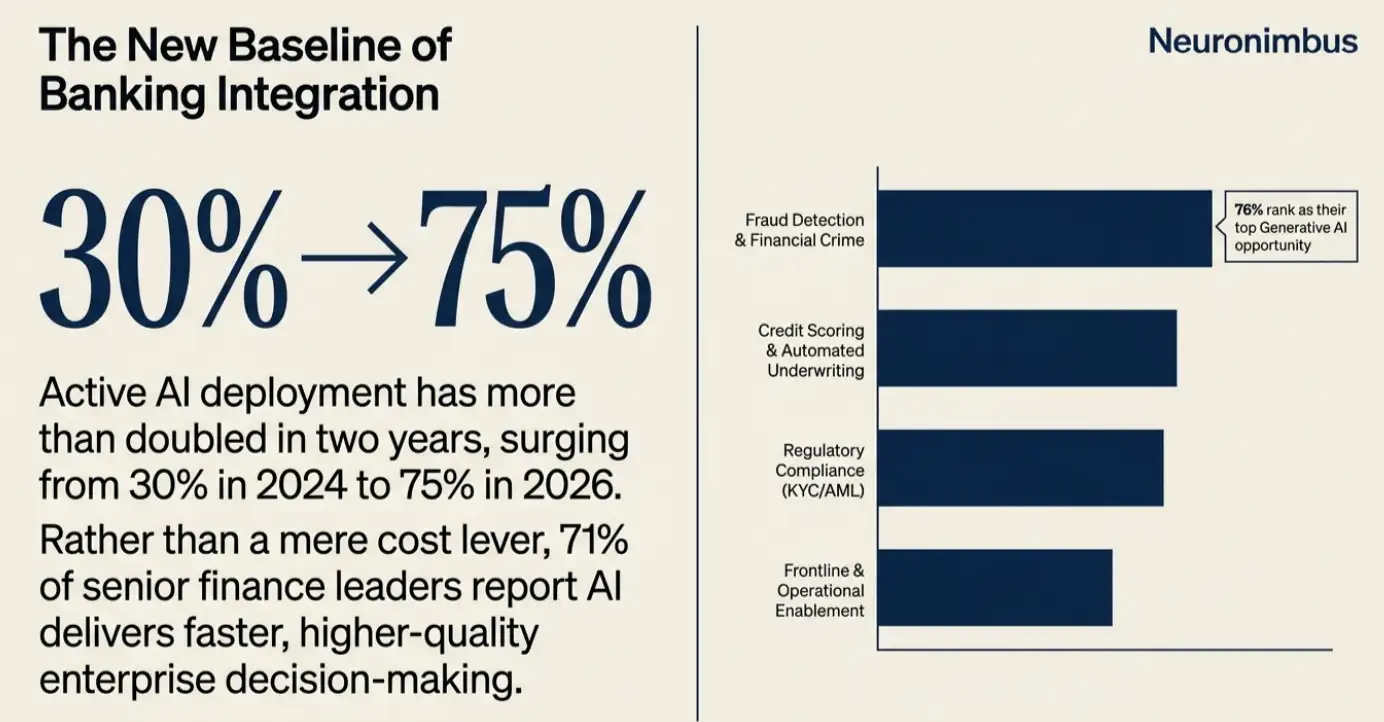
Let me walk through each of these high-impact areas in detail, starting with the one that 76% of institutions ranked highest.
Traditional fraud systems have been at work in banks for many years, and these run on static rules. As an example, if a transaction exceeded a fixed threshold or originated from a flagged geography, one of these static rules would cause an alert to be triggered.
The problem was not that these rules didn’t catch fraud. The problem was they were too blunt as instruments, and they flooded analysts with false positives. Also, they would simultaneously miss out on any kind of novel attack patterns that didn’t fit any predefined templates.
AI fraud detection in banking has changed this in three fundamental ways.
Today, banks use supervised models that are trained on historical data, where the dataset contains verified fraud records as well as legitimate transactions. This sort of training allows the machine learning model to recognise established attack signatures. Unsupervised models such as isolation forests, autoencoders are also used, and these go further. They analyze live data streams without prior labels and detect behavioral anomalies that no analyst can be expected to detect. This is how banks catch zero-day fraud tactics.
Early ML models looked at transaction variables in isolation. These variables would include amount, time, merchant category, etc. Modern machine learning models fuse those with user-level context:
The performance difference is measurable. When you train a model on transaction data alone, it performs reasonably well. But when you add user profile context on top of that, the model’s ability to correctly distinguish fraud from legitimate activity jumps significantly. In benchmarking terms, the detection accuracy (measured by AUC-ROC) goes from 0.89 to 0.97, and the balance between catching real fraud and avoiding false alarms (F1-score) improves from 0.80 to 0.91. In practical terms, that means fewer genuine frauds slipping through, and far fewer legitimate customers getting their cards blocked unnecessarily.
Scoring one transaction at a time works for isolated fraud. But it misses the larger schemes, where multiple accounts, merchants, and devices are working together.
This is where graph neural networks come in. Think of them as a way to map every relationship in a bank’s ecosystem as a connected web. Instead of asking “is this single transaction suspicious?”, the model asks “is this cluster of accounts behaving like a coordinated operation?”
That shift is how banks uncover mule account networks, where money is passed through chains of seemingly unrelated accounts. It is how they spot collusive merchant schemes and layered money-laundering structures that would look perfectly normal if you examined any single transaction in isolation.
On top of these three core layers, generative AI is adding capabilities that were not possible even two years ago. Banks are using it to generate synthetic fraud datasets for model training without exposing real customer data, to detect deepfakes and voice clones that target biometric verification, and to build agentic assistants that auto-prioritise alerts and summarise complex case histories for human analysts.
Also read: AI in Financial Services: The Future of Smart Banking
Manual credit underwriting in banking has always been slow and inconsistent. And it is increasingly inadequate for the volume and speed at which lending decisions need to happen in modern banks.
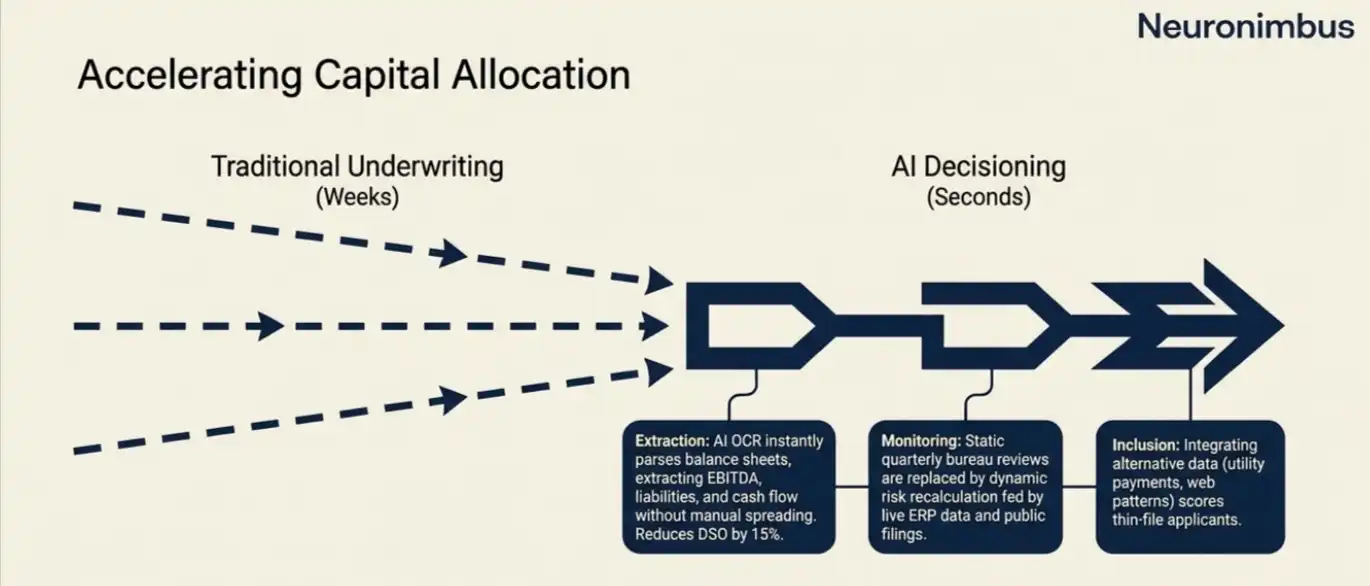
33% of firms admit to rushing credit approvals because the manual workflow is simply too tedious. Thankfully, AI credit scoring addresses this at multiple levels.
Banks use automated decision engines to evaluate applicants against standardized risk rules and approve low-risk candidates instantly. At the same time, AI-powered OCR and natural language parsing are used to pull key balance-sheet metrics directly from uploaded documents. Things like EBITDA, liabilities, cash flow, debt-to-equity ratios are all extracted automatically, with no manual spreading required.
Most banks traditionally did credit reviews quarterly, and for this purpose they used bureau data that has almost always gone stale by the time anyone looks at it. AI systems work differently. They monitor live signals on an ongoing basis. These signals include ERP payment history, credit utilization changes, rating shifts, and public filings like bankruptcy alerts. And they recalculate borrower risk profiles in real time as these signals change.
This is where the impact goes beyond efficiency into inclusion. By incorporating non-traditional signals like smartphone behavioural metadata, utility payment patterns, and e-commerce activity, lenders can score thin-file and credit-invisible borrowers who lack formal bureau histories.
The evidence is encouraging. ML models using alternative data increased approval rates for underrepresented minorities by 13 percentage points without elevating default rates. They also reduced human underwriting bias by up to 40%.
Regulators do not accept “the model said no” as a reason for credit denial. Under FCRA and ECOA, lenders must provide clear adverse-action notices that detail the principal reasons for a decision.
This is where techniques like SHAP (Shapley Additive Explanations) and LIME (Local Interpretable Model-agnostic Explanations) become essential. These tools take the output of a complex model and break it down into plain, feature-level attribution. They show exactly which variables drove a specific lending decision. And by how much.
Also read: AI-Powered Credit Scoring: Faster, Smarter Lending
Customer service is where AI becomes most visible to the people banks actually serve. And the numbers here have moved well past early experimentation.
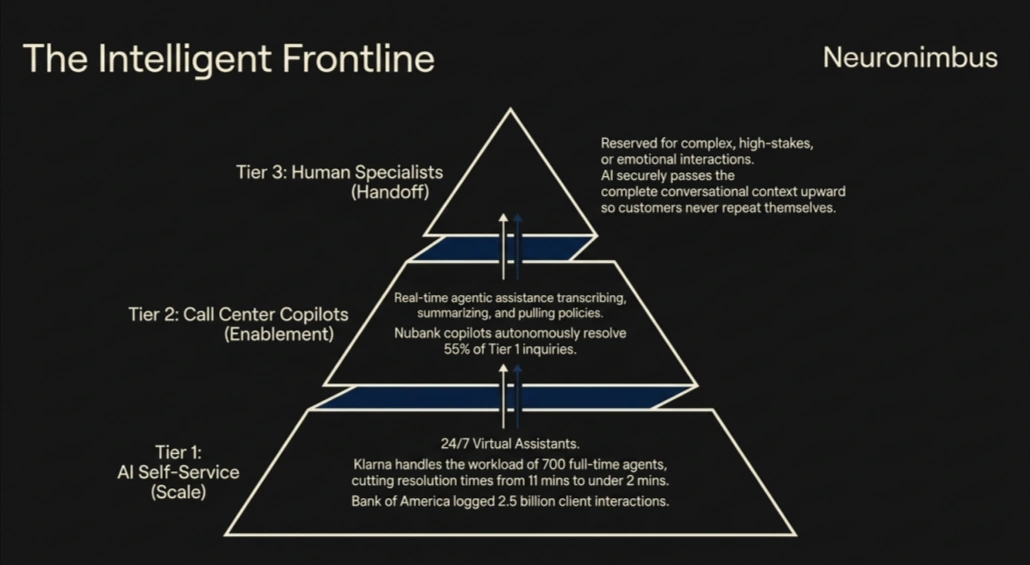
Bank of America’s virtual assistant Erica has facilitated over 2.5 billion client interactions across 42 million users already. Klarna’s AI banking chatbot handles two-thirds of all customer service conversations. That is equivalent to the workload of 700 full-time agents. It also cut average resolution time from 11 minutes to under 2 minutes. NatWest’s upgraded Cora+ boosted customer satisfaction scores by 150%.
But the real shift is in how AI has augmented the entire service layer.
In practice, banks are structuring this across three tiers.
Tier 1: AI-led self-service. Virtual assistants handle routine, low-risk requests around the clock, such as balance inquiries, card activations., fee explanations, and bill payments. This is where volume compression happens.
Tier 2: Agent copilots. For more complex queries, AI works alongside human agents in real time. It transcribes calls. It pulls up policy rules. It summarises customer history and suggests resolution steps. DBS deployed this model to 500 service officers handling 250,000 monthly inquiries. Nubank’s copilots resolve 55% of Tier 1 inquiries autonomously.
Tier 3: Human-led for high-stakes interactions. Hardship cases, dispute claims, complex loan discussions. These stay with people. What AI does here is preserve full context across channels so the customer never has to repeat themselves when they get escalated to a specialist.
And voice-native AI is opening access for customers who struggle with app interfaces, for example, elderly users and on-native speakers who benefit from real-time translation. Or anyone who simply prefers to talk.
Compliance is the function nobody sees until something goes wrong. It is also where banks burn some of their largest operational budgets. AI banking compliance is changing this across five layers.
AI synthesises transaction data alongside unstructured sources like contracts, policy memos, and regulatory guidelines to draft filings automatically. This cuts manual review hours and reduces the risk of late submissions under constantly shifting legal standards.
Internal audit teams upload document batches and query specific policy details using AI tools. This eliminates the manual search through hundreds of pages. AI pre-validates client documents and centralises Prepared By Client (PBC) audit requests. The result is fewer sample errors and less follow-up friction.
Legacy anti-money laundering systems relied on static rules that generated excessive false positives. AI models monitor transaction flows in real time and spot suspicious patterns associated with money laundering, shell companies, or terrorist financing.
Computer vision and NLP process onboarding documents like passports, IDs, and utility bills. They check for tampering or inconsistencies and auto-fill onboarding workflows.
This is the most advanced pattern emerging right now. Instead of one system doing everything, distinct AI agents handle sequential steps in a compliance process:
The common thread across all these compliance applications is traceability. Every automated action needs an immutable audit log. That requirement connects directly to the broader risk and regulatory landscape banks must navigate.
Also read: AI-Driven Digital Transformation | Future-Proof Your Business
Every section so far has included individual data points. Here they are consolidated, because the aggregate picture matters more than any single metric.
5. 71% of finance leaders report faster decisions. 70% report higher decision quality. 64% report better forecast accuracy.
The pattern is clear. Banks that treat AI in banking as a strategic capability and not just a cost line are pulling ahead on both growth and risk metrics.
Historical training data carries historical inequities. Models can engage in proxy discrimination through seemingly neutral variables like postcode, shopping patterns, or device type. These proxies can replicate biases that violate fair lending laws even when the model never sees a protected characteristic directly.
Complex deep learning models contain millions of parameters. When a model denies credit or flags a transaction, regulators and consumers both need to understand why. “The model said so” is not an acceptable answer in any jurisdiction.
Generative models can produce confident but false outputs. In a customer-facing chatbot, that is embarrassing. In financial calculations or regulatory filings, it is a compliance and legal exposure.
Training AI requires large datasets. Insecure pipelines or improper handling risk exposing customer PII and violating privacy regulations across jurisdictions.
Fragmented core banking systems struggle to feed clean, unified data to AI models. This creates instability and governance gaps that no amount of model tuning can fix.
The regulatory response to these risks is substantive and growing. Here is where key frameworks stand:
The consistent expectation across all of these: every automated decision must carry a traceable audit trail. The policy that was applied. The model version that ran. The underlying data context that fed the decision.
Here is something that may seem counterintuitive. Banks that build governance into their AI architecture from day one find that these requirements actually accelerate deployment rather than slow it down. 65% of AI leaders use centralised governance, compared to just 36.1% of laggards.
Let’s look at the numbers first.
81% of banking leaders have adapted their build-versus-buy strategy over the past five years.
64% now actively consider partnerships, up from just 25% five years ago.
Still, all three options are legitimate, and here is how the they compare:
Build: Proprietary IP, custom risk models, and core differentiation.
Buy: Commodity tools such as HR systems, basic CRM, and cloud infrastructure.
Partner: Complex and fast-moving domains such as agentic AI, RegTech, and advanced fraud detection.
The most important insight here: 62.5% of AI leaders deploy hybrid architectures. They combine standardized platforms with targeted co-innovation where it matters most.
75% of banks remain stuck in what the industry calls “pilot purgatory.” They are running experiments that never reach production because the foundations are not in place.
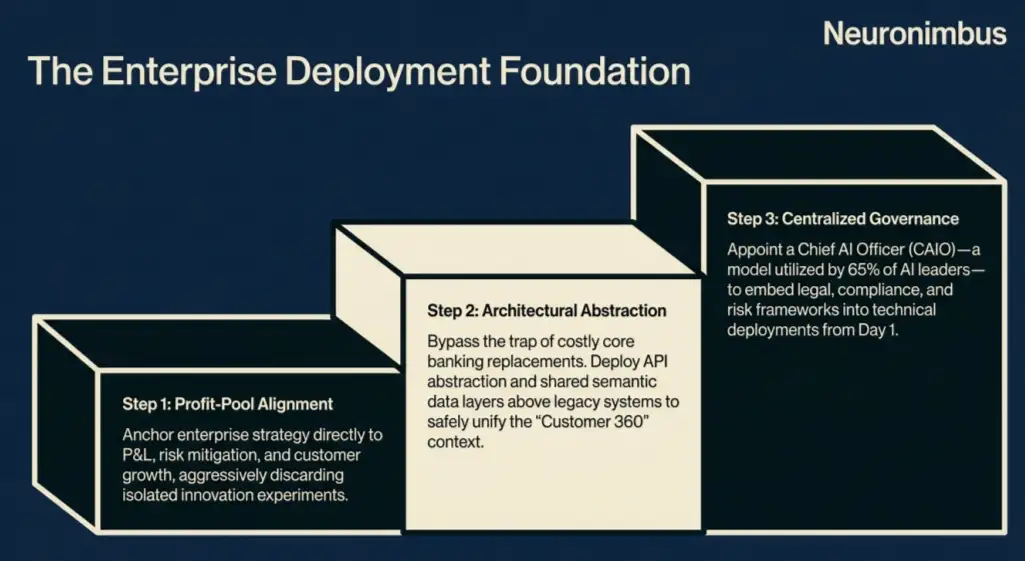
You can break that cycle in five steps:
Align AI initiatives directly to P&L and risk objectives. Not innovation theatre. Strategy-aligned banks are 25.8 percentage points more likely to see real profit uplift.
Unify your data with an API abstraction layer above legacy systems. You do not need a full core replacement. You need a shared semantic layer that gives AI models a single source of truth.
Centralise governance and appoint a Chief AI Officer with explicit authority over enterprise AI risk. Embed compliance and legal teams into projects from day one.
Start narrow in shadow mode. Pick one high-volume, rule-bound workflow like KYC extraction, loan spreading, or fraud alert triage. Run AI alongside human reviewers for four to six weeks to build institutional confidence.
Redesign end-to-end workflows, then reinvest the savings. Automate full journeys, not isolated tasks. Early margin gains fund deeper infrastructure. That creates a compounding cycle of advantage.

AI in banking pays off where strategy is specific, governance is centralised, and deployment targets measurable outcomes.
The evidence is consistent across every use case we have covered. Banks that align AI to their profit pools, fix their data foundations, and build governance into the architecture from the start are pulling ahead by double-digit margins.
The next wave will widen that gap further.
The question is not whether AI in banking works. It does. The question is whether your organisation is structured to capture the value before the gap becomes permanent.
If that is the question you are working through right now, we should talk. That is exactly the kind of problem we help banks solve.
Yes, but with strict conditions. Regulations like ECOA and FCRA in the US and the EU AI Act require that AI credit scoring models provide explainable outputs and clear adverse-action notices. Lenders must demonstrate that their models do not discriminate.
The primary risks are algorithmic bias from historical training data, lack of explainability in complex models, generative AI hallucinations in sensitive outputs, data privacy exposures, and integration challenges with legacy core banking systems.
Banks deploy supervised ML to catch known attack patterns and unsupervised models to detect zero-day anomalies. AI fraud detection in banking now includes behavioural profile fusion for higher accuracy, graph neural networks that expose coordinated network-level schemes, and generative AI for synthetic training data and deepfake defence.
Yes. The buy-or-partner model makes AI accessible without large internal teams. Cloud-based platforms and SaaS solutions offer pre-built fraud, credit, and compliance capabilities that are ready to deploy. Small banks benefit most by starting with one high-volume workflow and expanding from proven results.
A focused pilot in shadow mode typically runs four to six weeks. Moving from pilot to production depends on data readiness and governance maturity. Banks with unified data layers and centralised oversight reach production-scale AI significantly faster than those still wrestling with fragmented legacy systems.


Let Neuronimbus chart your course to a higher growth trajectory. Drop us a line, we'll get the conversation started.


Call Us

Schedule a Call


Your Next Big Idea or Transforming Your Brand Digitally
Let's talk about how we can make it happen.