The term Agentic AI refers to AI systems that can pursue a goal, decide what steps to take, use tools and enterprise systems, and act with limited supervision. In this guide, we look at 15 agentic AI examples across banking, healthcare, retail, HR, public services, software and legal operations, with a focus on what each system actually does.
Before looking at the examples of agentic AI use cases, it helps to define and agree on ‘what exactly is agentic AI’.
It is easy to accept that every chatbot is an AI agent and not every workflow that uses an LLM is agentic either.
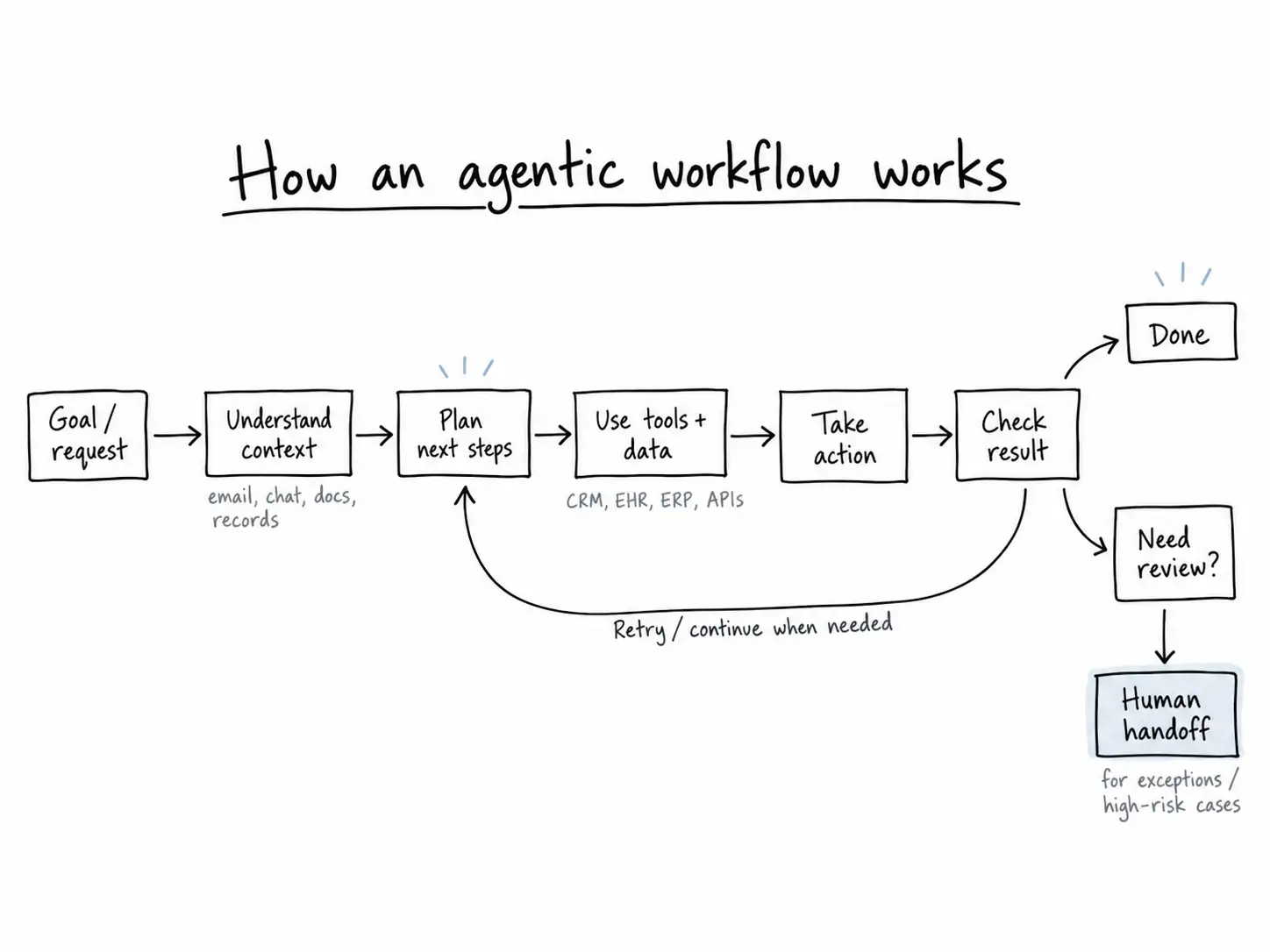
An AI agent is more sophisticated. It is a system to which you should be able to assign an objective, and then the system should work within defined boundaries and work towards and achieve that objective.
For me, for any AI-based solution to qualify as an example of an agentic AI use case, it has to have these five characteristics.
Customer service is probably an organizational function where the difference between the capabilities of an AI chatbot and an AI agent are the easiest to spot.
An AI chatbot can tell an employee or a customer about the refund policy.
An AI agent can understand the customer's request, retrieve the details of the relevant order from one system, retrieve the payment information from another system, check whether the customer qualifies under that organization’s refund policy, and if so, even issue the refund if the amount under question falls within the monetary transaction limits allowed to the agent.
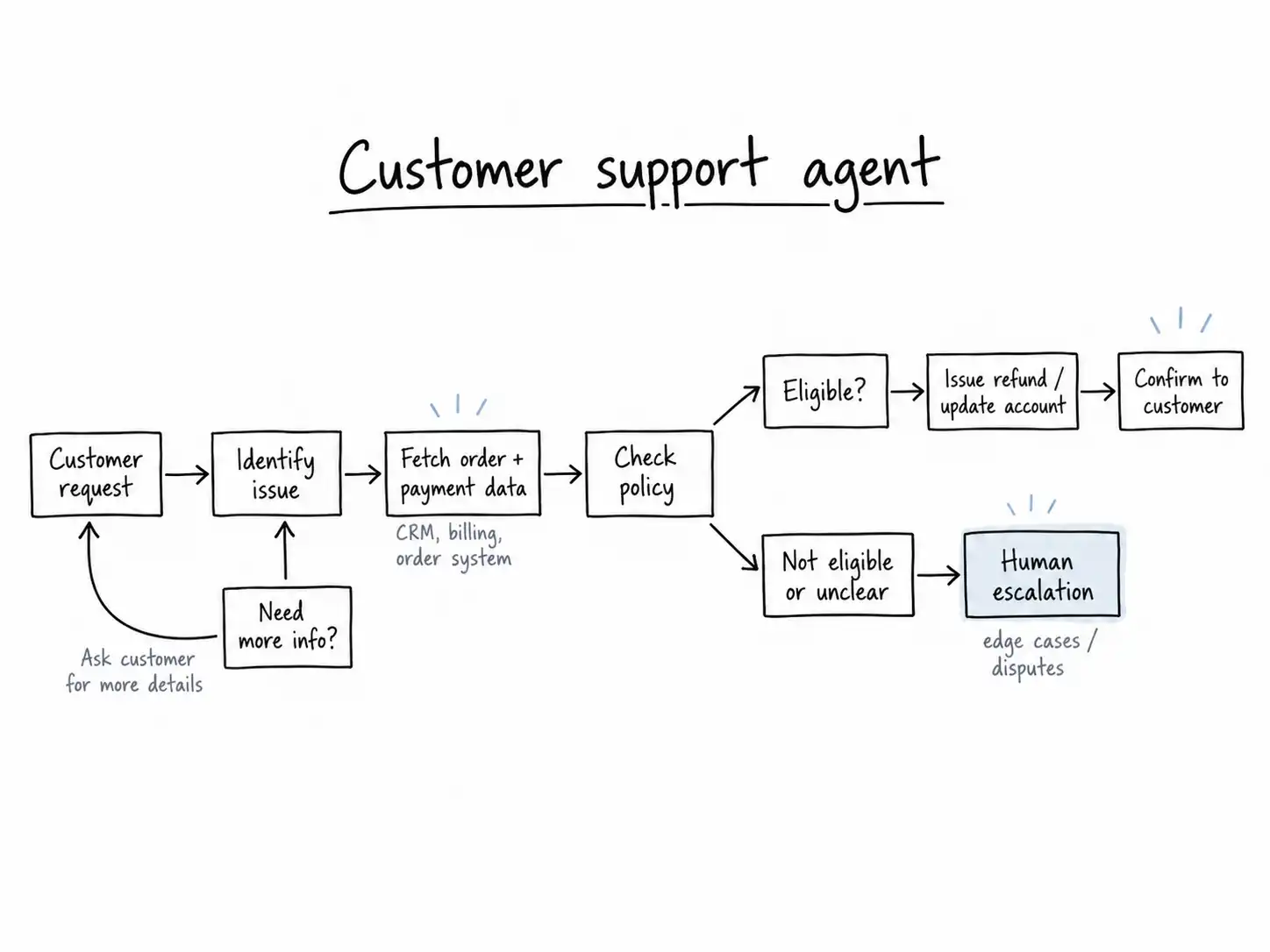
Klarna's customer-service AI agent works broadly along these lines. It is connected to live customer information such as purchase history, payment status, account standing and previous conversations.
The AI agent reportedly handles work equivalent to that done by 853 full-time customer-service employees across 35 languages, and delivers around $60 million in annualised run-rate savings.
But there is another aspect of this example that I think is more useful for a technology leader. During the early deployment of the AI agent, Klarna observed that when the customer requests were complex, the AI agent’s actions led to escalations by some customers.
This is not necessarily a failure of agentic AI, but a reminder that the scope of autonomy of an AI agent has to be designed carefully. You ideally want the agent to move quickly through cases it understands well. You also want it to recognise when it has moved beyond that boundary.
Also read: Agentic AI in Customer Service: Use Cases & Architecture
Now consider a very different banking workflow. Imagine an investment-banking analyst tasked with preparing a Public Information Book for a product or service. The analyst will need to collect filings, earnings material, company information, market data and news, and then turn all of that into a structured document.
Here too, an LLM can be easily expected to summarise one filing. Bit it will take an AI agent to assume the responsibility for much more of the workflow.
In JPMorgan's case, specialist AI agents have been deployed. These agents have the ability to collect information from different sources, analyse documents in parallel and then bring those outputs together into structured Word, Excel or PowerPoint material.
The reported reduction in human effort is from roughly four to six hours of work to around ten minutes for one PIB.
What matters in this use case is the architecture of the agentic AI solution. Here, the AI engineers are not trying to build one enormous AI model that “knows investment banking”. They are breaking a business objective into smaller jobs and coordinating them.
That pattern comes up repeatedly in serious agentic AI use cases.
Also read: Enterprise Agentic AI Strategy Guide for CTOs & Leaders
Anti-money-laundering (AML) work is a good example for understanding what an AI agent is expected to do in a banking environment.
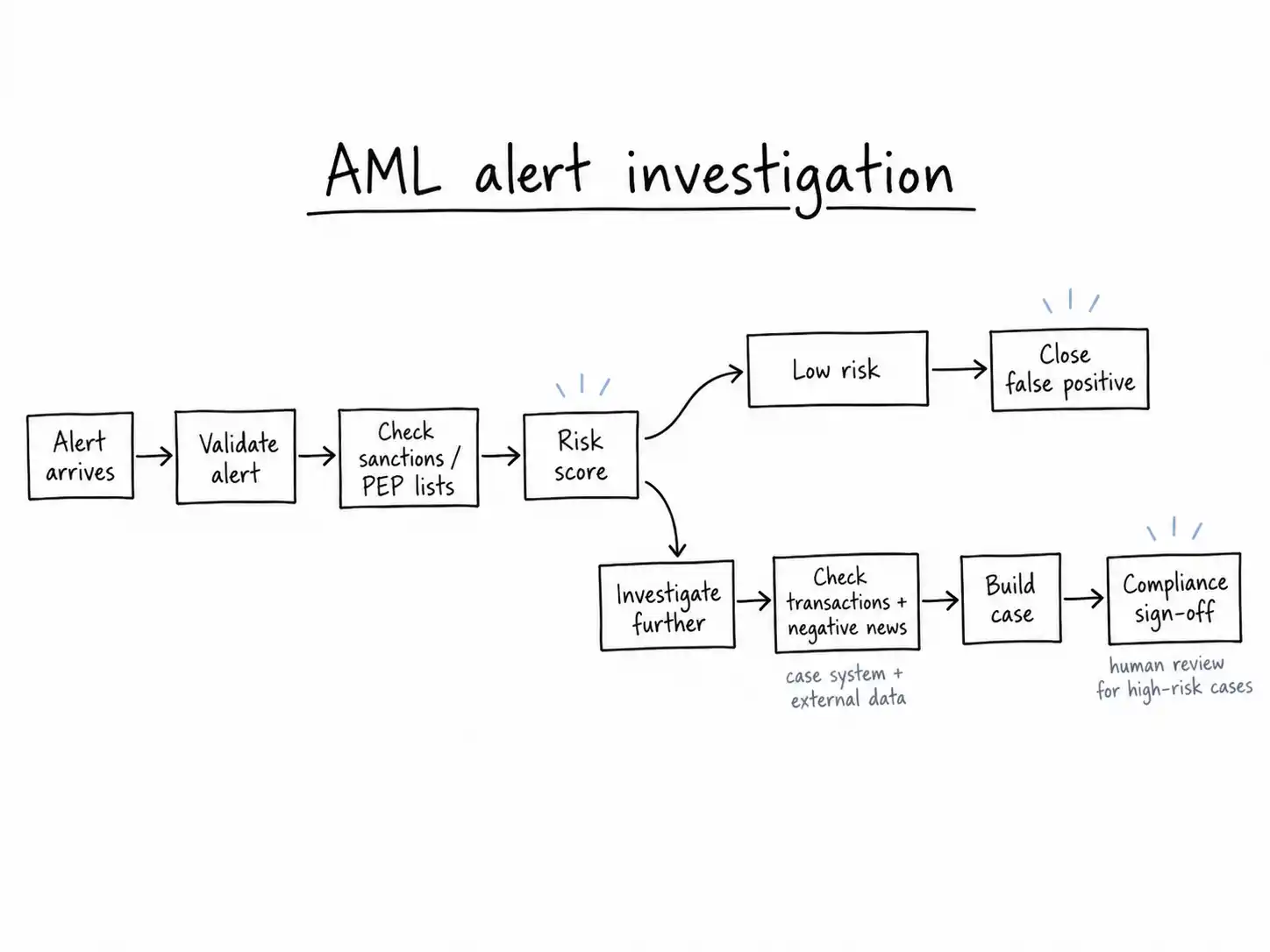
To perform AML checks for a banking institution, an AI agent first has to be set up to validate an incoming alert. It may then need to check the customer or transaction against sanctions lists, Politically Exposed Persons (PEP) databases and other risk indicators.
If the agent considers the customer or transaction to be low risk, it can close the alert or mark it as a likely false positive, within the limits defined by the bank.
If the risk appears higher, the workflow changes.
The agent may then need to:
At this stage, the agent is doing something very different from a fixed automation. It is deciding how far the investigation needs to go based on what it finds along the way.
However, this does not mean the AI agent should also make the final regulated judgment.
For higher-risk cases, the evidence gathered by the agent can be passed to a compliance officer for review and sign-off.
This is an important pattern in agentic AI in banking. The agent can take responsibility for much of the investigative work, while the final decision remains with the person who carries regulatory accountability.
A health-insurance contact centre is another environment where one customer request can trigger work across several systems.
Imagine a policyholder calling to ask why a claim was rejected or whether a particular treatment is covered under the policy they hold.
Before anyone can answer properly, the system may need to verify the member's identity, retrieve policy information, check claim details and understand what has already happened in earlier interactions.
An AI agent built for this kind of work should be able to understand the request, retrieve the relevant information from the insurer's systems and decide whether the case can be resolved automatically or needs to be routed to a human representative.
A major North American health insurer has deployed AI agents broadly along these lines.
The system can authenticate members, understand intent and resolve routine requests. During the conversation, other parts of the workflow can transcribe the call, generate notes and update backend systems.
If the issue becomes more complex, the human representative receives the context that the AI agent has already gathered.
For this insurer, the operating costs of the workflow where the AI agents were introduced dropped by 40%.
For me, the interesting point here is that the value is not coming only from answering the member faster. The AI agent is reducing the administrative work that would otherwise have to be done by a human.
Healthcare also gives us examples where the AI agent should not be allowed to make the final decision. Cancer treatment planning is one such case.
A clinician preparing for a multidisciplinary team discussion may need to review a patient's medical history, imaging, pathology, laboratory results and clinical guidelines before they how the cancer should be staged and what treatment options should be considered.
An agentic AI solution for this kind of work can be designed as a group of specialised agents.
One agent can assemble the patient's clinical history into a structured summary.
Another can evaluate the available evidence against cancer-staging frameworks.
A third can check relevant clinical guidelines and identify treatment options that fit the case.
This is broadly how the Oxford University / TrustedMD system has been designed to operate.
The agents that form this solution work on different parts of the same clinical objective, but the final recommendation is presented to the oncologist for verification.
An appointment scheduling system for patients may look like a simple workflow from the outside. Actually, several systems have to work together for an appointment scheduler to work properly.
Suppose a patient wants to book an appointment with a specialist.
An AI agent could verify the patient's identity. It may then need to check whether the patient's insurance is valid, whether the requested specialist is covered, which providers are available and which appointment slots match the patient's preferences.
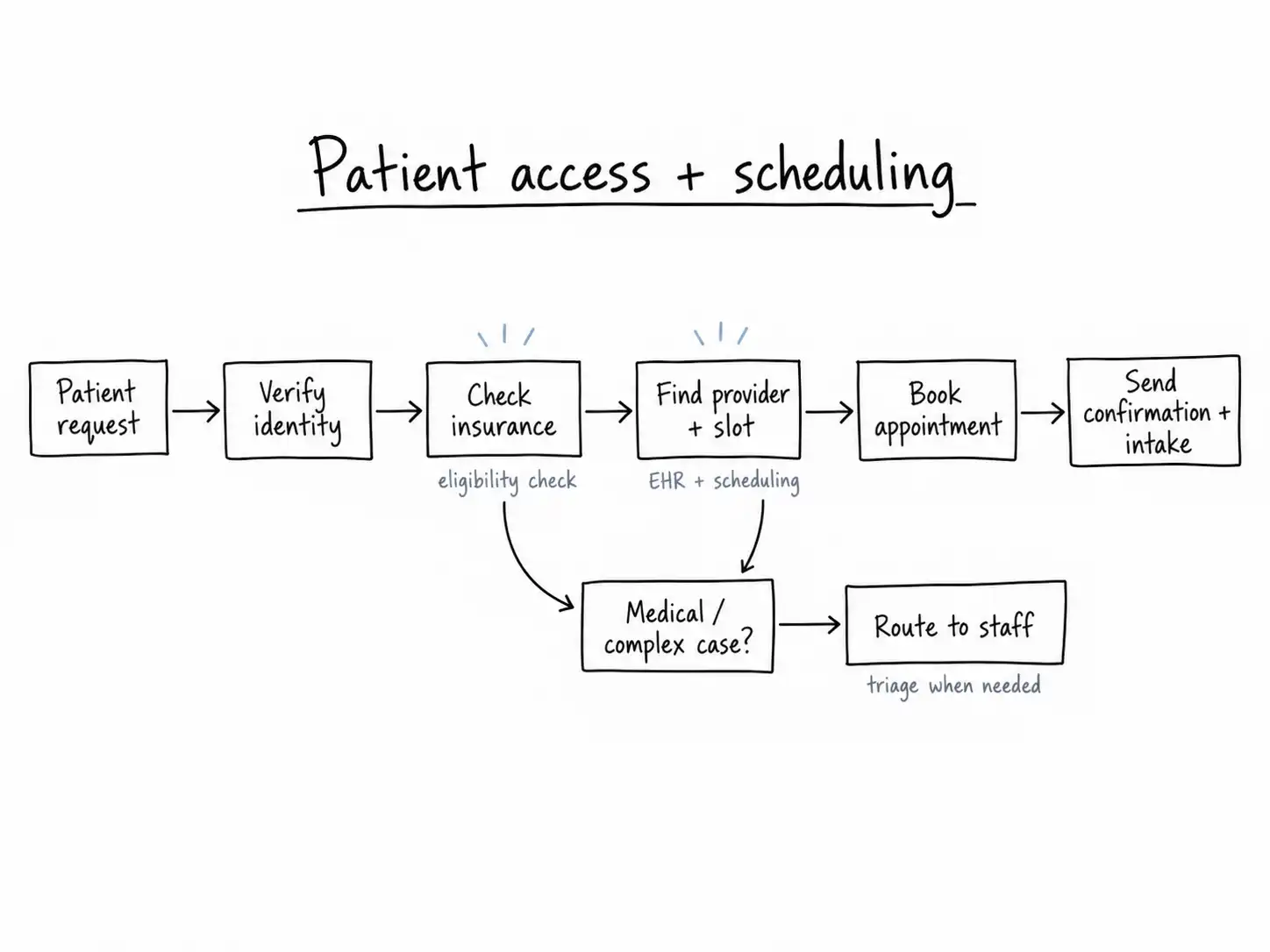
If those conditions are satisfied, the agent can move ahead and book the appointment.
If the request includes a medical issue that requires clinical judgment, the workflow should change and the case should be routed to staff.
A California-based healthcare provider has deployed an agentic system along these lines. This agentic AI solution connects to scheduling tools, EHRs and payer infrastructure. It can verify a patient’s insurance eligibility, find provider availability, book appointments and support digital intake.
The deployment reportedly generated $3.2 million in new revenue and delivered a 468% ROI for the healthcare company.
Also read: AI-Driven Digital Transformation | Future-Proof Your Business
Retail personalisation is nothing new. But agentic AI can take personalisation a step further by deciding not only what message or offer should be shown to a customer, but also whether the customer should be contacted at all, when that contact should happen and through which channel.
An AI agent set up for this kind of work may continuously monitor:
It can then decide whether there is a meaningful reason to engage a particular customer or buyer.
McKesson, a USA-based healthcare corporation, has reportedly used an agentic architecture broadly in this way.
This agentic AI solution brings together behavioural, transactional and CRM data to identify individual decision-makers and detect buying signals. The AI analyst agent then hands over its analysis to an AI outreach agent that can then decide when to trigger personalised communication through channels such as email or SMS.
The reported impact of this agentic AI solution for McKesson was $900 million in new revenue.
Suppose a customer calls up an organization’s helpline number and reports that an order they were expecting to be delivered on a certain day never arrived.
The AI agent cannot simply accept the statement and issue a refund. Instead, it first has to identify the order, retrieve fulfillment data, check shipment status, review the refund policy and determine whether the claim falls within the limits under which it is allowed to act.
If the claim is straightforward and within those limits, the AI agent can issue the refund.
If the information is unclear, or if there are possible fraud indicators, it should stop and escalate the case.
Product search gives us another useful agentic AI in retail examples.
Imagine a customer typing:
“I need something waterproof but smart enough for a coastal wedding in October.”
A traditional search engine may struggle because the customer has not given it a product name or chosen to use search filters.
An AI agent first has to interpret what the customer actually means.
It may identify requirements such as:
A second agent can then search the product catalogue and check which items are actually available.
A third can bring in customer information such as size needs, preferred brands, and budget preferences based on previous purchases.
The system can then assemble a relevant set of recommendations.
Retail companies are already using this kind of a multi-agent approach, and have shown a 6.9% improvement in seasonal sell-through.
Again, what makes this capability agentic is not the ability to understand natural language alone.
It is the ability to convert that understanding into a sequence of actions across catalogue, inventory and customer systems.
The process of recruitment is full of small steps that do not look difficult individually but create delays when every step has to be done by a person.
A candidate may email a set of questions about the role. The recruiter may need to check whether the candidate meets basic requirements. Then someone needs to collect information, find a manager's availability and schedule an interview.
An AI agent can be given responsibility for coordinating much of this process.
Chipotle's Ava Cado recruitment assistant does this broadly.
It communicates with candidates, answers role-related questions, gathers information and performs initial qualification.
If the candidate can move forward in the process, the agent connects to store managers' calendars and arranges interview times.
It also keeps recruitment systems updated as the candidate progresses.
Chipotle reported that application-to-employment time fell from 12 days to four because of this agentic AI capability.
This example is useful because here the benefit is not coming from one major automation but from removing the delays between several smaller tasks.
The recruitment workflow can become even more agentically driven when the system is expected to adapt the assessment itself.
Suppose you are interviewing a software engineer.
If the candidate gives a strong answer to one technical question, the next useful question may be very different from what you would ask someone who struggled with the same topic.
A fixed questionnaire cannot respond to that difference very well, but an AI agent can.
Agentic AI hiring software that have been designed around this kind of skills-based recruitment workflow are already available in the market. Such software can analyse job descriptions and résumés, build candidate skill profiles and conduct interactive video interviews.
The next question during an evaluation or an interview can change depending on how the candidate responds.
The system also connects with enterprise ATS, HRIS and CRM platforms and can support outreach and fraud checking.
This is a good example of an AI agent use case where the decision path itself has to become dynamic.
Internal IT support is another environment where an AI chatbot and an AI agent can look similar on the surface but behave very differently underneath. Let’s consider an example wherein an employee says: “I can't access the finance system.”
A chatbot may explain how access requests normally work, but an AI agent should be able to investigate the issue.
It may check the employee's identity, review account status, look at current permissions, query ServiceNow and determine whether the request falls within an action it is permitted to take.
If so, it may reset access or provision software.
If not, it can create or update a ticket and pass the case to a specialist together with the context it has already collected.
A global confectionery business has deployed an agentic assistant for around 90,000 employees across 34 languages. For them, the reported autonomous resolution rate reached 74%, with an employee satisfaction score of 90%.
For enterprise technology leaders, this kind of use case is particularly interesting because the AI agent is being added to systems and workflows that already exist.
A large government cannot realistically expect one AI agent to understand every policy, service and department equally well.
Singapore's VICA platform is useful because it takes a different architectural approach to address this challenge.
More than 100 virtual assistants operate on the platform, across over 60 public agencies.
Instead of relying on one general-purpose agent, individual assistants remain focused on their own areas of responsibility.
When a citizen raises a request, a central routing layer first receives it, identifies which government service or agency it relates to, and then directs it to the relevant agency assistant.
That assistant can then work with a more tightly defined knowledge base and service scope.
The platform reportedly handles more than 800,000 citizen inquiries each month.
For a CTO running a large enterprise, the architectural lesson is quite practical.
If your organization contains many domains, each with its own systems, rules and permissions, it may be better to build several bounded agents and coordinate them than to create one agent with access to everything.
AI-generated code by itself is not a particularly strong example of agentic AI. But a more interesting use case begins to emerge when an agentic AI system takes responsibility for several stages of the development workflow.
Imagine giving an AI agent a feature request.
The agent first has to understand what needs to change.
It may then break the work into smaller development tasks, modify the relevant code, write tests and run those tests inside the CI/CD environment.
If something fails, the agent can inspect the failure and revise its work.
Once the quality checks is done, the agent can update documentation and prepare a pull request for human review.
Enterprise deployments of these kinds of development and QA agents have reported reductions in QA costs of around 37%.
There is an architectural principle here that I think is especially important. The AI agent is allowed to reason about how to implement the feature. But whether that implementation is acceptable is still tested by deterministic software. That is a sensible division of responsibility.
Contract review is another area where an AI agent can take over a substantial amount of preparatory work without taking over the final legal decision.
Imagine that a new commercial agreement comes in for review. Before a lawyer can decide whether to accept, reject or negotiate its terms, someone has to read the document carefully, identify the relevant clauses and compare them against the organization’s standard positions.
An AI agent can do all this work.
It may find, for example, that an indemnity clause is missing or that a liability provision falls outside the company's standard position.
The AI agent can then flag the issue, explain why it matters and suggest a possible redline.
Salesforce has deployed an LLM-driven contract-review system broadly around this approach.
This system handles the first-pass review and pattern detection, while corporate lawyers retain responsibility for negotiation, interpretation and the final legal decision.
The deployment reportedly reduced administrative legal effort by 35% and annual legal costs by $5 million.
Again, I would not interpret this as AI replacing legal judgment.
The more useful interpretation is that the AI agent takes responsibility for the large amount of preparation that has to happen before a lawyer needs to exercise that judgment.
When you put all 15 agentic AI examples next to each other, there are a few patterns worth paying attention to.
And I would focus on these patterns more than on any individual vendor or technology stack.
Across the examples I explained earlier, the AI agents are touching:
That tells us something quite practical.
If your agent can understand what needs to happen but cannot access the systems required to make it happen, all you have is a copilot.
A second pattern evident from the AI use case examples I listed is that limited autonomy is an enabler for AI workflows.
This principle of ‘limited autonomy’ is worth stressing because all discussions you will come across around agentic AI are such where human involvement is framed as something that is meant to eventually disappear.
The evidence of real world AI use cases points in another direction.
There is another pattern across AI use cases in banking, healthcare, recruiting, support and retail.
The input an AI agent can expect to receive is rarely going to be well formatted and comprehensive.
An AI agent can itself introduce variability in the process because a customer initiated request may be such where the agent needs to request:
The system therefore has to decide what happens next at every stage. rather than simply process every case through the same sequence.
That is where conventional workflow automation begins to struggle and where agentic AI becomes a meaningful answer.
When I look across these agentic AI use cases, that is the larger change I see.
We are moving from systems that help a person perform each individual step to systems that can take responsibility for coordinating a meaningful part of the workflow.
For most enterprises, that is a much more useful definition of agentic AI than the idea of an autonomous machine operating without people.
At Neuronimbus, this is the kind of realism we bring to custom AI agents and automation: understanding where autonomy can genuinely create value, where deterministic controls are still necessary, and where human judgment must remain in the loop. If you are exploring what is realistically possible with agentic AI in your enterprise, we would be glad to speak with you.
Generative AI primarily creates or transforms content such as text, code, images or videos. Agentic AI can use generative models, but it goes further. It can decide what needs to happen next, use external tools or systems, take permitted actions and continue working towards an objective.
The biggest change is that the AI can move beyond answering the customer. It can understand the request, retrieve account or order information, check relevant policies, carry out permitted actions such as refunds or account updates, and pass unusual cases to a person with the context already assembled.
We are currently seeing strong agentic AI use cases in banking, healthcare, retail, customer support, HR, software engineering and enterprise operations. These sectors have something in common, and that is large volumes of digital work, multiple connected systems and processes where the next action depends on what happens during the case.
It can be, but actual safety depends heavily on the architecture and governance of the solution. In agentic AI in banking and agentic AI in healthcare, the stronger designs depend on access controls, audit logs, business rules, action thresholds and human approval for higher-risk decisions
A customer refund workflow is a useful example. The agent can understand the request, locate the order, check delivery and payment information, apply the refund policy, issue an eligible refund and escalate the case if it falls outside the limits it has been given.

Let Neuronimbus chart your course to a higher growth trajectory. Drop us a line, we'll get the conversation started.






Call Us

Schedule a Call


Your Next Big Idea or Transforming Your Brand Digitally
Let's talk about how we can make it happen.