Unplanned downtime is the worst nightmare for a manufacturer, and it costs the world's largest manufacturers $1.4 trillion a year, which is roughly 11% of their total revenue. That single number explains why the leading manufacturers are so keen on AI in manufacturing.

Today, manufacturers use AI primarily in four areas:
Each of these solves a different manufacturing problem. Let me walk you through how AI in manufacturing works.
Manufacturing use cases solved with AI are not spectacular, but solid. The evidence is in the market size. The global market for AI in manufacturing is projected to grow from $34 billion in 2025 to $155 billion by 2030. That is a 35.3% CAGR. 88% of manufacturing organisations already deploy AI in at least one function.
Here is a breakdown of key use cases of AI in manufacturing, with the data dependencies, the typical ROI, and the implementation difficulty:
A few AI in manufacturing examples that can help you visualize this:
Here are a few AI in manufacturing examples that show what this looks like in practice:
BMW’s Regensburg plant wanted to reduce unplanned stoppages on its assembly line but rather than installing new sensors, the team looked at data that was already being collected. Their PLCs and conveyor motor controllers were logging current draw, encoder counts, and cycle times as part of normal operations. BMW built an AI early-warning system on top of this existing data. The system now spots patterns that indicate a conveyor motor or drive component is beginning to degrade, and flags it before it causes a stoppage. The result: over 500 minutes of assembly line disruption prevented per year.
StarKist had a different problem. Their production planning process was taking 16 hours to run through manually. The team integrated machine learning into the scheduling workflow, letting the model evaluate thousands of possible production sequences against the same constraints the planners were juggling by hand. Planning time dropped to under 1 hour.
There is a pattern here that is worth noting: operations is the single largest generator of AI-driven business value in manufacturing, and accounts for 23% of total value.
That visibility is what makes quality inspection one of the most common starting points for implementing AI in manufacturing.
Machine vision is nothing new in manufacturing. However, traditional machine vision works on the basis of fixed rules built around contrast thresholds, edge detection, template matching, etc. A quality inspection system based on machine vision performs well when the product, lighting, and defect shapes are consistent, which isn’t true a lot of the time.
Quality inspection based on human inspection has the opposite problem. It is flexible but slow, and it operates via sampling.
AI based quality inspection in manufacturing solves both problems.
The underlying process for AI based quality inspection in manufacturing is fairly straightforward, although each stage needs to be configured for the products being inspected.
Industrial cameras → Edge AI processing → Defect identification → Quality decision → MES/ERP records
Here is what happens at each stage.
A real-world example can help bring all of this conceptual information together.
Rolls-Royce manufactures turbine blades, and each blade has thousands of tiny cooling holes that must meet exact specifications. The quality inspectors at a Rolls-Royse unit were manually inspecting 2 million of these holes per month. The transition to an AI-driven visual inspection system brought fault resolution to near real-time and boosted machine utilisation by 30%.
The natural companion to catching defects after they happen is preventing the machine failures that cause them in the first place.
Most manufacturing equipment is maintained using one of two approaches.
The first is reactive maintenance, where a machine is repaired after something breaks.
The second is preventive maintenance, where equipment is serviced according to a fixed schedule.
Imagine a motor that has been operating normally for several months. As a bearing begins to wear, the machine may continue functioning, but its vibration pattern could gradually change. Temperature or electricity consumption might also increase slightly.
Individually, these changes may not be large enough to trigger a conventional alarm.
But AI can examine several operating signals together and recognize patterns associated with equipment deterioration.
The process generally follows four stages.
Machine sensors → AI analysis → Early warning → Maintenance inspection → Planned repair
Sensors and existing machine controllers pick up signals like:
Raw readings on their own are not enough. They need to be collected over time and tied to the machine's actual operating conditions at that moment.
Why does this matter? Because a motor naturally vibrates more under heavy load. A compressor draws more current during peak cycles. The system needs to tell the difference between normal variation caused by operating conditions and genuine signs that something is wearing out. Without that context, you get false alarms — and false alarms erode trust fast.
This is where machine learning comes in. Models such as Random Forest, XGBoost, or neural networks look at equipment behaviour across multiple signals simultaneously. Depending on what data is available and how the system has been trained, the model might flag an unusual condition, narrow it down to a likely failure type, or estimate how much useful life a component has left.
The key point is that the model is looking at combinations of signals that a human monitoring a single dashboard would struggle to spot — slight changes across vibration, temperature, and current that individually seem fine but together suggest a bearing is three weeks from failure.
When the system identifies a potential problem, it notifies the maintenance team — or, in more mature setups, creates a work order directly in the Computerised Maintenance Management System (CMMS).
The team can then go inspect the equipment, confirm the issue, and schedule the repair during planned downtime rather than dealing with an emergency stop at 2am on a Tuesday.
Here is an example of AI in predictive maintenance:
Ford implemented AI predictive maintenance across its commercial truck manufacturing cells. The result: 122,000 hours of saved downtime and $7 million in cost avoidance, with the system predicting nearly a quarter of equipment failures 10 days in advance.
Maintenance and quality inspection address what happens inside the production facility. But manufacturers also have to decide what to produce, how much material to order, and how to make the best use of their available production capacity. This is where demand forecasting and inventory planning come into the picture.
Traditional demand forecasting relies on statistical models like ARIMA or exponential smoothing. These work mostly off historical sales patterns — what sold last quarter, what the seasonal trend looks like, and so on.
The trouble is, demand does not just depend on what happened before. A lot of other things influence it, and most of them sit outside your sales history.
AI-based manufacturing demand forecasting helps manufacturers bring many more of these variables into the planning process — things that affect future demand but that a traditional model has no way of seeing.
An AI forecasting model can look at historical sales alongside a much broader set of information:
The AI learns relationships between these variables and demand for different products. Not just correlations, but the non-linear interactions between them — the kind of patterns that a spreadsheet with ARIMA coefficients simply cannot capture.
More advanced setups also let manufacturers run scenario planning. What happens if demand for a key product line jumps 20% next month? What if a second-tier supplier goes offline for two weeks? The model can stress-test your inventory position against these scenarios before they actually happen.
Of course, a better demand forecast is only valuable if it actually feeds into purchasing and production decisions.
Say the AI forecasts a 20% demand increase for one product over the coming month. The inventory planning layer can check whether you have enough raw materials on hand, how long it would take to get more, and whether your current safety stock covers the gap. It can then flag recommended changes to purchase quantities or reorder timing — before the shortage shows up as a missed delivery.
A few real-world results that show this working in practice:
For small manufacturers: AI for demand forecasting is the most accessible entry point for small manufacturers to use AI. Unlike predictive maintenance or vision inspection, demand forecasting is primarily a software play. There are no sensor retrofits, no edge hardware, no camera installations needed. If your ERP has 12 or more months of transaction history, you have enough data to start.
Every AI use case in manufacturing sits on top of the same four-layer technology stack. If any layer is broken or siloed, the model above it will underperform, regardless of how sophisticated the algorithm is.
Consider a factory that wants to introduce predictive maintenance for its pumps.
The SCADA system may already record temperature, pressure, and operating status. The MES may contain information about the production activities involving those pumps.
Meanwhile, the ERP or maintenance system may store repair costs and historical maintenance records.
Now, an AI application needs to connect this information to understand what happened to a particular machine and under what operating conditions.
This creates a data integration challenge.
For example, the same pump might be identified as:
A human engineer may recognise that these identifiers refer to the same equipment. But an AI system needs that relationship to be established explicitly.
Manufacturers therefore need a consistent way to identify equipment, connect timestamps, and associate operational events with the correct machines and production activities.
Standards such as ISA-95 can help organise information across manufacturing and enterprise systems.
Once the data foundation is in place, the question becomes how to actually roll this out without getting stuck in pilot purgatory.
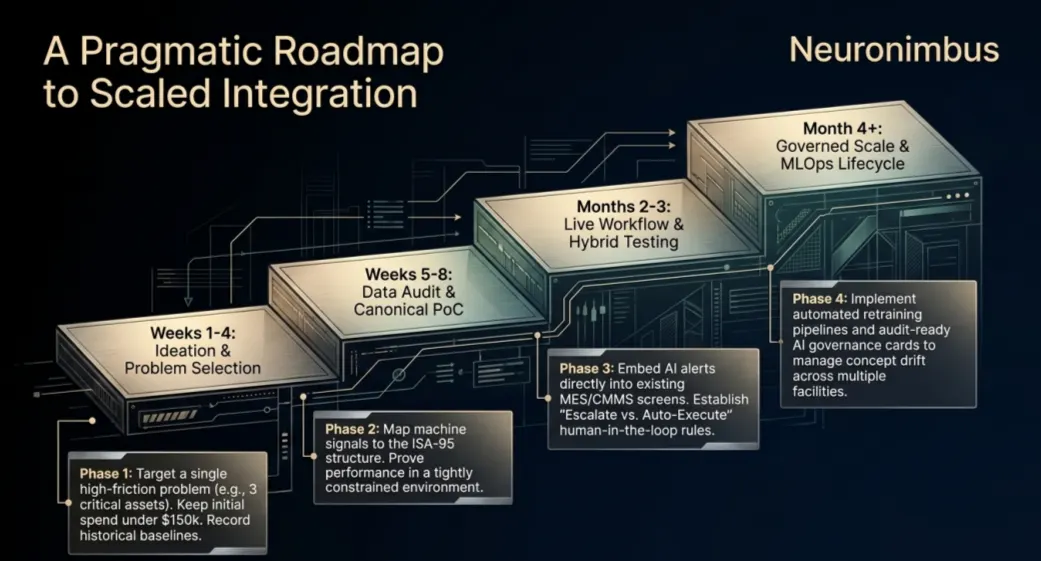
I would recommend implementing AI in manufacturing in stages.
This allows the manufacturer to establish whether the technology works under actual operating conditions and whether the improvement justifies further investment.
A practical implementation process has four phases.
Typical Timeline: Weeks 1–4
Main Activities:
Typical Timeline: Weeks 5–8
Main Activities:
Typical Timeline: Months 2–3
Main Activities:
Typical Timeline: Month 4 onwards
Main Activities:
Begin with a recurring problem that has a measurable impact on operations.
For instance, suppose a manufacturer experiences frequent unexpected stoppages on a critical CNC production line.
The team should establish how much downtime the line experiences, what causes the stoppages, and what the resulting production losses cost.
This provides a baseline against which the AI application can be evaluated.
The next step is to examine whether the required information is available and reliable.
For a predictive maintenance project, this might involve analysing motor current, vibration, temperature, and maintenance records.
The team can then build and test a model on a limited number of machines.
A prediction has limited value if it remains inside a dashboard that nobody regularly checks.
For example, when the AI system identifies possible equipment deterioration, the result should reach the maintenance team through its existing workflow.
This may mean creating an alert in the CMMS or presenting information on the MES interface.
The team also needs to establish which decisions can be automated and which require human approval.
Once the application demonstrates value, the manufacturer can extend it to other machines, production lines, or facilities.
The expansion also requires ongoing monitoring.
Machine behaviour changes as equipment ages, products change, and operating conditions evolve. AI models may need recalibration or retraining to maintain their performance.
The objective is to move from a successful technical pilot to a dependable operational system.
This is also where working with a technology partner that understands AI development, enterprise integration, and deployment can be useful. At Neuronimbus, we provide these capabilities through our Industry AI Solutions services.
The cost of deploying AI in manufacturing use cases varies considerably and depends on the application, the number of machines or production lines involved, and the condition of the existing technology infrastructure.
The following are indicative project-level estimates I have been able to compile from market research.
These ranges describe relatively substantial deployments. Smaller pilots, particularly those using existing infrastructure, may cost considerably less.
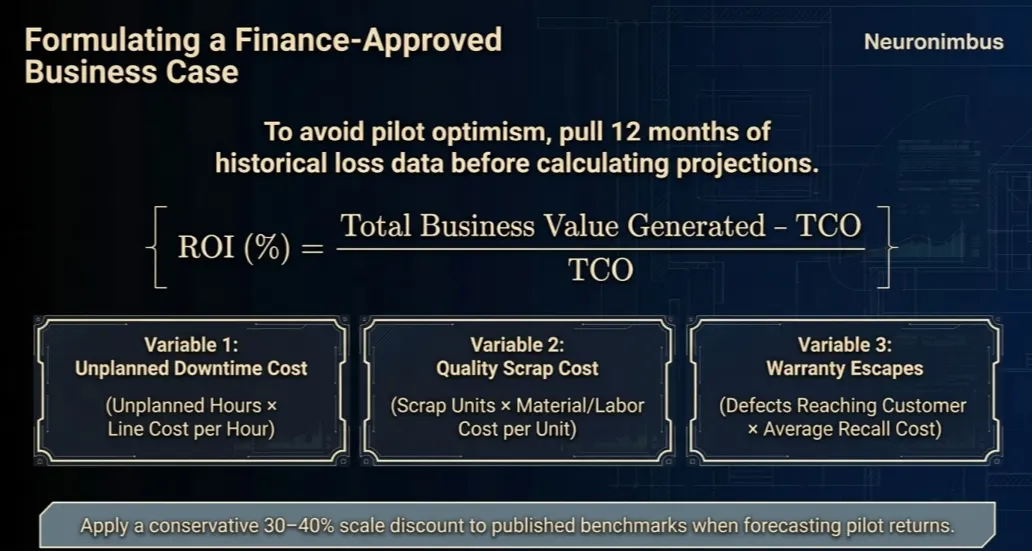
For this reason, ROI should be calculated using total cost of ownership rather than only the initial software development cost.
Let me walk through a concrete scenario with stated assumptions.
A mid-size manufacturer has one CNC bottleneck line. Unplanned downtime on this line: 200 hours per year. Line cost: $5,000 per hour. That puts the annual loss from this single bottleneck at $1,000,000.
Predictive maintenance deployment cost: $250,000. This includes sensors, edge hardware, integration with the existing CMMS, and operator training.
Conservative downtime reduction (applying the standard 30–40% scale discount to published benchmarks): 30%. That gives you $300,000 in savings in year one.
After ongoing MLOps and model maintenance costs of roughly $60,000 per year, the net payback period is approximately 10 months. Cumulative ROI by the end of year two: roughly 140%.
That is using conservative assumptions. Published Deloitte benchmarks report an average 10:1 ROI within 24 months for well-executed deployments.
The important part is establishing a credible baseline and using actual operational results rather than assuming that a particular percentage improvement will occur.
Even when the financial case is attractive, there are operational challenges that need to be addressed.
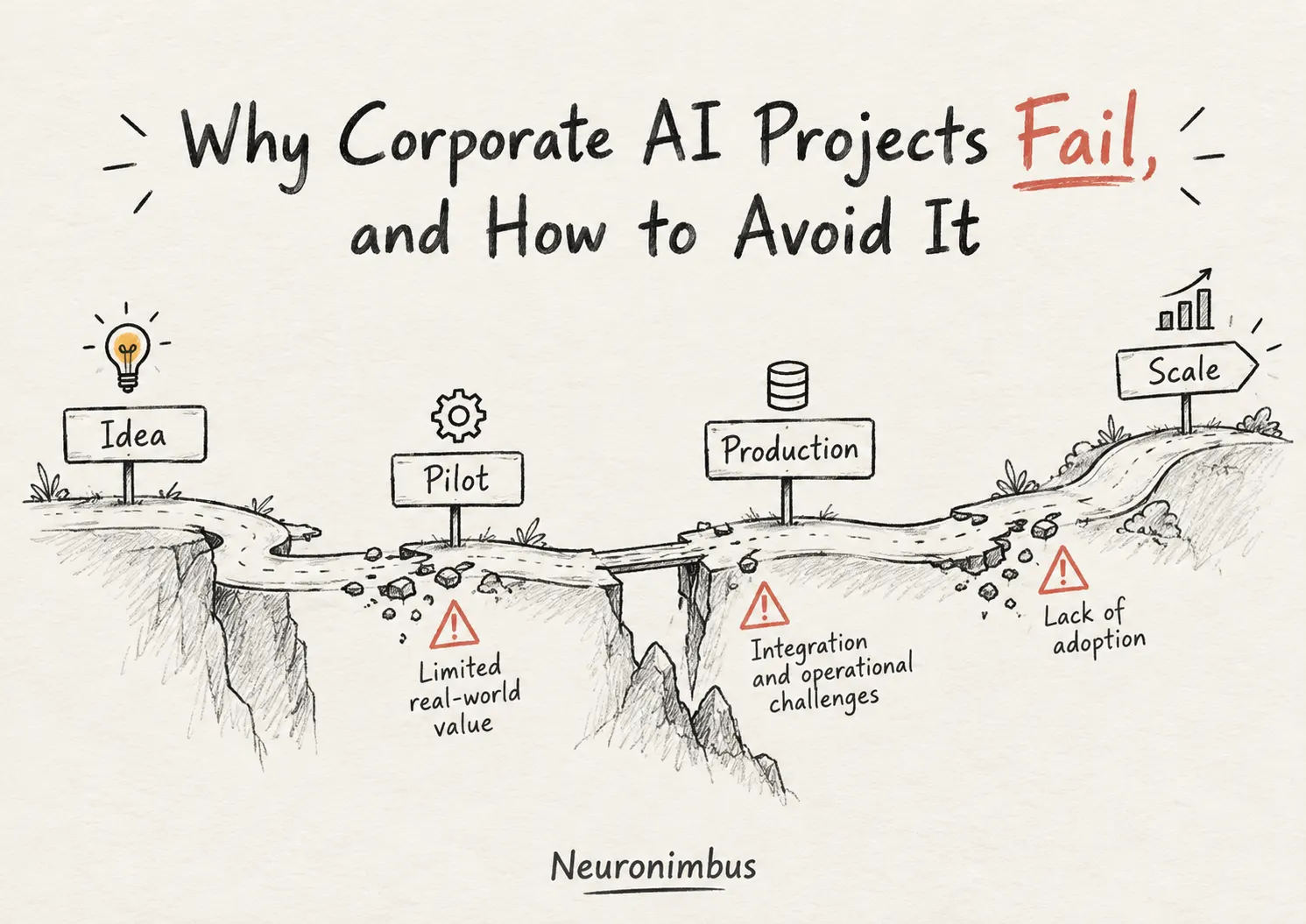
76% of manufacturing AI projects fail to scale beyond the pilot phase. That is a striking number given the ROI figures we have just covered. The reasons are structural, and more importantly, they are avoidable if you plan for them.
IT systems communicate via modern REST APIs and SQL. Operational Technology (including PLCs, SCADA) uses proprietary industrial protocols like Modbus and Profibus. Terminals from these two worlds were never designed to talk to each other. To bridge this gap, engineers require custom protocol gateways, and this integration work consumes 40–50% of deployment budgets.
This is the PMP-07 / Pump 7 / EQ-2047-B problem we covered in the data section. If your systems cannot agree on which physical asset a data point refers to, the AI model has no coherent picture to learn from.
Cameras and sensors on factory floors are subject to severe vibration, dust, electromagnetic interference, and ambient temperature swings (sometimes from 10°C to 45°C within the same facility). As a result, hardware that works perfectly in a clean lab may degrade within weeks on a production floor.
This is the human problem, and it may be the most important one on this list. When an AI system produces excessive false alarms in its early stages, operators lose trust. Once trust is lost, it is very difficult to rebuild it. Studies show that operators override up to 73% of AI recommendations when they have not been involved in designing the workflow.
AI that dynamically adjusts machine parameters such as temperatures, pressures, speeds can inadvertently violate OSHA safety interlocks, UL equipment parameter limits, or functional safety certifications like ISO 26262. These violations carry real liability.
Mitigation: Build compliance into your governance framework from the start. Retrofitting regulatory documentation after deployment is far more expensive and disruptive than including it from Phase 4 onwards.
There are several promising applications of AI in manufacturing, but the right starting point will be different for every manufacturer.
I would begin by identifying one operational problem with a measurable financial impact.
If the application works, the manufacturer has a practical foundation for extending AI to other operations.
The objective should be to solve manufacturing problems, not simply to introduce more technology into the factory.
If you are evaluating where AI fits in your operations, our Industry AI Solutions practice helps manufacturing teams move from assessment to production deployment.
Reduce downtime, improve quality control, and optimise production with AI solutions tailored to your operational needs. Neuronimbus helps manufacturers identify practical AI use cases, integrate systems, and move from pilot projects to production deployment.
Choose a problem with measurable losses and sufficient existing data. Predictive maintenance, quality inspection, and demand forecasting are common starting points, but the best choice depends on the facility's operations.
Yes. A smart inventory management system for small manufacturing units can use existing sales, purchasing, and inventory records. Small manufacturers can also begin with narrowly scoped quality inspection or equipment monitoring projects.
There is no fixed minimum. Anomaly detection may begin with representative normal operating data, while predicting specific equipment failures generally requires historical failure records.
AI can automate certain inspection, monitoring, and planning activities, but workers remain necessary for maintenance, exception handling, and operational decisions.
A focused pilot may take approximately eight to twelve weeks when the relevant data and infrastructure are available.

Let Neuronimbus chart your course to a higher growth trajectory. Drop us a line, we'll get the conversation started.


Call Us

Schedule a Call


Your Next Big Idea or Transforming Your Brand Digitally
Let's talk about how we can make it happen.