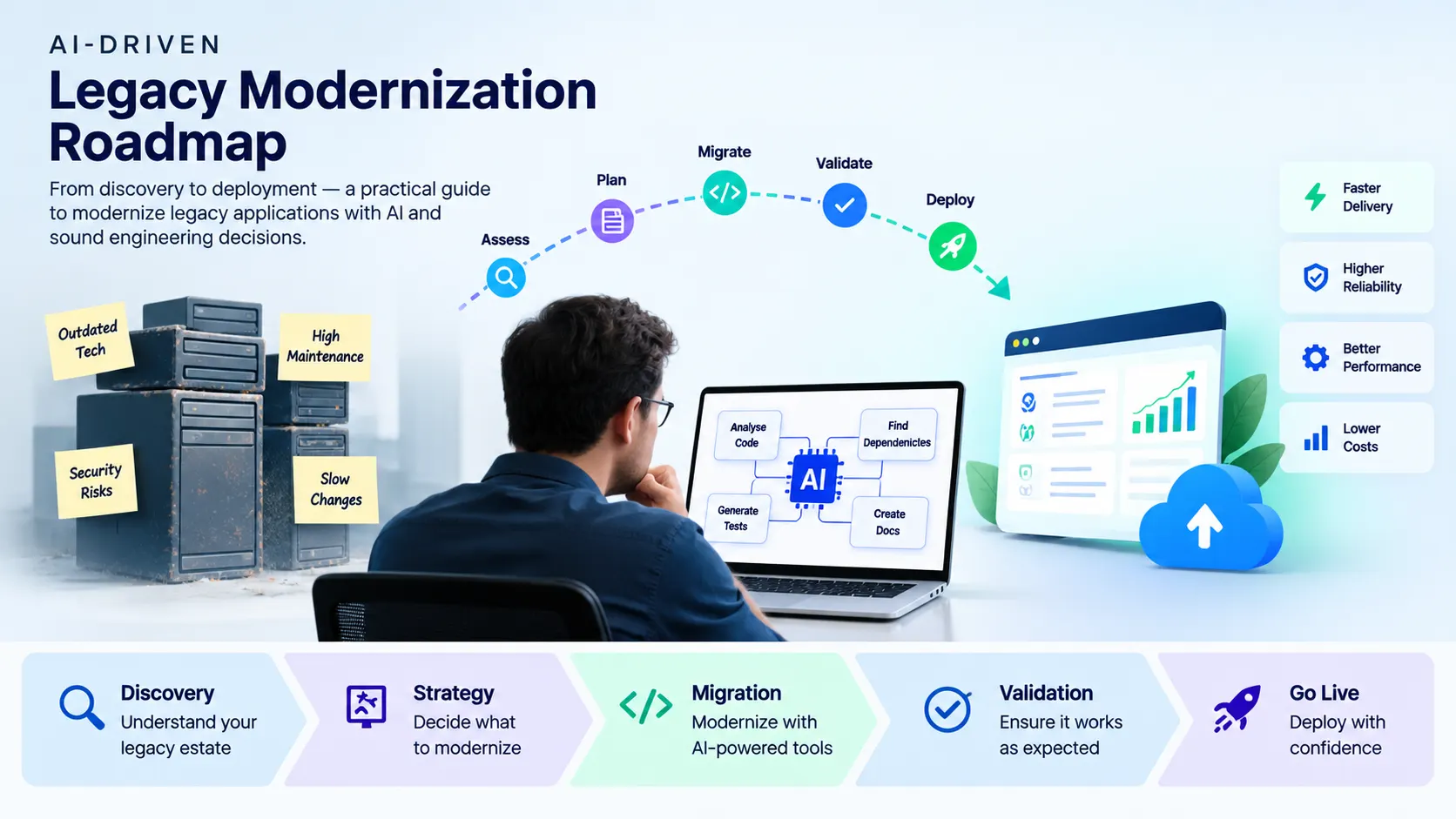
As an IT leader at an enterprise, you may not decide to modernize an application simply because it is old, but because the application has started making something important harder.
For instance:
At that point, you need to decide what should change, what should remain untouched, and how to make that transition without disrupting a system your business may depend on every day.
AI gives you some genuinely useful new options here. It can accelerate discovery, documentation, legacy code migration and testing.
But good legacy application modernization services still depend on sound engineering decisions.
So, in this AI legacy modernization roadmap, I want to separate what AI actually changes from what you still need to decide for yourself.
To judge whether AI really changes legacy modernization, it helps to look at two of the hardest parts of the work.
First, you have to understand the application you already have.
Then, you have to transform it without losing the business logic and behaviour.
Let's start with discovery.
Imagine you are responsible for a large application that was built over many years in Java, .NET or COBOL. The application itself may contain thousands of modules and database procedures. Then there might be scheduled jobs, shared databases, file transfers and point-to-point integrations that connect the application with other business systems.
The difficulty is that you may not have one reliable document that shows how all these pieces work together, as your architecture diagrams may be several years old. Some interfaces may never have been formally documented. You may even find code that looks unnecessary until an experienced engineer explains that it was added years ago to handle a particular billing exception or production issue.
So before you modernize the application, your team has to reconstruct this picture. This discovery process is one of the first places where AI can materially change the work.
AI-assisted coding and IT management tools can analyse source code, database relationships, APIs, configuration files and available documentation together. They can help your engineers trace dependencies and explain unfamiliar code. They can also assist engineers to generate missing documentation and identify business rules buried inside older programs.
That is one practical answer to how AI helps with legacy application modernization.
The second change is in legacy application transformation itself.
Modern AI code migration tools for legacy systems can help your team generate tests, convert repetitive code patterns, upgrade frameworks and propose equivalent implementations in newer technologies.
But you should not treat this as automatic code conversion.
For transformations where the rule is known, deterministic tools are a safer choice. AI is more useful when the task requires interpretation. Your engineers still need to review the result, test its behaviour and decide whether the proposed design belongs in the target architecture.
So AI can make modernization faster. It cannot tell you which parts of your technology estate are worth modernizing in the first place.
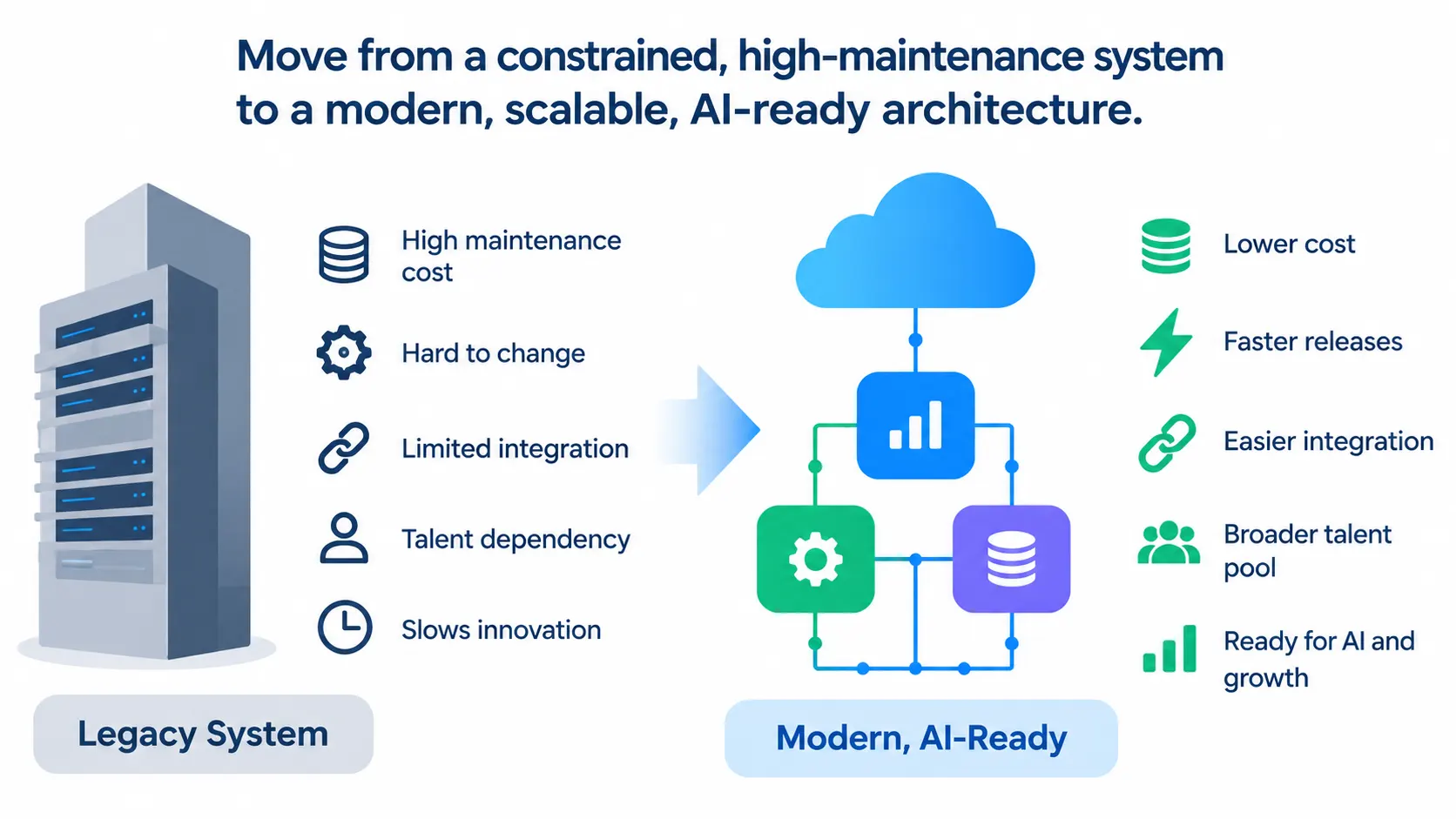
That decision comes next.
If you have 50, 100 or 500 applications, it will be a mistake to treat all of them as modernization candidates.
Start by asking two questions about each important application:
You can use this matrix to decide how to deal with different legacy applications:
However, the matrix only looks simple; the work behind the actions it suggests is not.
To evaluate technical health, you need to understand code complexity, security exposure, unsupported technologies, performance limitations and maintainability. You also need to know how tightly the application is connected to everything around it.
To evaluate business value you need the same care. Ask what process the application supports, how many customers or employees depend on it, whether it creates competitive differentiation and what happens if it becomes unavailable.
This is where legacy system modernization becomes a portfolio decision rather than a technology refresh.
You may discover, for example, that an old application has significant technical debt, but supports a process you intend to retire in two years. A major technical debt reduction program would probably make little economic sense in such a case.
You may discover another application that may look healthier but is also a critical part of a new digital workflow. That could make it a higher modernization priority.
With AI-assisted dependency analysis, you can make this assessment faster, but the analysis cannot assign business significance to everything it finds.
If a stored procedure is called only four times a year, an automated tool may reasonably classify it as low usage. Your finance team may tell you those four executions produce the company's statutory year-end calculations.
So you need both the views.
Your application modernization roadmap should therefore come from business value, technical condition and dependency risk together.
Once you know what deserves investment, you can decide what kind of modernization each application needs.
You do not need one modernization strategy for your entire technology portfolio.
In practice, the best legacy modernization strategy for enterprises is a combination of approaches. The important part is to match the intervention to the problem you are trying to solve.
The four strategies differ mainly in how much of the existing application you choose to keep.
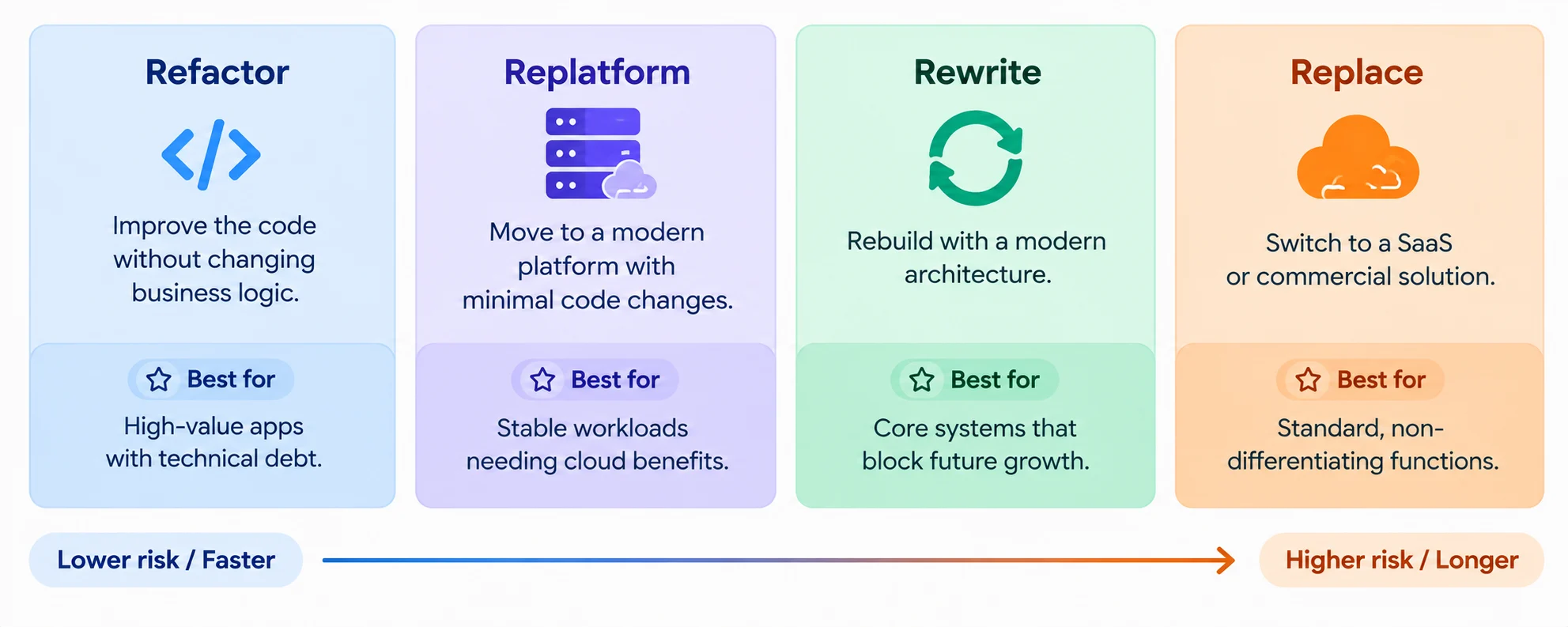
For example, you may have a Java application with business logic that is still valuable, but it runs on an outdated framework, contains tightly coupled modules and takes too much effort to change. You can refactor parts of the application, improve its internal structure and remove technical debt without changing what the application fundamentally does.
This approach lets you preserve proven business logic. The challenge is making sure that the refactoring does not alter existing behaviour, which is why strong regression and integration testing matters.
You may, for example, have an application running on infrastructure you want to retire. Moving it to containers, a managed database or a cloud platform can reduce infrastructure and operational constraints without requiring you to redesign the whole application.
This can be a sensible part of a cloud modernization strategy, particularly when you need a faster data-centre exit. But be clear about what you have achieved. If the application had tightly coupled code before the move, it will still have tightly coupled code afterwards. Replatforming modernizes the platform, not necessarily the application architecture.
Suppose you have a core application where every new capability requires changes across several tightly connected modules. If that architecture is limiting scale, release frequency or integration with newer systems, incremental refactoring may not take you far enough.
You can redesign selected capabilities around clearer service boundaries, APIs or event-driven patterns. This gives you more architectural freedom, but also creates more risk.
This is the important distinction in legacy modernization vs full rewrite. When you rewrite an application, you are not only replacing old code. You are also trying to reproduce years of business behaviour, including exceptions that may not exist in your current requirements documentation. For that reason, I would choose a full rewrite only when the existing architecture gives you a strong enough reason to accept that additional risk.
If an old application handles a relatively standard function, a mature SaaS or commercial platform may give you a better outcome than another internal development programme.
Your work then shifts from code modernization to data migration, configuration, integration and change management.
So, you should not ask which of these four strategies is universally better. Ask which one removes the specific constraint you identified during assessment.
In fact, your application modernization roadmap may use all four. You could replace an old HR application, replatform a stable internal system, refactor a valuable customer application and rearchitect selected parts of a core transaction platform.
The objective is not to modernize every application in the same way. It is to make the least disruptive change that gets each application where your business needs it to go.
For a business-critical application, I would not treat modernization as one long build.
A more manageable legacy application modernization roadmap for 2026 would be one where you can break the work into stages:
Map → Understand → Migrate → Validate → Govern
With each stage, you can reduce a different type of uncertainty before you take the next step.
Before you change a component, establish all its touchpoints in the IT landscape.
In an older application, that dependency may be obvious, such as an API call. But you could be dealing with a database table that is read directly by another system.
You can use source analysis, runtime information, database metadata, configuration and existing documentation to build a map. AI can help your engineers connect information that would otherwise have to be traced manually.
Once the above is done, define the first migration boundary.
Do not begin with "modernize the order-management system" if order management touches inventory, payments, customer records, fulfilment and reporting.
Find a capability you can isolate, change and validate without having to move everything around it at the same time.
By doing this, you can give your legacy code migration a controlled starting point.
AI can help explain code, trace data transformations, document interfaces and extract conditional logic from older programs. For large applications, AI can generate knowledge graphs and retrieval systems to give engineers a way to navigate relationships across repositories.
But there is one distinction you should keep throughout the program:
The code can show you what is happening. It may not tell you why it is happening.
Imagine you find an unusual rule, for example, a rule to exclude certain transactions from an automated process.
Technically, AI may explain the condition perfectly. What it cannot reliably establish is whether that condition is an obsolete workaround, a customer commitment or a regulatory need.
So, you will need to document those recovered rules and ask questions from the people who understand the business process.
Before you start the migration, agree on the behaviour that must be preserved, the behaviour that should change and the behaviour nobody needs anymore.
If the application cannot simply be switched off while you rebuild it, you can use the strangler fig pattern as your migration model.
Do not replace the entire legacy application at once. Instead, introduce a routing or abstraction layer in front of it.
Users and channels
↓
API gateway / routing layer
↙ ↘
Legacyapplication Modern services
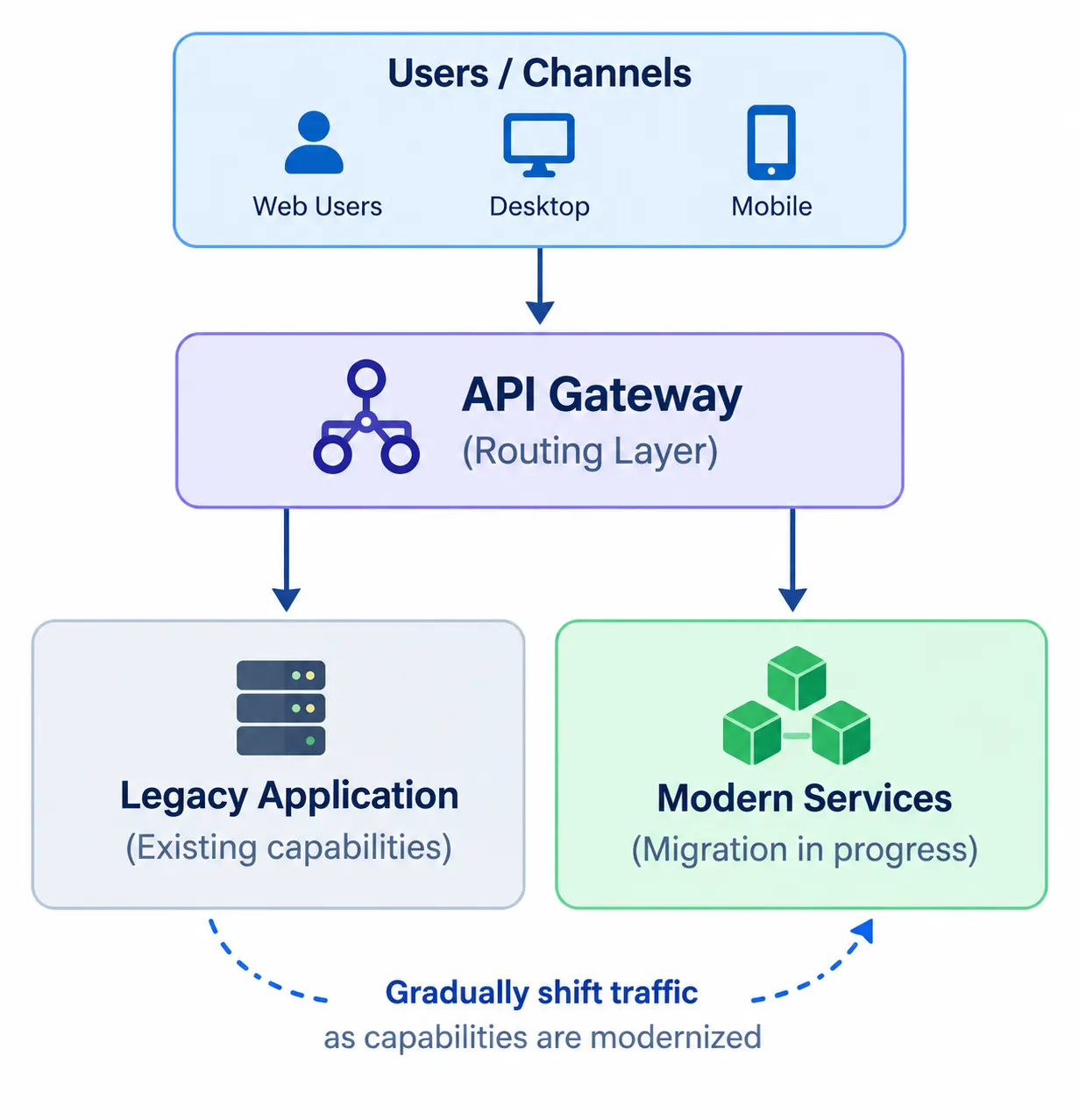
At first, the legacy application should continue to serve most requests.
As you extract and validate capabilities, the routing layer can direct those requests to the new implementation.
Old and new components can therefore coexist while modernization goes on. This is one practical answer to how to modernize a legacy application without downtime.
However, application routing is only half the problem.
You also need to decide who will own the data while the old and new components coexist.
Suppose both systems can update the same customer record. You now have to manage synchronization, consistency and failure scenarios. Depending on the application, you may use change data capture, events or an integration layer to manage the transition.
AI can help you produce migration code faster. That makes testing even more important.
Before you change a component, establish its existing behaviour.
AI-assisted tools can generate unit, integration and contract tests from source code, interfaces and existing specifications. Your engineers can then expand those tests around business-critical scenarios and known edge cases.
For each migrated capability, ask your engineers to validate several things separately:
For critical systems, you can go further and mirror production traffic to the new component without allowing it to execute the real transaction. You can compare the old and new outputs to expose differences that synthetic tests might not anticipate.
The important point is that your acceptance criteria should remain explicit and testable.
You should not use one AI model to generate code and another to tell you that the generated code looks correct.
Governance of modernization should not begin just before production.
Decide early which AI-generated changes will require engineer review, which changes need domain approval and which automated gates must pass before deployment.
Record important architectural choices as well. Six months down the line, your team should be able to understand not only what was changed but why a particular service boundary, data pattern or migration approach was chosen.
Then instrument the new components.
If you establish performance, reliability and delivery baselines before migration, you can later determine whether the modernization actually improved anything.
By this stage, you can see several places where AI can reduce the manual work involved in modernization. But there is an equally important question to ask: which parts of the work should you not hand over to AI?
The distinction becomes clearer when you separate the tasks AI can assist with from the decisions for which your engineers and business teams still need to remain accountable.
My rule would be straightforward:
Use AI to reduce the work required to reach an engineering decision. Do not use it to remove accountability for that decision.
And if AI is reducing that work, you should be able to demonstrate the improvement in business and engineering terms.
Do not measure a modernization program primarily by how many lines of code are able to convert.
You can migrate every line and still end up with an application that is expensive to change.
Before modernization begins, establish a baseline for the things you actually want to improve.
Pair every speed or cost metric with a quality measure. You also need to be realistic about the investment when you assess the cost of legacy application modernization services. Include engineering, discovery, AI tooling, cloud infrastructure, security, data migration, testing, training and governance.
AI gives you better tools for some of the hardest work in legacy modernization.
You can use these tools to understand unfamiliar code faster, reconstruct missing documentation, trace dependencies, accelerate repetitive transformations and build broader test coverage.
But the objective is not simply to convert more code with AI.
You still need to decide what is worth changing, which existing behaviour needs to survive, what the target architecture should look like and how you can make the transition without creating unnecessary business risk.
That is also how we approach legacy application modernization services at Neuronimbus.
We work with technology teams across the modernization journey, from understanding legacy applications and defining the right modernization path to application engineering, integration, cloud architecture, AI-assisted transformation and production deployment.
The goal is not to move yesterday's complexity into a newer technology stack. It is to leave you with applications that are easier to understand, integrate, operate and change as your business moves forward.
If your organization is considering legacy application transformation and wants to determine the right way forward, we should talk.
The cost of legacy application modernization services depends on application size, technology, integrations, data complexity, security requirements and the target architecture. Ask providers to separate discovery, application work, data migration, testing, infrastructure and ongoing operating costs.
A contained application may be modernized in months, while a large core platform can require a multi-year program.
Yes. AI can help explain COBOL, document existing programs, identify dependencies, generate tests and assist code transformation.
Yes, although you will need stronger discovery. Source analysis, runtime logs, database structures, version history and AI-assisted code analysis can reconstruct much of the technical picture.
Not necessarily. Keeping the existing database temporarily can reduce the number of variables in an application migration. In other cases, the database schema itself may be the main constraint. Make the decision based on data ownership, consistency requirements, performance and downstream dependencies.
Not by itself. A cloud move can improve infrastructure flexibility and remove data-centre dependencies, but the application may retain the same tightly coupled architecture and technical debt.
Start by reconstructing documentation from the system itself. Code analysis, dependency mapping, database metadata, logs and AI-assisted explanation can establish how components interact. Then validate the reconstructed picture with business users and experienced operations staff before making significant changes.
Consider retirement when usage and business value are low, another system already provides the capability, or the underlying business process is disappearing. Removing an unnecessary application can reduce cost and complexity more effectively than investing in technically improving it.
Let Neuronimbus chart your course to a higher growth trajectory. Drop us a line, we'll get the conversation started.






Call Us

Schedule a Call


Your Next Big Idea or Transforming Your Brand Digitally
Let's talk about how we can make it happen.