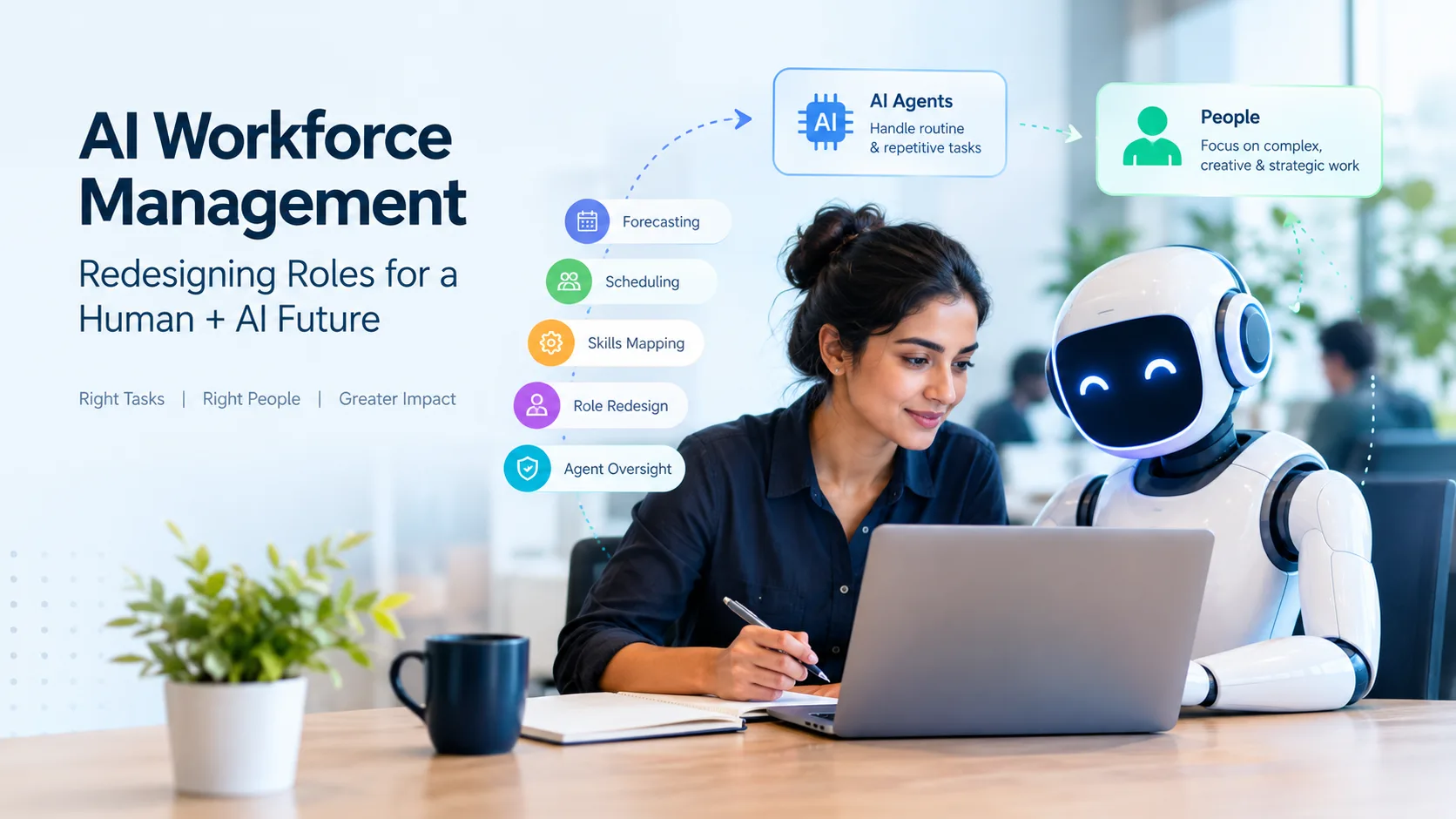
The BCG Henderson Institute studied 165 million US jobs across 1,500 roles. They found that in 43% of those jobs, more than 40% of the tasks that make up the role can now be performed by AI. That is a meaningful threshold, as once nearly half the tasks in a role are automatable, you cannot simply hand someone a new tool and keep the role unchanged. The role itself needs to be redesigned.
This is what AI workforce management actually means. You look at every role in terms of the tasks it contains, figure out which of those tasks an agent can own, and then rebuild the role around the tasks that still require a human.
In this guide I will try to offer a practical framework for AI workforce management.
Let us start with what the term actually means, because it gets confused with something else entirely.
AI workforce management is the practice of redesigning how work gets split between your people and AI agents, at the task level.
It covers the full operational surface:
One of the most common mistakes I see organizations make is applying a single mental model which essentially says "AI handles the routine stuff, humans handle the complex stuff", uniformly across every function. The reality is that different roles change in different ways depending on two factors: how much of the role's task load is automatable, and whether demand for that role's output is growing or fixed.
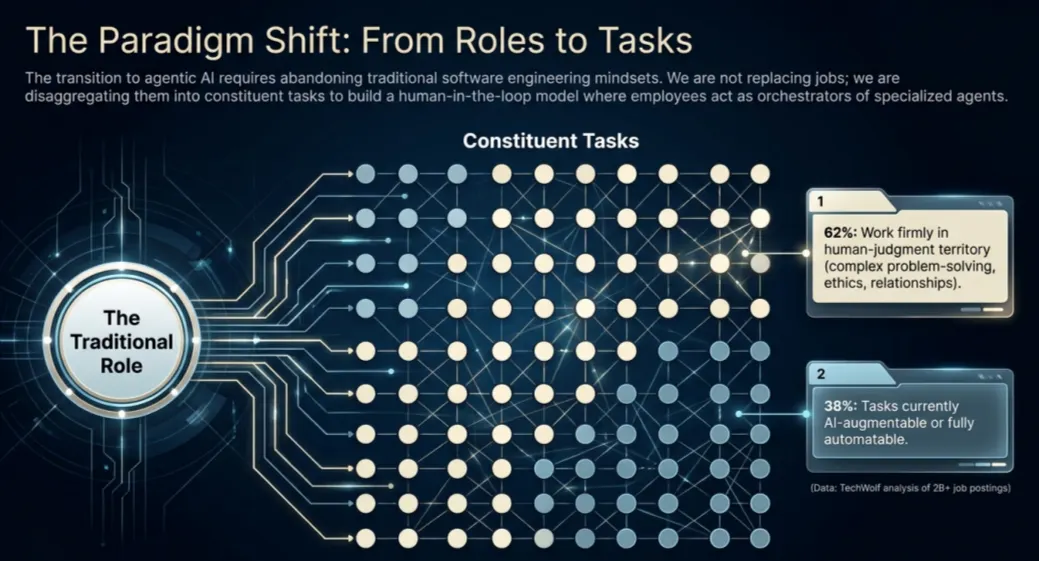
The BCG Henderson Institute maps the impact of AI on roles into three categories, and I think their framework is the most useful one available for making practical decisions.
These are the positions where demand for the output is relatively fixed and AI agents can perform the core tasks directly. Think of a role where the volume of work is not going to grow just because you can do it faster. When you automate those tasks, the role shrinks.
To see what this looks like in practice, consider Stitch Fix. They replaced their manual onboarding process with automated, mobile-first hiring workflows. The result was that candidate completion rates jumped from 68% to 95%, which is a major improvement in output quality. But it also meant fewer people were needed to run the process. The role delivered better results with a smaller team.
These are the roles where AI gets embedded into daily work but the fundamental shape of the role stays intact. Your people do the same job, just faster and with better inputs.
Kraken, the customer service platform built by Octopus Energy, is a good example. They deployed a generative AI tool called Magic Ink to assist their 8,000 human support agents. The tool now handles initial drafting and resolution for over 60% of incoming customer emails. But the human agents still own every complex inquiry, every judgment call, every escalation.
These are the tricky ones and also the ones that deserve the most attention.
In a divergent role, AI automates the entry-level, routine tasks, which is the work that junior people typically do in their first few years. But at the same time, demand for the experienced, judgment-heavy work at the senior end of that role actually increases. The result is that the junior layer of the role starts disappearing.
You can already see organizations responding to this pressure in opposite ways. KPMG and EY, for instance, cut their UK graduate intakes by 29% and 11% respectively, because much of the routine work those graduates would have done is now handled by AI. IBM, facing the same technology shift, made a completely different choice. They tripled their entry-level Gen Z hiring and repositioned those employees as accelerated citizen developers who work alongside agents rather than being replaced by them.
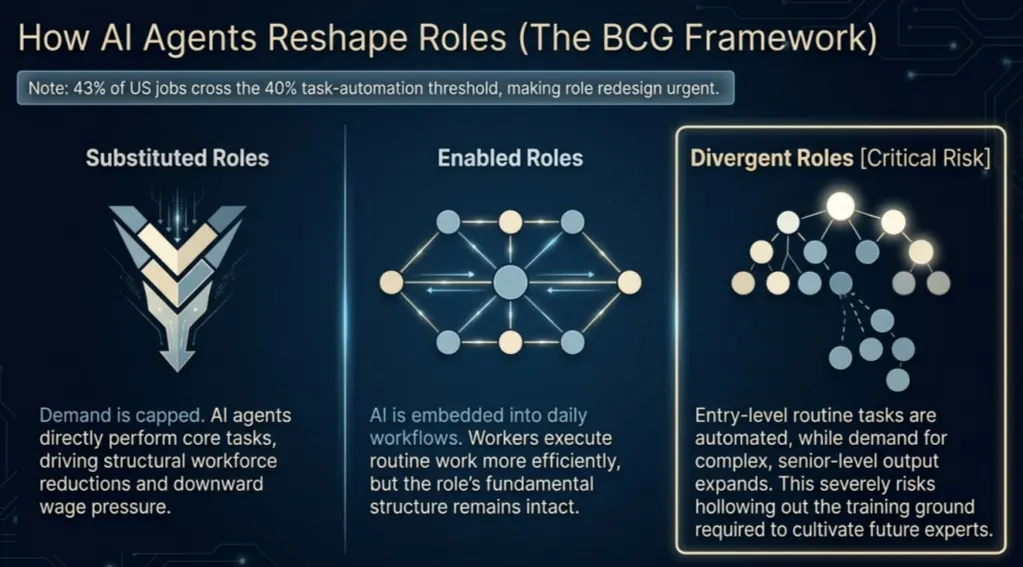
So when you look at your own team, the question should be: “Which category does each role fall into, and what does that mean for how you redesign it?”
That is exactly what the next section covers.
Also read: Agentic AI in Customer Service: Use Cases & Architecture
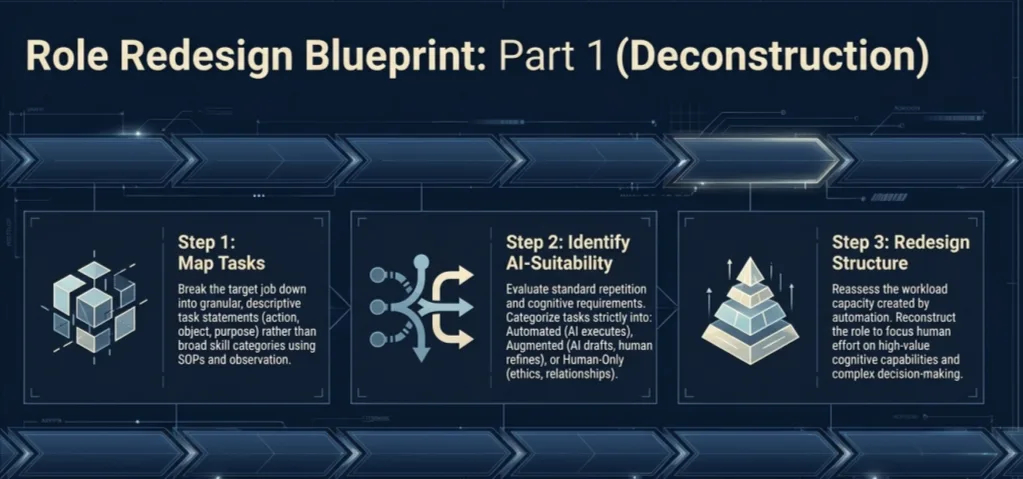
Let us walk through the 6-step process we think works best for redesigning roles around AI agents.
You want granular, descriptive statements that answer what action is being performed, on what object, for what purpose. Pull these from job descriptions, SOPs, direct observation, and conversations with the people doing the work. The reason this matters is that most job descriptions are 60% aspiration, 40% reality. You need reality.
Take your task list and sort each one into four buckets:
Once you know which tasks are moving to agents, you need to look at what is left and ask whether this collection of tasks still makes sense as a role? In most cases, automating the preparation and data-processing work frees up significant capacity. Your job now is to redirect that capacity toward the higher-value work your people were previously too busy to focus on.
To give you a concrete picture of what this looks like, consider what a hospital in Singapore did. They mapped every task their Patient Service Associates performed. They identified that the scheduling and coordination work could be automated, and then transitioned those same employees into direct clinical support, where the employees performed tasks such as drawing blood, assisting elderly patients, handling in-person care. The people did not change. The role they performed became genuinely more valuable.
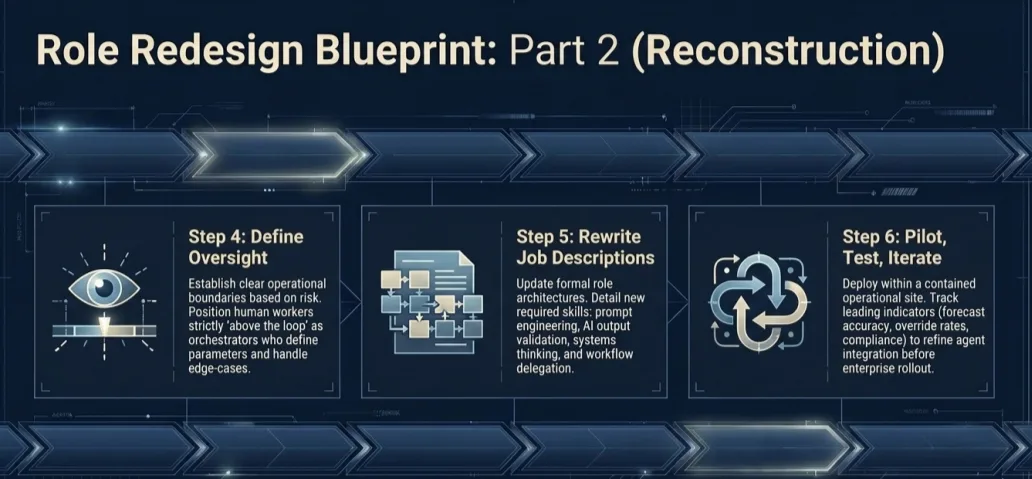
This is where agentic AI workforce planning either works or falls apart. You need explicit rules for when an agent can act autonomously, when it will need approval, and when a human should take over entirely.
Think of it as three modes:
Your people should be positioned "above the loop", where they set parameters, review outputs, and handle exceptions.
Also read: Enterprise Agentic AI Strategy Guide for CTOs & Leaders
If you have redesigned what someone actually does but do not update their job description, you risk confusing your existing employees about what is expected of them, hiring candidates who are suited for the old version of the role, and running performance reviews against criteria that no longer reflect the actual work.
Update role titles, competency frameworks, and required skills. New capabilities like prompt engineering, AI output validation, and workflow delegation need to show up in the actual document.
Do not push a redesigned role across the entire organization on day one. Pick one team, one department, or one operational site, and let your people work in the new structure for 60 to 90 days.
Track things like task completion rates, override frequency, employee satisfaction, and whether your forecast accuracy improved.
To get a sense of what a successful pilot looks like, consider GoFor, a last-mile logistics company. They ran a contained pilot of their redesigned onboarding workflow and cut the process from 30 days down to 5.
Similarly, the law firm Norton Rose Fulbright tested their approach through a programme called Transform, wherein they broke legal services into standardized tasks, deployed AI on the routine ones, and let lawyers in specific practice areas work in the redesigned role before scaling it across the firm.
In both cases, the pattern was the same: start narrow, measure what happens, and scale only when the evidence supports it.
Of course, redesigning a role is one thing. But what does it actually feel like to manage a team where some of your "employees" are autonomous agents?
Also read: AI-Native vs AI-Enabled: 4 Levels of AI Maturity for Leaders
Let us imagine that you have redesigned the role and the agent is deployed. Now what?
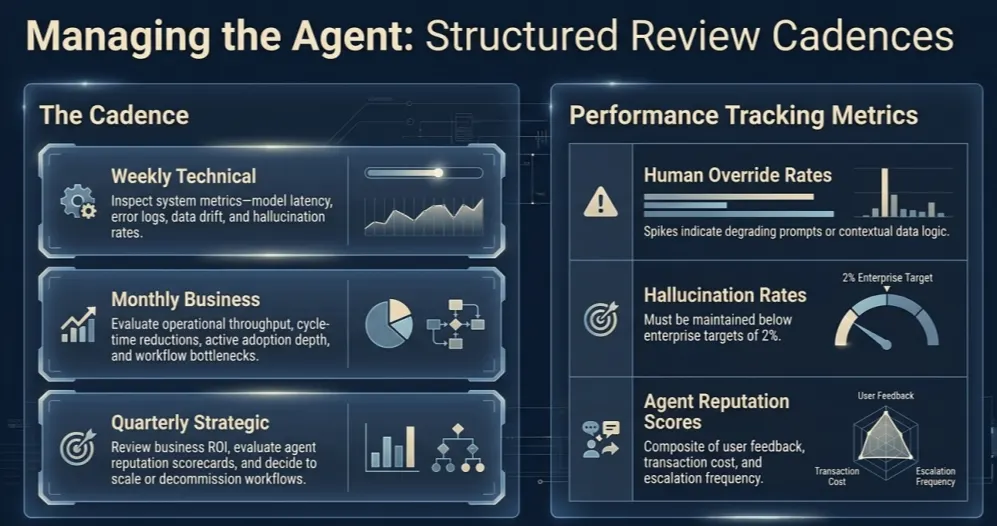
This is where I see a real gap. Most teams plan carefully for the rollout and then have no structure for the Tuesday morning after launch. To manage a team of humans and AI agents, you need a different operating rhythm as compared to managing humans alone.
It comes down to three things.
You need a layered schedule of reviews. Weekly, your engineering and ops leads should be looking at system-level health indicators such as latency, error logs, data drift, hallucination rates. This may seem like a mechanical thing to do, but it will help you catch problems before they compound.
Monthly, you should zoom out and check things like how is throughput changing, whether cycle times are actually dropping, and how often are humans overriding agent decisions.
Quarterly, leadership should ask even bigger questions. What is the ROI on this workflow? Do we scale it, optimize it, or shut it down?
Your agents need clear boundaries for when they are supposed to act alone and when they should stop and ask. We covered the three modes earlier, that is, auto-run, approval-required, agent-decides. Your work is to calibrate those thresholds for your specific context.
Raw output speed (what I would call generation velocity) is not the metric that matters most. What matters is stabilization effort. How much human time goes into reviewing, debugging, and correcting what the agent produces?
Track these together:
When you track these as a system, you can tell the difference between an agent that is fast and one that is reliable. Human-AI collaboration only works when you can trust the AI side of that equation, and trust comes from measurement, not hope.
But you can not solve the hardest part of this transition through measurement alone. Your people are watching all of this happen, and they have questions you need to answer honestly.
The biggest risk in AI workforce transformation is losing the trust of your people before the system has had a chance to prove itself.
In 2026, researchers at CMI conducted a survey and found that 70% of employees now seek workplace guidance from AI tools instead of their human managers. That is more a trust stat than a technology stat and it reveals to you that how you communicate matters as much as what you deploy.
Talk about tasks instead of job titles. Use phrases such as “we are automating parts of this role" as the message lands very differently than "we are eliminating this position." Show people specifically which tasks in their roles will be done by AI agents, which ones will be AI-augmented, and which ones will remain entirely theirs to perform.
Be honest about the executive layer too. Research shows that 64% of managers say their organization’s leadership encourages AI experimentation, but only 13% strongly agree that the senior leaders at the organization actually experiment with AI themselves. Your team will notice this gap. Change management for AI agent adoption can fail in an organization where the leadership asks its people to embrace a new system of work but fails to show themselves embracing the same system.
For the AI workforce paradigm to work well, your people will need to learn systems thinking, prompt engineering, AI output validation, and workflow delegation. None of these skills is a nice-to-have anymore.
Consider what Ericsson did. They mapped 100,000 employees across 140 countries using real-time skills data and then ran structured upskilling programmes that brought 75% of their workforce to competency in cloud-native technologies.
That kind of commitment that tells your people the organization is genuinely invested in their transition. TechWolf's research reinforces why this level of investment matters: their analysis shows that 71% of the workforce needs to develop real AI fluency, not just basic tool familiarity.
Consider this fact.
PwC and WEF research across 48 countries shows that 37% of workers aged 15 to 24 are in occupations with medium-to-high AI exposure. If you automate away all the junior-level tasks in those roles, you lose the training ground where your future senior talent learns the fundamentals. And that is a pipeline problem that takes years to become visible but even longer to repair.
So when you think about preserving early-career roles, think of it as a long-term talent investment. Redesign those roles around AI auditing, agent oversight rotations, and human-AI collaboration rather than eliminating them.
If your primary success metric is headcount reduction, you are measuring the wrong thing, and I realize that this sounds counterintuitive.
The same CMI survey I referred to earlier also found out that 68% of organizations are stuck in the pilot phase of their AI deployments. Of those organizations, 70% report minor productivity improvements, but only 5% say the results have been genuinely transformational. The rest are seeing just enough to justify continuing, but not enough to call it a success.
To measure AI workforce management success, you need a balanced scorecard across four dimensions.
The first two dimensions tell you whether the system works. The second two tell you whether it is sustainable.
Organizations that have implemented AI-driven scheduling report that schedule conflicts have dropped by as much as 60%. That is a meaningful operational improvement by any measure. But if your workforce sentiment scores are tanking at the same time, you may have traded one problem for another.
So, try to not look at AI workforce management as a technology decision. It is an organizational design decision that happens to involve technology.
In every successful implementation of AI workforce transformation I have seen, the secret sauce is to be clear about what work humans should own and what work agents should own.
The framework is straightforward. Understand how each role is being affected. Redesign from the task level up. Build real operating rhythms for managing agents alongside your people. Communicate honestly and invest in reskilling that matches the scale of the shift. And measure success broadly enough that you catch problems before they become structural.
If you are working through any part of this, we would genuinely enjoy the conversation. This is the kind of work we do at Neuronimbus every day, and we have found that even a short discussion tends to surface clarity that is hard to reach on your own. Reach out to us here.
Roles with a high percentage of repetitive, rule-based, and data-structured tasks are most affected by AI agents.
By running the pilot for sixty to ninety days, you can gather enough data to evaluate the program’s performance on KPIs such as task completion rates, override frequency, and employee adjustment.
Employees should develop these four capabilities: systems thinking, prompt and context engineering, AI output validation, and workflow delegation.
An approach of layered oversight can help you ensure that your agentic AI workforce does not create single points of failure. Conduct structured review cadences, set clear escalation thresholds, and develop human override protocols.
A big mistake is to treat AI workforce transformation as a technology deployment rather than an operating model change.
To sustain and uplift the morale of the workforce, communicate the operational details of the transformation at the task level of a job role, rather than at the level of the role itself. Also, invest in the upskilling of your employees. Make sure leadership is visibly using the same tools they are asking everyone else to adopt.

Let Neuronimbus chart your course to a higher growth trajectory. Drop us a line, we'll get the conversation started.






Call Us

Schedule a Call


Your Next Big Idea or Transforming Your Brand Digitally
Let's talk about how we can make it happen.