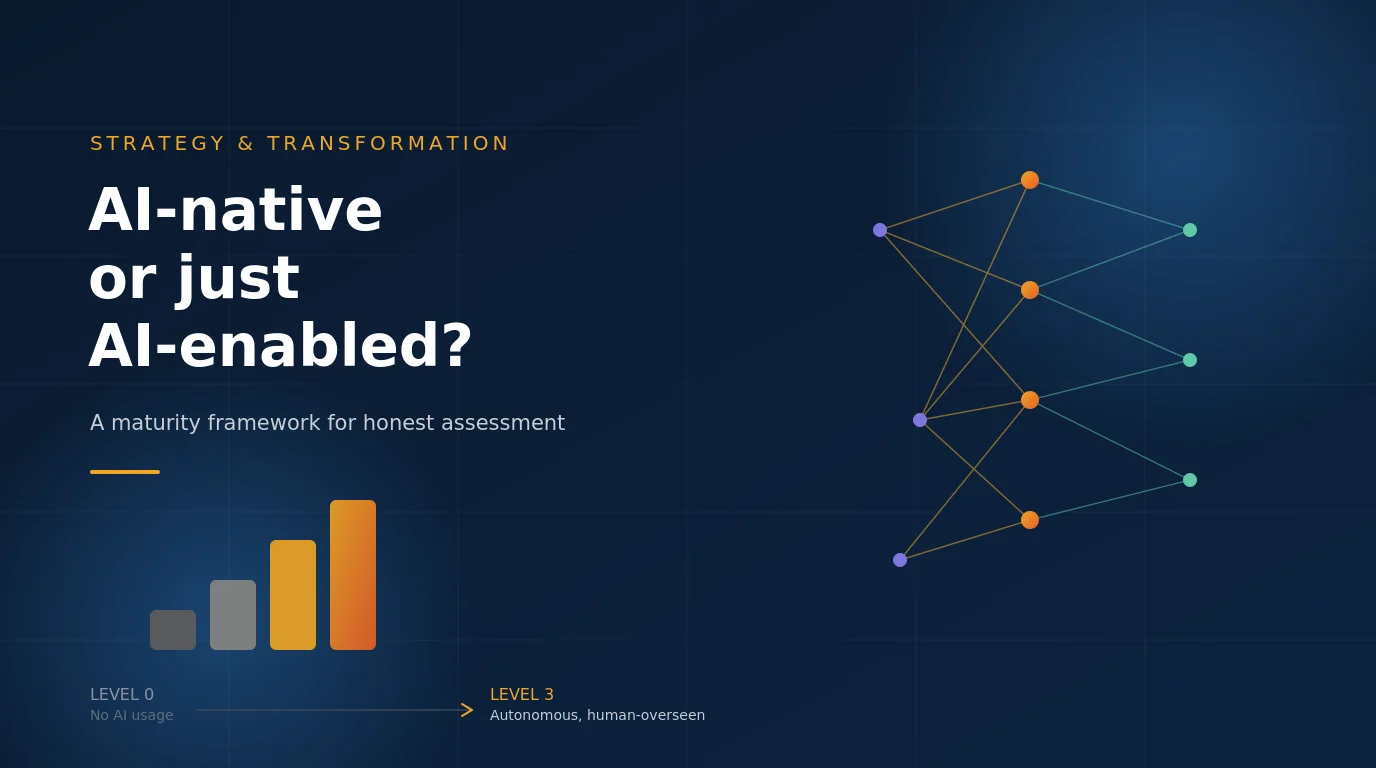
There is a significant difference between using AI tools and being an AI-native organization.
Most companies are on one side of this divide. The organizations pulling ahead are on the other.
I hope to offer a framework for any tech leader to assess their organisation’s AI readiness with honesty and without feeling weighed down by jargon.
The phrase appears in pitch decks and analyst reports with increasing frequency. But it is rarely defined with enough precision to be useful.
An AI-native organization is one where artificial intelligence is the engine around which products, workflows, and decision-making are architected. If you were to remove the AI layer entirely, the organization would lose the ability to deliver its core value.
On the other hand, an AI-enabled company takes its existing workflows and attaches AI to specific steps.
For an AI-native organization, the AI is not a layer on top of the business. It is embedded in how the business thinks, decides, and operates.
Understanding what AI-native means as a destination is a necessary first step. But strategy requires knowing where you are starting from, not just where you intend to arrive.
In practice, organizations do not leap from manual operations to autonomous systems in a single move. The transition follows a predictable AI maturity model, which is a progression through four levels.
This is the traditional operating state where all workflows are manual and deterministic, and governed by rules that human programmers have explicitly defined. Whatever automation exists at this stage is rigid. It executes a fixed sequence and fails when it encounters unstructured data or inputs it was not designed to handle.
At this level, individuals within the organization use AI as a personal productivity tool. The pattern of interaction is request and response.
The defining characteristic of Level 1 is that AI sits outside the workflow. It is a tool that an individual picks up, uses for a discrete task, and sets down. The human remains fully responsible for deciding what to do, when to do it, and how to execute.
At this stage, AI is no longer a standalone tool that individuals consult on their own initiative. It is embedded into team-level processes.
This changes the nature of human contribution in a meaningful way. Instead of creating output from a blank page, the professional becomes a guide and a verifier.
This transition from "creator" to "editor" is more demanding than it appears. It requires a different skill set, a different management approach, and a level of trust in AI output that most teams have not yet developed.
Level 3 represents the fully agentic AI workforce model.
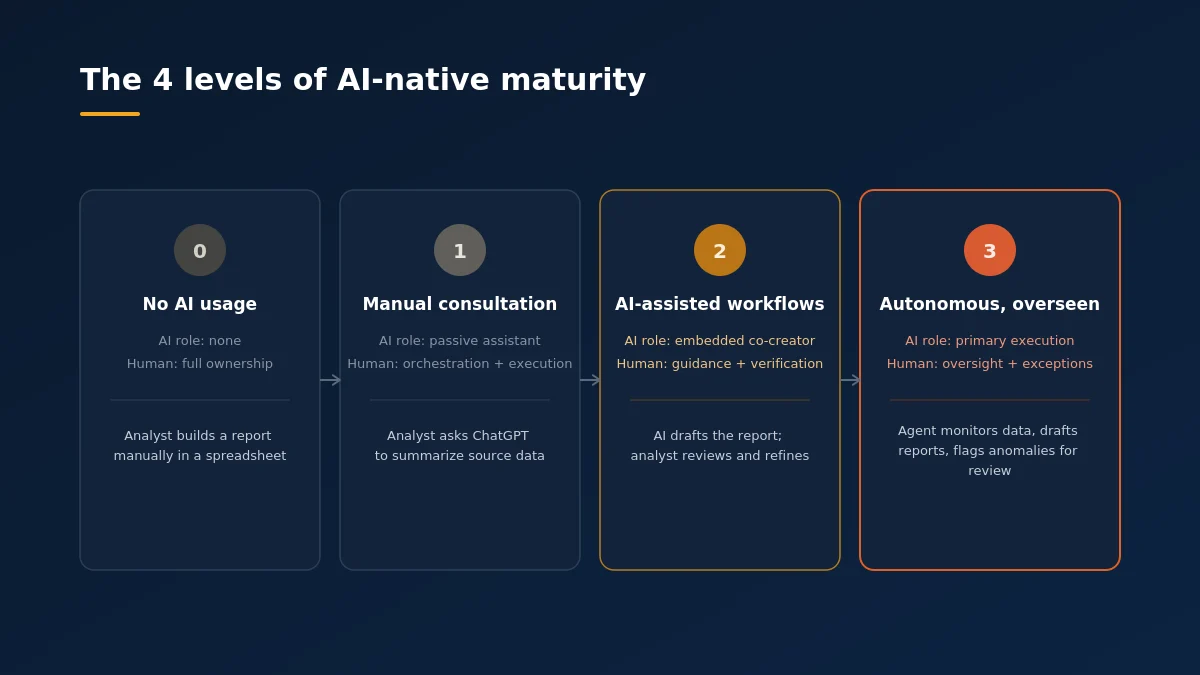
At this stage, AI agents are capable of reasoning over context, selecting and invoking tools, coordinating actions across multiple systems, and executing multi-step processes with minimal human intervention.
The human role at this level is fundamentally different from every preceding stage. Professionals become orchestrators. They define the objectives, set the constraints and safety boundaries, and intervene only when the situation exceeds what the agent was designed to handle.
Maturity frameworks are useful for orientation. But they can also make it easy to overestimate your position.
The following checklist is designed to make the assessment more concrete. For each item, answer "yes" only if the practice is actively in place across the organization.
In our experience, most organizations that complete this assessment with genuine honesty score between 3 and 5.
Most organizations that stall on the path to becoming an AI-native organization do so because of factors that no tool purchase can control.
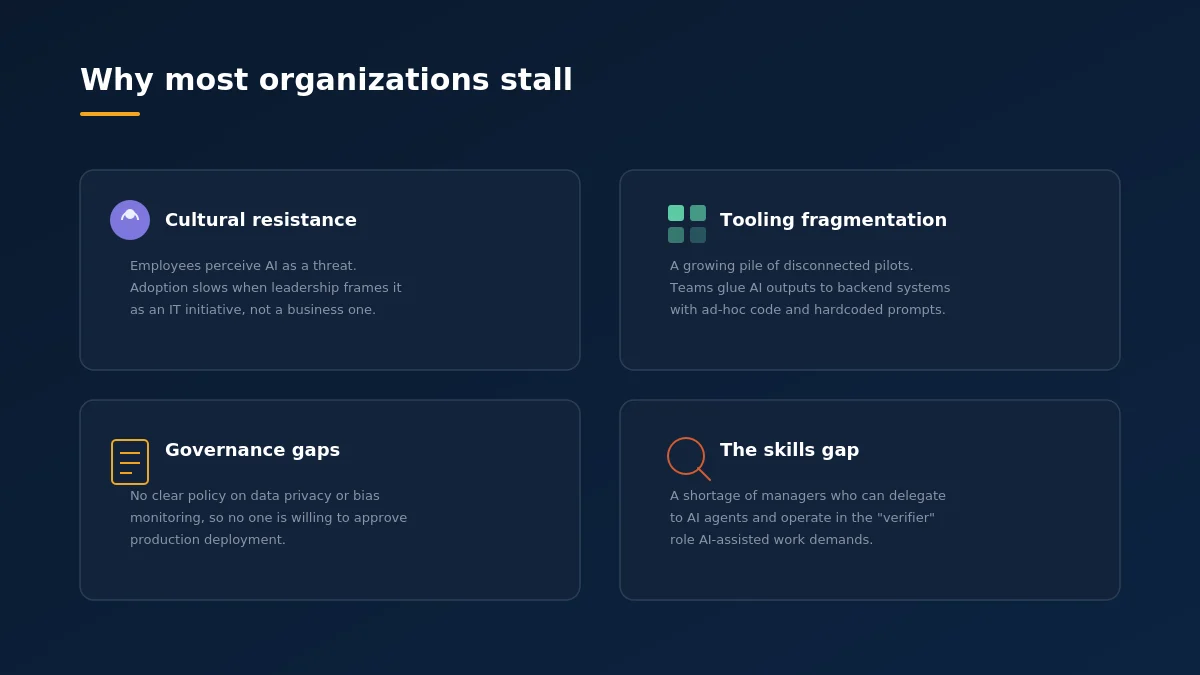
Employees frequently perceive AI through a lens of threat. When that perception takes hold, adoption slows regardless of how capable the tooling is. The problem compounds when leadership frames AI as an IT initiative rather than a business transformation.
Many organizations suffer from what could be called "pilotitis" — a growing collection of disconnected AI experiments. Teams build ad-hoc integrations using glue code and hardcoded prompts to bridge AI outputs with backend systems.
Organizations that experiment freely but delay establishing clear policies around data privacy, bias monitoring, and human-in-the-loop requirements eventually reach a point where no one is willing to approve production deployment. Without a model registry and proper telemetry, AI systems remain black boxes.
The scarcest resource in most organizations is judgment. There is a significant shortage of managers who understand how to delegate effectively to AI agents, evaluate the performance of human-agent teams, and operate in the "verifier" role that AI-assisted workflows demand. Until this capability is developed, organizations cannot progress beyond Level 1.
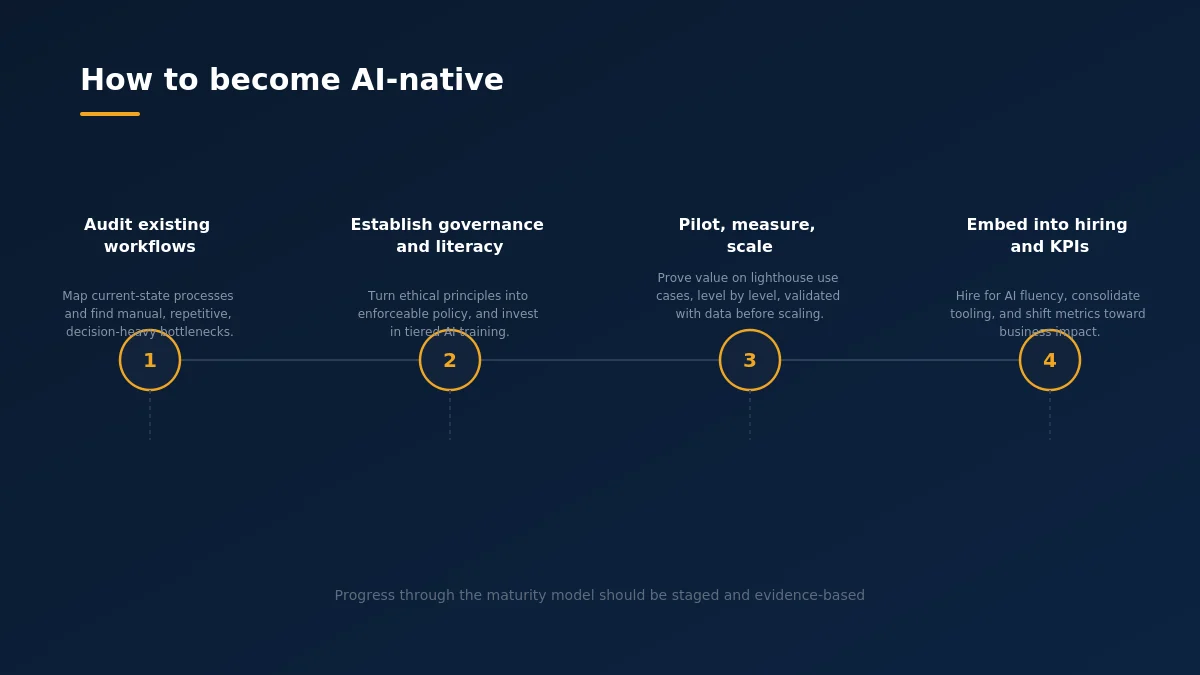
Map how your organization actually operates today. Conduct interviews and build current-state process maps that identify bottlenecks, duplicated effort, and manual friction points.
The highest-value opportunities for AI transition are workflows that are manual, repetitive, and decision-intensive. Once identified, design a future-state map showing how AI agents or autonomous processes can replace or restructure those steps.
Governance is the foundation that makes experimentation safe enough to scale.
Translate ethical principles into actionable, enforceable policies. A robust governance structure operates across three lines of defense: developers building responsible systems, risk evaluators monitoring for bias and security issues, and independent auditors providing objective assurance.
In parallel, invest in AI literacy through tiered training. People adopt what they understand. They resist what they do not.
Progress through the AI maturity model should be staged and evidence-based. Select lighthouse use cases and use them to prove value before scaling. Start with business outcomes, not features. Each level of maturity should be validated with data before the organization moves to the next.
The final stage requires rethinking human capital and measurement. Hiring strategies should prioritize AI fluency and hybrid roles. Tooling should consolidate toward unified platforms that manage the full AI lifecycle. And success metrics must shift from technical indicators like model accuracy to business impact KPIs.
This distinction determines the ceiling on long-term competitiveness of an organisation.
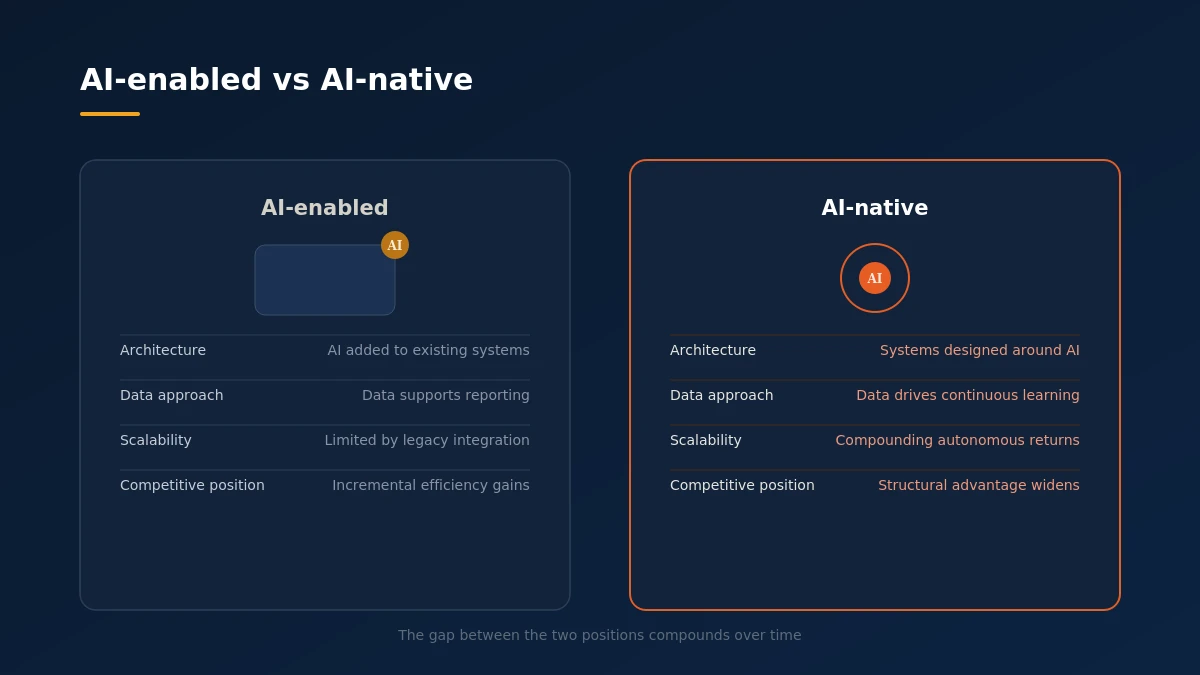
AI-enabled organizations improve what they already do. AI-native organizations redefine what is possible. The gap between these two positions compounds with time, which is why the decision about which path to pursue is a strategic one.
This is precisely the kind of strategic decision where an experienced partner makes a measurable difference. At Neuronimbus, we work with leadership teams to assess their current AI maturity and build the roadmap to AI-native. If your organization is ready to move beyond experimentation, we should talk.
An organization where AI is the structural foundation of operations, not an add-on. Core products and workflows are architected around AI capabilities. Without AI, the business model itself would not function.
Yes, but it requires fundamental redesign. Legacy companies must restructure workflows, governance, and talent strategies rather than layering AI onto processes that were designed for purely human execution.
Executive sponsorship is non-negotiable. Without a named leader carrying direct accountability and a funded mandate, AI initiatives fragment into disconnected experiments that never reach organizational scale.
No. AI-enabled is a legitimate and necessary stage. The risk is treating it as the destination. Organizations that remain AI-enabled indefinitely face a widening competitive gap against those that continue progressing toward native integration.
Not necessarily. The priority is architectural readiness. Some legacy systems can be wrapped and connected rather than replaced, provided they support the data flows that AI requires.

Let Neuronimbus chart your course to a higher growth trajectory. Drop us a line, we'll get the conversation started.






Call Us

Schedule a Call


Your Next Big Idea or Transforming Your Brand Digitally
Let's talk about how we can make it happen.