.webp)
The 2022–2023 season was massive (not in a good way) for the e-scooters industry.
Bird went bankrupt, dozens of operators folded, Paris banned shared scooters entirely, and naturally, a lot of enterprise buyers wrote off micromobility as another tech fad.
Within a year it was clear that the market was not dying, it was just spring cleaning itself.
A hard reset happened in the e-scooters market. Operators with real unit economics withstood the storm and came out stronger. Startups running on hype were buried under the rubble.
The numbers bear this out.
The e-scooters industry is thriving, and so is the market for electric scooter app development — which is what this guide is about.
E-scooter apps are not only relevant for consumer-facing micromobility startups.
They are equally valuable for:
Each of these buyers has a fundamentally different use case, which is precisely why a generic, off-the-shelf e-scooter app consistently fails them. The real-world deployments illustrate why.
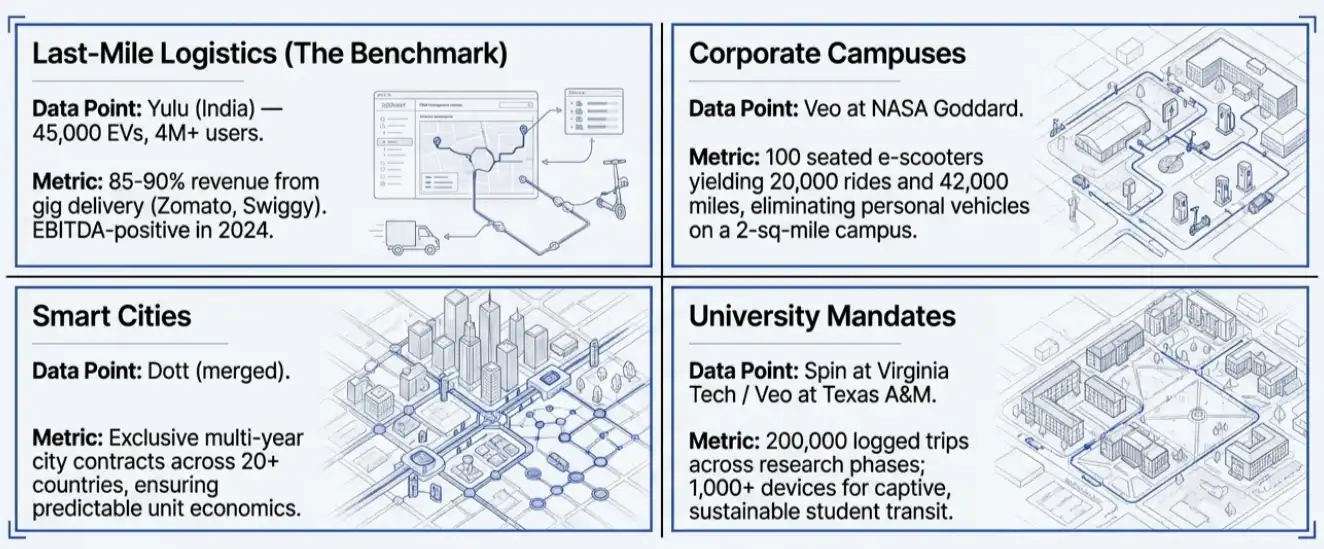
Corporate campuses: Veo, a US-based shared micromobility operator, deployed 100 seated e-scooters at NASA Goddard Space Flight Center in June 2024. The result: 20,000 rides and 42,000 miles covered on a 2-square-mile campus.
Universities: Veo operates 1,000+ devices at Texas A&M, one of the largest public universities in the United States with a sprawling 5,200-acre campus. Spin, an e-scooters company, runs research-backed programs at Virginia Tech with 200,000 logged trips across three study phases.
Last-mile logistics: India's Yulu is the clearest proof of concept in this category. An EV mobility company backed by Bajaj Auto, Yulu operates 45,000 electric vehicles across major Indian cities with 4M+ users, and 85–90% of its revenue comes from gig-delivery partnerships with platforms like Zomato, Swiggy, Blinkit, and Flipkart. They became EBITDA-positive in 2024.
Smart cities: Dott, a European shared mobility operator formed by the merger of Tier and Dott in 2024, operates on exclusive multi-year city contracts across 20+ countries. Cities here are not just buyers of fleet services, but more like institutional partners who receive live fleet data, push digital policy through the platform, and hold operators to defined performance commitments.
Beyond pay-per-ride, mature platforms in this space also generate income from subscriptions, B2B licensing, and data monetisation. But monetisation is only one of the benefits of owning an e-scooter app or platform.
In short: a custom platform converts a fleet of vehicles into a strategic digital asset.
This brings us to the crucial question about white-label platforms.
Let’s talk about whitelabeling an e-scooter app.
Tools like Wunder Mobility, Joyride, and goUrban are well-suited for a single-city pilot. If you have under 1,500 vehicles and no near-term expansion plans, white-label is the rational choice.
But the moment you go multi-city — or a corporate client needs to log in through their company identity system, or your logistics platform needs a direct API connection to your dispatch engine — the limitations become massive.
You do not own the data your fleet generates.
Your hardware choices are constrained by the e-scooter app platform vendor.
Your product roadmap depends on someone else's priorities.
Understanding why to build custom is the first half of the decision. The second half is understanding what you are actually building, because it is considerably more than a rider-facing app.
Most people picture a single mobile app when they hear about e-scooter app development. The reality is that an e-scooter platform could mean up to six interconnected systems running simultaneously.
A sophisticated e-scooter platform has:
Build only the rider app and you have half a product.
Build all six without a coherent architecture connecting them, and you have a maintenance problem that compounds with every new city you enter.
The central challenge is that these systems need to share data in real time, reliably, at scale, across multiple geographies.
Every scooter is a connected device that transmits its location, battery level, and operational state continuously. A single 13-minute ride generates hundreds of data events: location updates, battery readings, ride-state transitions. Multiply that across 1,000 vehicles doing two trips a day and you are processing millions of events daily, per city. The backend architecture needs to handle that volume without degrading and do so consistently across different cities, time zones, and regulatory environments.
For a single-city e-scooter app MVP, a single-application backend is the right starting point as it is simpler to build, easier to debug, and faster to market. As the platform grows, it makes sense to break it into independent services: one for payments, one for ride lifecycle, one for geofencing, one for vehicle commands. Each service owns its own data and can be updated independently.
Voi, the European operator, runs this model on Google Cloud with hundreds of independent services, each deployable without touching the rest of the app. That is what makes it possible to change pricing logic in one city without affecting the ride-unlock experience in another.
The right time to move in this direction is when you cross roughly three cities or five thousand vehicles. Not before.
The technology choices for this stack are well-established in 2026:
Mobile (cross-platform)
Backend services
Databases
Real-time event processing
Live state and caching
Cloud infrastructure
Note: Cloud choice is typically driven by your enterprise customer's existing infrastructure commitments rather than any meaningful technical difference between providers.
The mistake most teams make is building a long list of rider-facing features and calling it an e-scooter platform. A real e-scooter mobile app development brief has three feature tiers, and each is meant to serve a different stakeholder.
This is the surface most people focus on. Get the basics absolutely right before adding anything clever.
Retention data from mature operators is consistent: the three things that keep riders returning are availability (a scooter within a 3-minute walk), unlock speed, and transparent pricing. Feature breadth is secondary to getting these right.
This is where enterprise buyers should spend more attention than they typically do.
An operations team running 1,000 scooters without the right tooling spends its day reacting. With the right dashboard, it spends the day preventing.
This is the layer that almost no off-the-shelf product gets right and it's the layer that unlocks city permits, enterprise contracts, and long-term defensibility.
Tier 3 is also where compliance requirements become engineering requirements. And that conversation starts with a €125,000 fine in Paris.
Compliance is the part of electric scooter app development that nobody wants to budget for and almost everyone ends up paying for twice.
Let me give you one case study that every enterprise CTO should know.
In March 2023, France's data regulator CNIL fined Cityscoot €125,000 for collecting rider geolocation every 30 seconds during a ride. The ruling: continuous location tracking violated GDPR Article 5.1(c) — the data minimisation principle. The service could have been delivered with less.
The lesson isn't that you can't collect location data. You can, and you must. The lesson is that the cadence and purpose of every data point you collect must be documented and defensible before you launch, not after.
There are four compliance areas every e-scooter app needs to address before it goes live.
For platforms operating in Europe, GDPR sets the baseline. In practice, this means:
Most cities require riders to be 18 or older. Standard implementation combines document scanning with a live selfie. Providers like Onfido, Jumio, and Persona handle this reliably at scale. In India, Aadhaar-based digital identity verification is the standard for onboarding delivery-fleet riders.
Requirements differ significantly across markets:
Southeast Asia and MENA have less consistent frameworks. Validate insurance requirements market by market before committing to a launch timeline.
If your e-scooter app processes payment data, SOC 2 or PCI-DSS certification becomes a practical prerequisite for enterprise sales. Budget $30K–$80K per certification, with recurring annual audits.
The overarching point: compliance is not a Phase 2 workstream. It is an architectural decision made in Phase 0. Built in from the start, it is a line item.
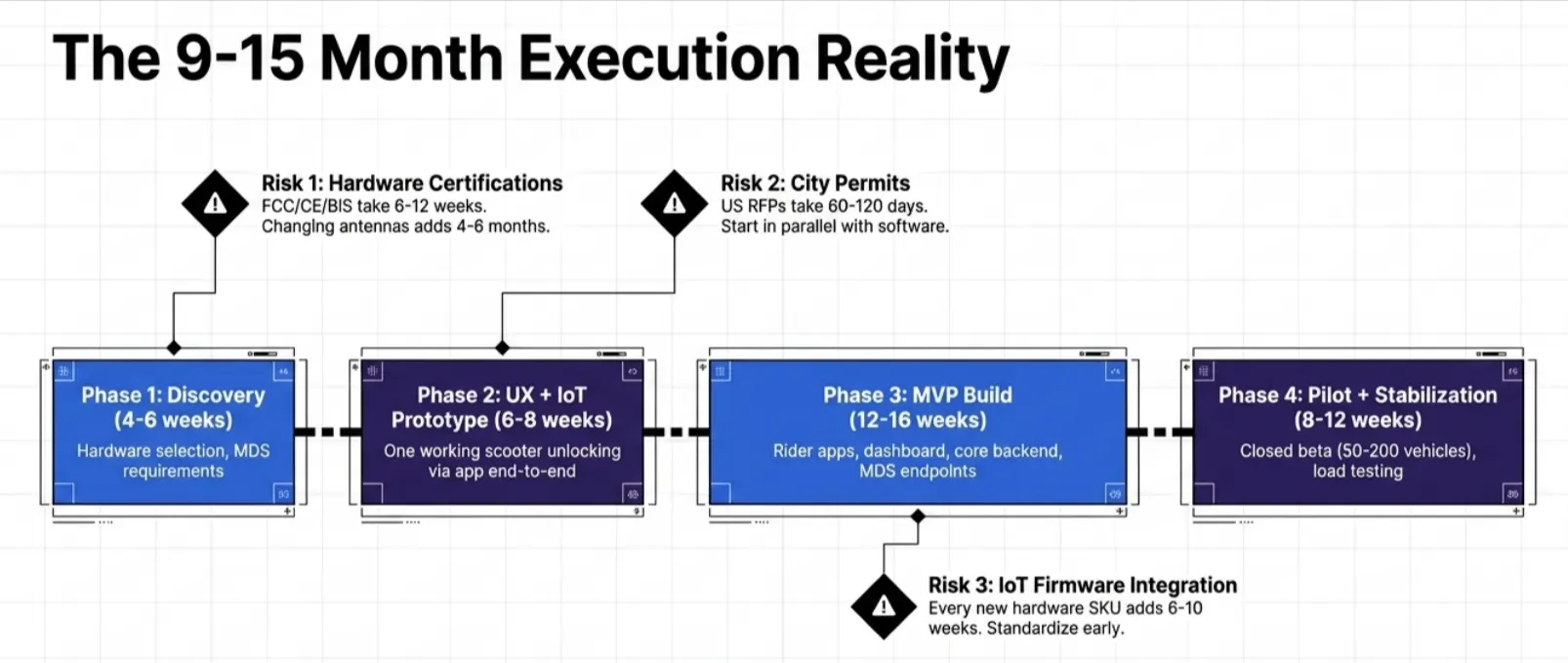
A production e-scooter app development project runs in four phases:
Total: 9–15 months from kick-off to a scaled first-city launch.
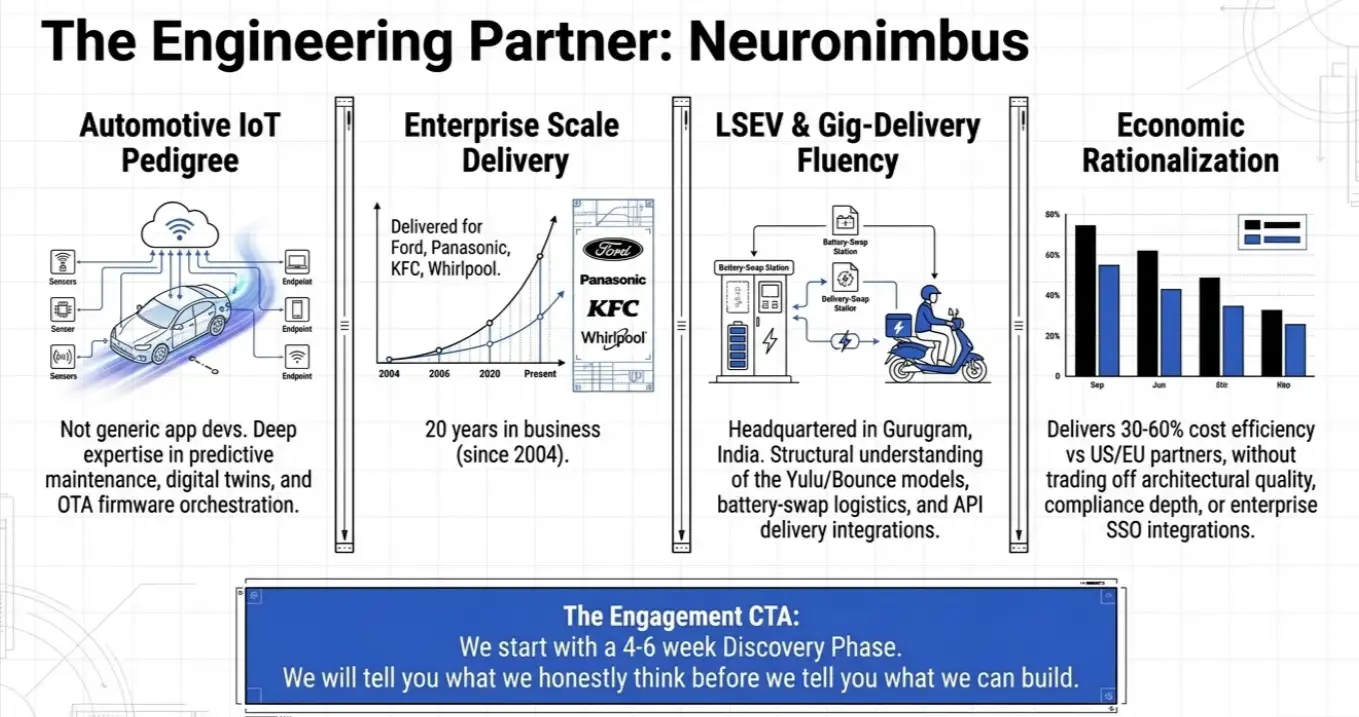
We have been building enterprise digital products since 2004. Our team brings four capabilities that are directly relevant to the capabilities required in an e-scooter app development company:
Businesses are investing in custom e-scooter apps to gain full control over fleet operations, rider experience, pricing, and data. Custom platforms also support integrations, compliance, and scalability across multiple cities or enterprise use cases.
A modern e-scooter app should include real-time scooter tracking, QR/BLE unlocking, secure payments, geofencing, ride history, fleet management dashboards, predictive maintenance, and compliance reporting features.
White-label solutions work well for small pilots or single-city operations. However, businesses planning multi-city expansion, enterprise integrations, or advanced customization usually benefit more from a custom-built e-scooter platform.
A production-ready e-scooter app platform typically takes around 9–15 months to develop, depending on the number of features, integrations, compliance requirements, and scalability goals.
Compliance is critical because e-scooter platforms handle sensitive user data, payments, and location tracking. Features like GDPR compliance, geofence enforcement, identity verification, and SOC 2 certification help businesses avoid legal and operational risks.

Let Neuronimbus chart your course to a higher growth trajectory. Drop us a line, we'll get the conversation started.






Call Us

Schedule a Call


Your Next Big Idea or Transforming Your Brand Digitally
Let's talk about how we can make it happen.