Most enterprises today have AI somewhere in the building. Perhaps a pilot here, a chatbot there, maybe a handful of proofs-of-concept that impressed in a demo (but never reached production).
What's usually missing is the connective tissue, or an enterprise AI strategy that answers the harder questions such as:
Which business problems will AI actually solve?
With what data, tools, and people?
And how do we/will we know it's working?
That's what I intend to address with this post. By the time you’ve read this, I hope you will have clarity on how you can lay out a practical AI roadmap as an enterprise leader.
Whether you're running a 200-person engineering org or leading AI-driven digital transformation across a multi-geography enterprise, the sequence of the steps in this transformation matters more than the speed.
An enterprise AI strategy is an organisation-wide plan that connects AI investments directly to factors that influence business economics, such as revenue, cost, risk, and operational speed.
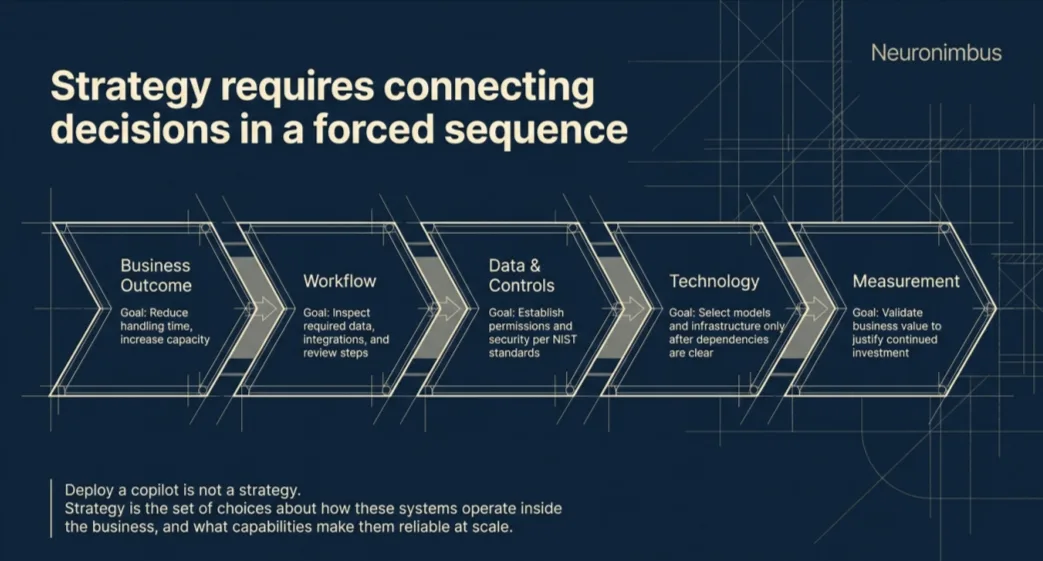
A well-built AI strategy framework works across three layers, and the order is important:
The principle underneath all of this is simple: the business outcome must always come before the technology decision.
Mature programmes don't rely on a single framework. They layer three: a governance and risk baseline (like the NIST AI Risk Management Framework), a multi-year maturity roadmap (like the Gartner AI Maturity Model), and a per-initiative scoring lens to evaluate feasibility before funding.
One pattern I keep seeing is what I'd call "vibes-based" prototyping, where teams ship AI workflow or solution demos that work surprisingly well for a small number of test cases, but can’t be moved to the production environment because they can’t be trusted to perform in the real world. An enterprise AI strategy is the system of planning and execution that can convert those prototypes into operated, governed, and measured capabilities ready for production.
And once that strategy is defined, the first real question it has to answer is: where do we start?
Also read: Enterprise Agentic AI Strategy Guide for CTOs & Leaders
Literally no enterprise anywhere in the world is saying that they have run out of ideas around the use of AI at the workplace. The problem is that these ideas collapse well before they become solutions, because of data gaps, integration friction, or governance constraints.
So before you allocate engineering resources to an idea, you need a structured way to filter and score them.
Look for tasks that currently consume five or more hours per week of repetitive cognitive work per employee. That's 260 hours a year per person, and that’s an ROI threshold that's hard to argue with. Moreover, this approach creates a natural force of end-user advocacy because the people doing the work want the solution.
Before you add any use case to your value-effort matrix, score it across four dimensions on a 1-to-5 scale:
A score of 1 means “ready to go,” and a score of 5 means “significant work needed.” A cumulative DFI above 12 signals that your team needs to invest in data infrastructure before that use case enters the AI build queue.
A use case that passes these two filters is ready for the next step: weighing its composite business value (revenue impact, strategic fit, speed to outcome) against the composite effort (development complexity, DFI score, integration load) it demands.
Lower DFI = more ready. A score above 12 means the data layer needs work before the use case enters the build queue.
This is illustrative. Your scoring weights and thresholds will vary by industry and org maturity. It’s the structure that matters.
One more thing on sequencing. Resist the temptation to run five pilots in parallel. Instead, consider a 90-day phased approach:
This approach will make each subsequent build run faster because you're compounding infrastructure, not starting from zero.
Now, that scoring table also exposes something important: most use cases don't fail on their potential business value. They fail on their data readiness. Which brings us to the next question.
Also read: AI-Native vs AI-Enabled: 4 Levels of AI Maturity for Leaders
Data and architectural readiness is the single largest failure point for enterprise AI initiatives.
A recent Gartner projection estimates that 60% of AI projects lacking AI-ready data foundations will be abandoned. And survey data shows only about 7% of enterprise IT leaders consider their data completely AI-ready.
I’d even say that those numbers aren't surprising when you look at what "AI-ready" actually requires. It's about operational fitness, that is, whether your data can support production AI across on-premise, multi-cloud, and SaaS systems without requiring massive upfront consolidation.
There are five criteria that matter. Your data needs to be:
If even one of these is missing for a given use case, you’d soon realize you were building on a weak foundation.
Beyond the data itself, you also need to check whether your systems are ready to support AI in production.
Two questions can help you cut through the noise:
Can your AI agents act within your existing systems safely? Audit your API landscape and workflow orchestration platforms. If an AI agent needs to trigger an action — say, updating a customer record or routing an approval — can it do that through your existing controls, or does it have to bypass them? If the answer is “bypass,” you have integration work to do before you build.
Does your infrastructure match the workload? If you’re weighing cloud vs on-prem AI scalability, this is where the decision becomes concrete. The readiness audit tells you whether your current setup can handle AI model development for enterprise workloads at the latency and governance levels production demands. If it can’t, you rearchitect before you build — not during.
One more thing: readiness isn’t uniform across geographies. Teams evaluating AI solutions for enterprises in India, for instance, face specific data residency and compliance requirements that must surface during the audit, not mid-pilot when they’re expensive to fix.
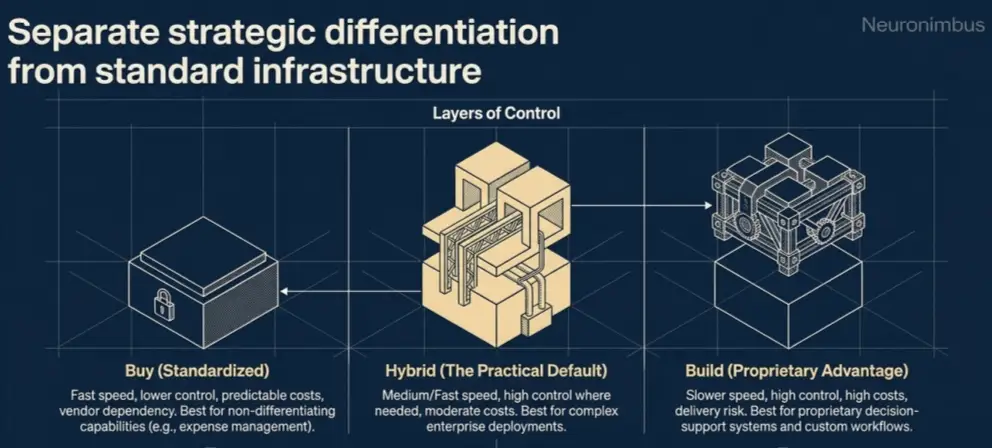
Once you know what your data and systems can actually support, the next decision becomes clearer: should you build the AI capability yourself, buy it off the shelf, or bring in a partner?
The build-versus-buy question sounds simple, but I’ve seen it stall leadership teams for months because it gets framed the wrong way.
It’s not about whether your engineers can build it. With today’s tooling, most teams can prototype almost anything in weeks. The real question is whether you should own this capability, and whether you have the operating model to run it safely and cost-effectively.
AI allows you to prototype faster, but a solution has to be impeccable to perform in the production environment. And if it’s not, it will introduce ongoing costs that prototypes don't reveal. Research suggests that hiring specialized providers to develop AI solutions works out well roughly 67% of the time, compared to about 33% for internal builds.
That doesn't mean you should buy everything. It means there should be a framework to help with your decision-making.
In my experience from the past three years, I’ve seen the blend/orchestrate model becoming the dominant choice because it balances speed with architectural control.
AI governance isn't a one-time policy document that you’d commission a few consultants to write and then forget. You have to treat it as the operational framework that ensures AI systems run safely, legally, and reliably across their full lifecycle.
The challenge is to build a governance layer potent enough to provide defence without becoming a bureaucratic bottleneck. I'd recommend a Minimum Viable Governance (MVG) stack, which has four components:
There are three models, and before you adopt one, you need to weigh the trade-offs:
Centralised (AI CoE) — A central data science or engineering team delivers all AI projects and enforces standards. The model works well for early-maturity organisations or highly regulated industries. But it becomes a bottleneck fast as demand scales.
Federated — Business units independently build and own AI solutions with light central oversight. This approach accelerates domain innovation, but causes duplication, inconsistent tooling, and governance drift.
Hybrid / Hub-and-Spoke — A central platform engineering team owns the horizontal infrastructure that includes identity, prompt stores, evaluation harnesses, security baselines, agent orchestration. Domain squads within business units consume those shared assets to build specific workflows. For most organisations scaling enterprise AI, this is the model that balances speed with control.
Beyond choosing the AI operating model, there are strategic moves that high-performing engineering orgs are making right now:
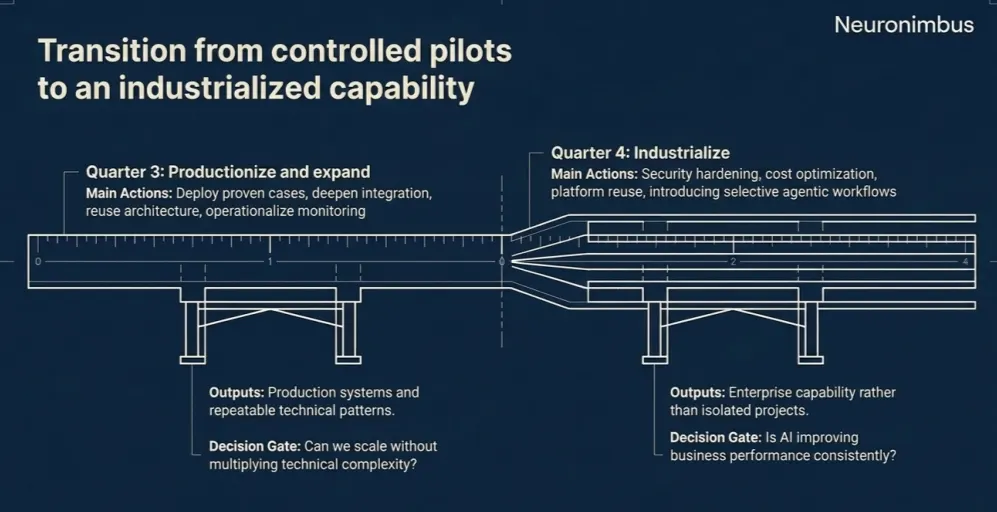
With the team in place and governance defined, you're ready to sequence the work across time.
A practical AI roadmap for enterprise should not try to transform the company in one quarter.
This AI roadmap for enterprise is a framework, not a rigid script. Your timelines will compress or stretch depending on data readiness, team capacity, and regulatory environment. The sequence, however, holds.
Most enterprise AI measurement fails for one of two reasons: metrics are defined after deployment when baseline data is already gone, or they measure system activity (queries processed, tokens consumed) instead of business impact.
Structure your measurement across three tiers:
Tier 1 — Operational Performance (Weeks 1–8):
Tier 2 — Workflow Integration (Weeks 4–16):
Tier 3 — Business Outcomes (Months 3–12):
The four metrics boards trust most: Time from sign-off to production. Cost per production use case. Platform reuse rate. EBIT attributed to AI. Report these quarterly on one dashboard.
An enterprise AI strategy isn't a document you write once and shelve. It's an operating discipline and a repeating cycle of audit, prioritise, pilot, govern, scale, and measure.
The enterprises that pull ahead in 2027 won't be the ones with the most pilots. They'll be the ones who connected those pilots to business outcomes through a coherent AI strategy framework.
If you're at the point where you need help turning this into a plan specific to your organisation, our AI strategy and consulting practice is built exactly for that conversation.
And if you're evaluating whether to host models internally, our guide to training an AI model for enterprises covers the infrastructure and trade-off decisions in detail.
A focused enterprise AI strategy typically takes 8 to 12 weeks to define properly, and covers use-case prioritisation, data readiness assessment, governance design, and a phased roadmap.
Ownership works best when it sits with a senior leader who spans both business and technology. The key is that the owner has budget authority and direct access to the executive team. Without that, the AI strategy framework becomes advisory rather than operational.
Digital strategy covers the broader transformation of business processes through technology. An enterprise AI strategy is a subset that focuses specifically on where machine intelligence changes business economics. The two should be tightly linked.
There's no single number, but most enterprises scaling beyond pilots allocate 5–10% of their IT budget to AI-specific initiatives, including infrastructure, talent, and vendor costs. The more useful framing is cost per production use case.
Start with the 5-Hour Rule. Identify tasks consuming five or more hours per week of repetitive cognitive work. Then score for data readiness using a Data Friction Index. Use cases that pass both filters enter a value-effort matrix ranked by business impact against implementation complexity. This gives you a defensible AI roadmap for enterprise prioritisation.

Let Neuronimbus chart your course to a higher growth trajectory. Drop us a line, we'll get the conversation started.


Call Us

Schedule a Call


Your Next Big Idea or Transforming Your Brand Digitally
Let's talk about how we can make it happen.