If you are looking at AI voice agents for your business, I’d go as far as saying that the interesting part about AI voice agents is not that they can hold a conversation on a phone call. Of course it can. The interesting bit is what happens after the conversation starts.
And it’s not until you experiment enough with the technology that you can truly find answers to important questions like:
Can the AI voice agent understand what the caller actually wants?
Can it work within the boundaries of your business systems?
Can it even complete small tasks correctly?
Can it decide when to hand off the call to a human expert?
Those are the questions that tell you whether you have a useful voice interface or an AI voice agent that can actually take part in a business process. So, before we get into use cases and costs, it helps to be precise about what an AI voice agent really is.
If I had to describe an AI voice agent in the simplest possible words, I’d say it’s a software that can listen to a person speak to it, understand what that person is trying to accomplish, decide how to respond, speak back naturally and, when the voice agent is also connected to business systems, take actions during the conversation.
Several companies that are doing great work in AI voice agents describe it as follows:
Phenom describes an AI voice agent as an autonomous, voice-first AI system that can hold natural spoken conversations, reason about them in real time and take action across connected systems without every turn having to be manually scripted.
Deepgram emphasizes the underlying combination of speech-to-text, text-to-speech and LLM-based reasoning that allows the system to understand natural language and perform more complex tasks.
Vosy AI makes another useful distinction: unlike a scripted phone menu, an AI voice agent is able to understand free-form speech, works out what the caller needs and responds conversationally.
There is a common thread across these definitions.
An AI voice agent needs to be able to:
Based on those elements, the definition my solution architects have encoded in our internal training documents is this:
An AI voice agent is a voice-based software agent that can understand an open-ended spoken request, reason about what should happen next, communicate its response and execute permitted actions across connected systems.
That final part may come across as an after-thought, when it is actually the most important and interesting part of working with AI voice agents.
An AI phone agent that can only answer questions is, at best, useful. An agent that can check the customer's account, find an available appointment, book it and update the CRM can actually complete work.
From the caller's side, the experience of interacting with an AI voice agent has to be simple and useful.
Suppose a customer calls an organization’s customer helpline, the call gets answered by an AI voice agent, and the called then says:
"I have an appointment on Thursday, but I need to move it to sometime next week."
If the AI voice agent is able to perform as expected, the caller would not have to say "reschedule" in exactly the right way or press 2, then 4, then 1 as in traditional IVR.
The AI voice agent listens to the request, understands that the caller wants to change a current appointment, asks for whatever information is required, checks available slots and continues the conversation as suitable.
If the customer says midway through the call, "Actually, you know what… Tuesday afternoon would be better," the AI voice agent must be able to understand that the nature of the request has changed.
This is a simple example, but even in such a workflow, several systems have to work together for the human caller and AI voice agent’s conversation to go on seamlessly.
Here’s how this works:
Caller → Speech-to-text → AI reasoning → Business systems → Text-to-speech → Caller
The first layer of this system is an automatic speech recognition module, usually called ASR or speech-to-text, whose purpose is to continuously convert the caller's audio into text.
You might think this is simple enough; however, wait till you put out an AI voice agent on an actual telephone line. Callers interrupt and contradict themselves all the time. They change sentences halfway through. There may be traffic noise. Another person could be speaking in the background. The caller may be speaking with a strong regional accent.
A production-ready AI voice agent system therefore has to understand when somebody has started speaking, stopped speaking or interrupted the agent.
The transcript generated by the ASR is passed to a reasoning layer that is built around a large language model. The model has the conversation context as well as instructions that define what the agent is allowed to do.
It might decide that it needs to:
This is why I would not think of AI voice agents simply as "ChatGPT connected to a phone" as I heard a principal architect of a Fortune 1000 company describe it at a conference I was a part of.
To understand this, let us revisit the “reschedule my appointment” example.
During the call, the language model itself will not know which appointment slots are free for the next Tuesday. The model will need access to the organization’s appointment scheduling system, from where it can retrieve the available slots and work from that live information.
In the same way, an AI voice agent for customer service will need the ability to read an order from a CRM. An AI voice agent working in the collections department of a bank has to be able to check an account balance. An AI voice engine for sales has to be able to qualify a prospect and then create an opportunity in Salesforce.
To do all this, the AI voice agent needs a tool-calling layer that connects the reasoning model to these external systems and controls what information it can read or what actions it is allowed to perform.
Once the reasoning layer has decided what the AI voice agent should say next, the text-to-speech module converts that response into audio that the caller can hear.
Modern AI voice models can produce very natural-sounding speech. But apart from voice quality, the timing also matters. Customers are used to waiting for a few seconds even when they use chatbots. But on the phone, they expect answers within seconds.
If the AI voice agent takes — let’s say — 5 seconds before it responds, the conversation will feel awkward to the caller. The caller might even assume the agent has stopped responding, say something to fill the gap, and convolute the voice-to-text and reasoning processes happening at the backend.
That is why latency has to be managed across the entire pipeline in an AI voice agent process.
The real engineering challenge is to manage the modules of speech recognition, reasoning, tool calls, synthesis and turn-taking quickly enough for the conversation to feel continuous to the caller.
That becomes especially important once the agent moves from answering questions to handling real business workflows, which is where most organizations are most excited to experiment with AI voice agents.
The best starting point is usually not "Where can we use voice AI?"
That question is too broad.
I would instead look for a high-volume conversation where the objective is clear, the information required is accessible and the conditions for human escalation can be defined.

I have observed that a few use cases excite CTO’s more than others, and these are ones where the conversations in scope are high in volume, clear in objectives, with definable levels of escalation, and where the required info can be reliably and quickly sourced from an easily connectible system.
Once you know which conversation you want to automate, the next question becomes much more practical: should you solve it with an AI voice agent, an IVR, or even a chatbot?
Once you have identified the conversation you want to automate, the next question is whether you need an AI voice agent at all.

Sometimes an IVR is enough. Sometimes a chatbot is enough. Sometimes, both aren’t enough and you need an AI voice agent. These three approaches to automating conversation based interactions are each good at solving different types of interactional challenges.
So how does one decide whether a traditional IVR or a chatbot or an AI voice agent is the right approach?
Traditional IVR is deterministic. The caller is expected to, for example, press 1 for billing, 2 for support and 3 for sales. The system follows a predefined tree. This means that IVR continues to work well when the number of possible paths is small and predictable.
A chatbot gives the user more freedom because they are able to type naturally and also without being under time pressure. Chatbots can also call APIs, retrieve account information and complete transactions.
For an AI phone agent, one of the biggest implementation challenges for technology companies is that the system has to perform inside a live spoken conversation.
That introduces problems that neither IVR nor chatbots have to solve for:
The architecture of AI voice agent solutions therefore has to resemble something close to the high level architecture I explained earlier.
What I’m drawing at is that AI voice agent vs IVR is not always an either-or decision. You may keep your existing contact-centre or IVR infrastructure and route particular call types to a voice agent. That could easily be more sensible than replacing the entire telephony stack.
Also read: Revolutionizing Tech: AI Chatbots as Cognitive Aides
There is no useful single figure I can offer to explain AI voice agent costs.
To understand the costs, you need to separate two things:
I did some market research on AI voice agent costs, and one thing became clear quite quickly: it is surprisingly difficult to compare like with like.
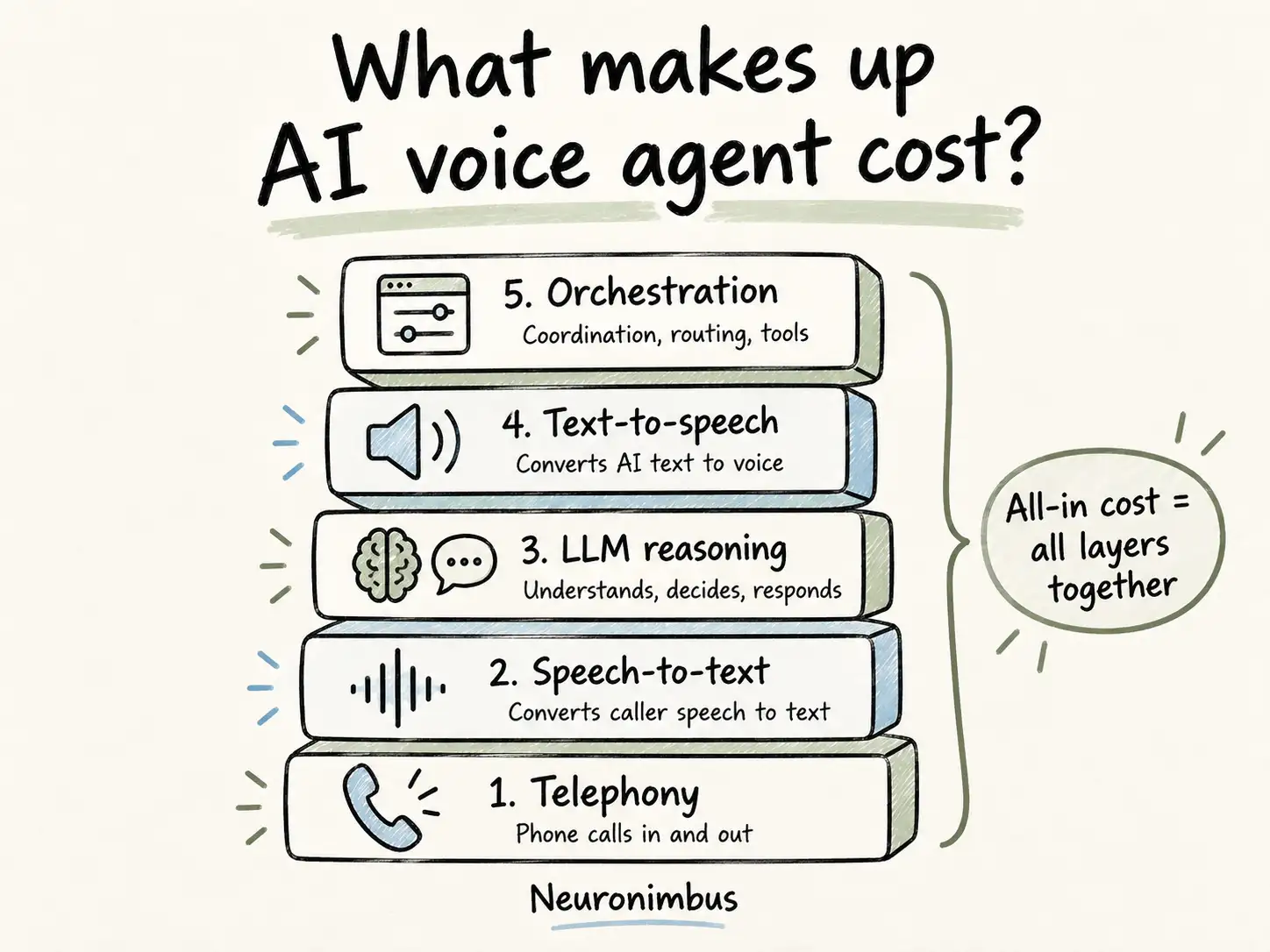
Most providers quote a dollar-per-minute rate, but that number does not always include the same components. In some cases, the quoted rate covers telephony, speech recognition, the LLM, voice synthesis and orchestration. In others, what looks like a very low headline price turns out to cover only one or two layers.
Across the pricing I reviewed, I saw all-in production costs commonly fall in the region of $0.12 to $0.25 per minute. If the architecture is more complex, uses premium voice models, or requires heavier orchestration and compliance controls, the cost can go higher.
So when you compare vendors, I would first ask a simple question: what exactly is included in the per-minute number you are showing me?
A word of caution: The cheapest price per minute does not necessarily give you the lowest cost per successful call.
Suppose one system costs less per minute but takes longer to respond, causes more callers to repeat themselves and escalates more calls to people.
Its infrastructure bill may look better while its operating economics will be worse.
That is why I would suggest that you cost your AI voice agent investment around completed outcomes.
The main variables are usually:
You also need to watch costs that are easy to miss, such as those associated with:
So before comparing vendors, calculate cost per resolved interaction, not only cost per minute.
However, I must also confess that costs will rarely cause an AI voice agent deployment to fail. Erratic production behavior is usually the harder problem.
Also read: Agentic AI in Customer Service: Use Cases & Architecture
A lot, unfortunately.
When we test an AI voice agent In a controlled demo, we make sure that an agent listens to voice coming via a clean microphone, gets predictable questions, and uses reliable APIs. Most of these conditions do not match those of a real call.

Calles interrupt, mumble, call from railway stations, change their minds halfway through a sentence. Even the external systems could fail.
That means we have to be aware of all the important failure modes that affect the performance of an AI voice agent in real world settings.
A spoken response from an AI voice agent passes through several stages:
speech detection → transcription → reasoning → tool call → speech generation
Each stage takes some time.
A few hundred milliseconds at one stage may not matter much. The problem starts when delays accumulate across several stages. The caller then hears silence while the system is still processing the request.
On a phone call, that silence feels much longer than it would in a chatbot. If it lasts too long, the caller may assume the system has stopped responding and start speaking again. That creates another interruption for the voice agent to process and can make the conversation progressively harder to manage.
In the real world, the exchange of voice messages between the human caller and the AI voice agent has a lot of interruptions.
Imagine a conversation where at one stage the AI voice agent says: "Your refund will arrive within five working days, but please note..."
And here the caller interrupts with another question.
The AI voice agent will pause to listen to the human voice, and in doing so, would have left vital information unfinished.
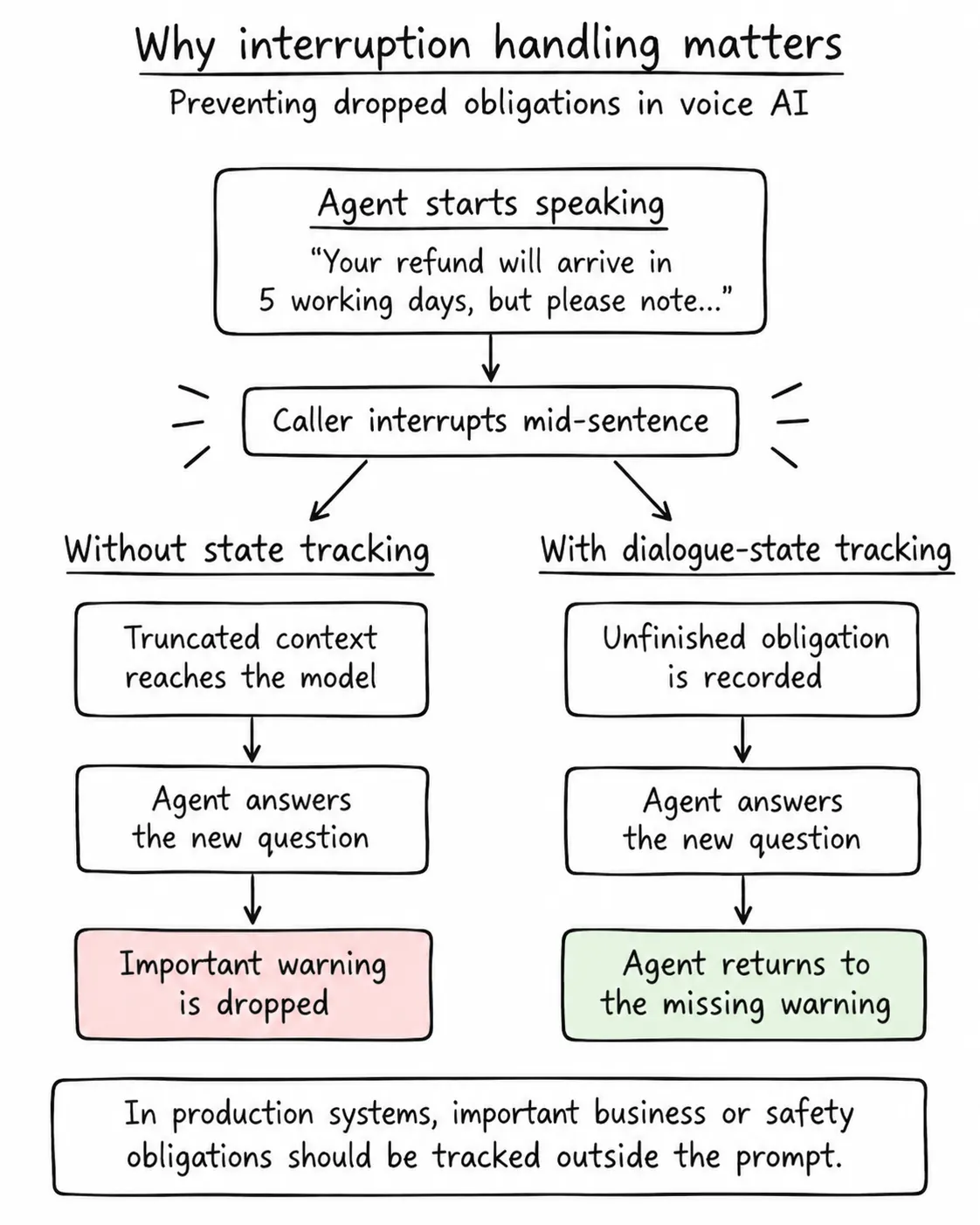
Potentially, each interruption can cause required information to disappear from the conversational state unless there are mechanisms to handle such cases.
A language model can produce a fluent answer that sounds plausible but is still wrong. So, for an AI voice agent for customer service, the only safe approach is to let the agent access transactional facts from verified systems.
Telephone audio is much lower quality than studio audio. Even for the best ASR modules, it may be difficult to understand the meaning in a human’s spoken words when they are spoken with a strong accent and amidst background noise. ASRs also get challenged when they listen to non-dictionary words such as names, addresses and account numbers.
The right goal is not to eliminate every possible error, as that is not feasible. The goal is to design the workflow in a way that an error cannot turn into a costly action.
That leads naturally to the other boundary you need to design for, before launch: regulation.
The rules around AI voice calls are not the same everywhere.
They also depend on what kind of call you are making. Regulation for an inbound customer-service call is very different from that for an automated outbound sales call. This is particularly important for outbound AI calling, where consent and telemarketing rules can become much stricter.
Practical considerations:
Practical considerations:
Practical considerations:
Practical considerations:
For me, the practical lesson is that compliance should not be added after the AI voice agent has already been built.
You need to decide early:
This is only an operational overview, not legal advice. Before putting an AI voice agent into production, I would have local legal counsel validate the exact requirements for the countries and call types involved.
Once these boundaries are clear, you have a much safer foundation for deciding how far the voice agent should be allowed to operate on its own
The strongest AI voice agents are the ones that start with a clearly defined workflow, have access to reliable data, and possess explicit permissions and a human path for situations that fall outside the boundary.
Once the first AI voice agent workflow performs as expected, you can expand the scope.

At Neuronimbus, that is how we think about custom AI agents and automation. Sure, the model matters, but production value usually comes from everything around it: workflow design, systems integration, state management, guardrails and measurement.
If your organization is ready to move beyond experimentation, we should talk.
Move beyond scripted calls with AI voice agents that handle customer queries, automate appointments, qualify leads, and connect with business systems. Neuronimbus helps businesses design and integrate AI solutions around real workflows, with appropriate safeguards and human handoffs.
An AI voice agent can take over repetitive and predictable calls, but replacing an entire contact-centre workforce is usually the wrong goal. Human agents remain crucial to handle exceptions in regular conversations, emotional conversations, and cases that require complex analysis.
A voice interaction needs to feel much faster than text chat. When the pause between the human response and the AI voice response is more than a couple of seconds, callers begin to notice the delays and feel the awkwardness of speaking with an artificial brain and artificial voice.
They can be, but outbound AI calling is regulated differently across countries. Consent, disclosure, do-not-call rules and automated marketing restrictions need to be checked for each jurisdiction before deployment.
Modern AI voice agents can support many languages, but one vendor may not be able to offer or guarantee the same quality of voice for each language. Speech recognition, accent handling, text-to-speech quality and mixed-language conversations should all be tested using real callers before rollout.
A bounded AI phone agent workflow can be implemented as a controlled pilot in a few weeks. Enterprise-grade AI voice agent deployments take longer as they involve multiple systems, security reviews, regulated data, complex call flows or large-scale contact-centre integration.

Let Neuronimbus chart your course to a higher growth trajectory. Drop us a line, we'll get the conversation started.






Call Us

Schedule a Call


Your Next Big Idea or Transforming Your Brand Digitally
Let's talk about how we can make it happen.