I’d start by contending that cities are struggling with traffic not because they lack signals, cameras, or traffic police.
They struggle because most urban traffic operations still run as a collection of disconnected tools.
Consider this:
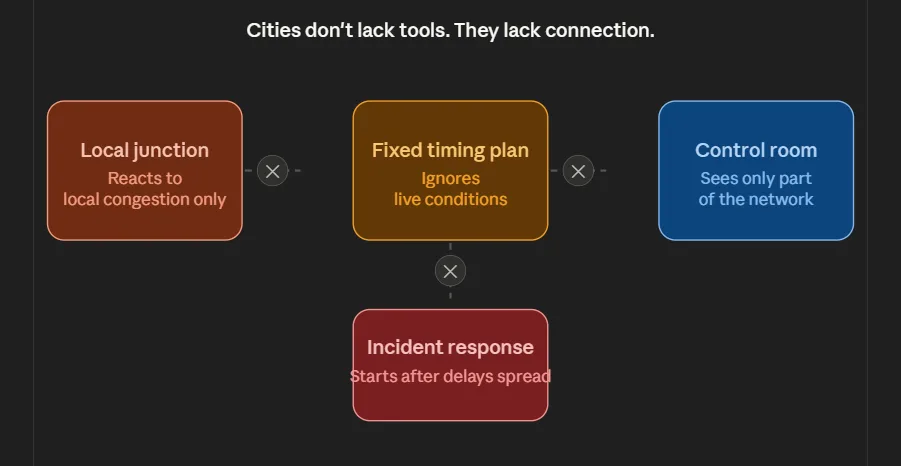
One junction reacts to local congestion.
Another follows a fixed plan.
A control room sees part of the network, not all of it.
Incident response starts after delays have already spread.
Till the time this patchwork of tools is replaced by a coherent system, city roads will continue to be clogged.
That is why smart traffic management systems matter so much now.
You can already see this shift in major tech-forward cities.
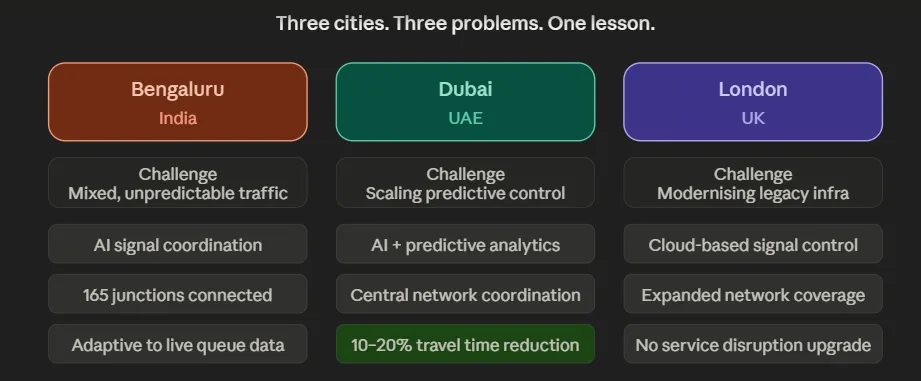
In Bengaluru, the city’s adaptive traffic control rollout has been tied to AI-led signal coordination across 165 junctions.
In Dubai, the Roads and Transport Authority has reported travel-time gains of 10% to 20% overall from its upgraded signal control system.
In London, Transport for London’s long-running adaptive control programmes have shown measurable reductions in delay and stops.
But the journey isn’t smooth, for sure, so let’s start from the basics.
Also read: Steering EV Innovation with Electric Vehicle Software
A smart traffic management system is a city-scale operating system for roads that brings together traffic data, control infrastructure, analytics, and operational decision-making so the network can respond in real time.
Traditional systems work with fixed-time plans, local controller logic, and fragmented visibility.
A smart traffic system moves beyond that as it connects intersections, corridors, control rooms, field devices, and data feeds into one coordinated environment.
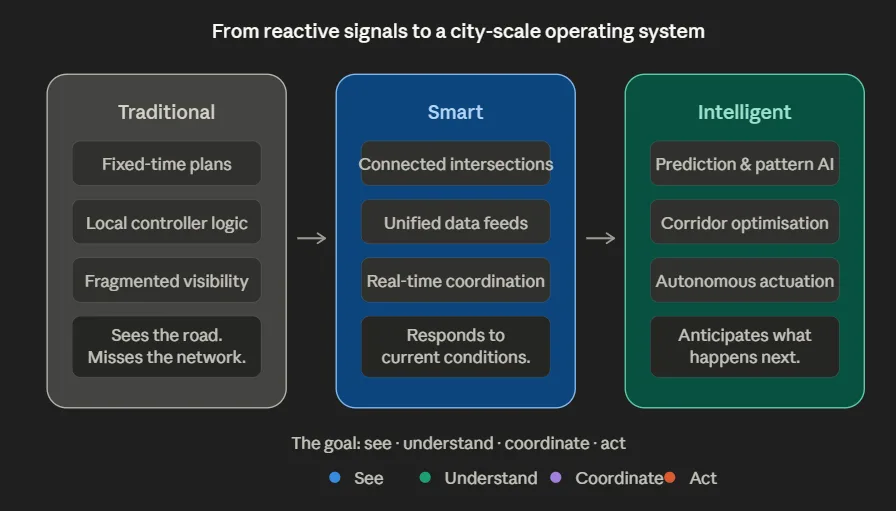
An intelligent traffic management system goes one step further. It does not only respond to current conditions. It also uses prediction, pattern recognition, and automation to improve what happens next.
That distinction matters hugely.
So when city leaders or transport agencies talk about smart city traffic, the real question is whether the city can do four things consistently:
That is why the best smart traffic management systems are not built as isolated tech projects but as operational platforms.
And once you look at them that way, the next question becomes obvious: what exactly sits inside one?
Also read: Discover How Telematics enhances EV Fleet Management
A lot of guides explain a smart city traffic management system as if it is a shopping list of cameras, sensors, and AI. But I feel that is far from the real picture.
What cities actually need is a working stack, where each layer supports the next one.
At a practical level, most smart traffic solutions should have five core components.
Visibility of road and traffic health comes from a mix of:
This is the foundation of smart traffic monitoring.
I consider this the first component because traffic is not just about volume. A traffic corridor can fail because of a stalled vehicle, bad weather, an event spillover, or poor progression between signals. Good monitoring has to capture those patterns early.
Raw field data is only useful if it can move reliably and fast.
That is where communication networks, gateways, and edge processing come in.
Some decisions have to happen close to the road, especially when latency matters. Video analytics for queue detection or incident detection, for example, work better at the edge because they reduce bandwidth load and shorten response time.
This is one reason newer smart traffic control systems are moving toward hybrid designs rather than sending everything back to a central platform first.
This is the operating core.
It is where the traffic management centre, command dashboards, alert workflows, and operator interfaces come together.
A mature control layer should help teams answer questions like:
London’s ongoing move toward cloud-based traffic signal control is a strong example of why this layer matters.
Analytics can help cities understand:
And when analytics becomes more advanced, it supports adaptive control, predictive alerts, and corridor-level optimisation.
This is the part people notice on the road.
This execution layer is what turns a system from passive monitoring into active traffic management.
Without it, the city only gets a better dashboard.
With it, the city gets a working intelligent traffic management capability.
That is the right place to pause, because these components explain how the system works in theory.
The more important test, though, is whether these ideas hold up in live urban environments with legacy infrastructure, mixed traffic conditions, and real operational pressure.
But there’s a lot to learn from cities that already have a good version of smart traffic management system in place.
Also read: Exploring 6G Technology: The Future of Fast Connectivity
A useful way to read these examples is to ask, “What problem were they trying to solve, and what does that tell us about how a modern smart city traffic management system should be designed?”
Bengaluru is one of the best examples of why Indian cities need a practical and adaptive approach to smart traffic management.
Traffic in Bengaluru is not difficult only because of volume, but also because of variation.
The system has to deal with mixed vehicle types, dense junction spacing, uneven corridor pressure, school and office peaks, sudden bottlenecks, and the constant ripple effect of local incidents.
In that environment, a fixed-plan traffic management system has clear limits.
That is why the city’s adaptive traffic control efforts matter.
Bengaluru’s rollout has involved AI-linked coordination across major junctions, with the goal of adjusting signal behaviour in response to real conditions instead of relying only on pre-set timings.
On the ground, that changes the operating model in a few practical ways:
This is especially relevant for Indian cities because road conditions are rarely clean or predictable.
So, a city’s traffic management system has to be designed for operational messiness, not ideal traffic behaviour.
That is a very important lesson for anyone planning smart traffic solutions in India.
Dubai shows what happens when a city pushes beyond connected signals and starts building a more intelligent traffic management system.
The Roads and Transport Authority has continued upgrading central traffic signal systems with a strong focus on AI, predictive analytics, and corridor-level optimisation.
Dubai’s work is notable for three reasons.
Unlike a newer smart city build, London has had to modernise a very large, heavily used, and deeply layered road network with decades of infrastructure history behind it.
That makes it a very useful reference point for cities that already have signals, control systems, and traffic operations in place, but need to upgrade them without disrupting live services.
Transport for London has been working on modernising its signal control environment through cloud-based upgrades and expanded network coordination.
This is important because large cities rarely get to start from scratch.
They have to improve what already exists.
And in most cases, that means the success of intelligent traffic management systems depends less on buying new devices and more on solving integration problems.
So, if real-world deployments succeed or fail based on how well systems connect, then architecture is the backbone of the entire smart traffic management system.
When people talk about smart traffic systems, they talk about features such as:
Those features matter, but they are not the starting point. Architecture is the starting point.
Without the right architecture, even good features stay trapped inside disconnected tools.
A practical smart city traffic management system usually works across five layers.
Field Layer
Connectivity Layer
Platform Layer
Intelligence Layer
Execution Layer
That looks straightforward on paper.
In real deployments, though, the architecture becomes difficult in three specific places.
This is the first real hurdle for most cities, because many urban networks already have:
So the challenge is to connect what already exists without creating operational risk.
This is why architecture decisions have to be grounded in interoperability from day one.
Not every decision should happen in one central platform.
Some traffic functions need low-latency processing near the road. Others need broader city-level visibility and optimisation.
A sound smart traffic control system balances both.
Edge capabilities help with fast local actions such as video-based incident detection or immediate junction response.
Central platforms help with corridor logic, control room visibility, reporting, and network-wide optimisation.
This hybrid model is becoming more important as cities deploy more cameras, more sensors, and more real-time analytics.
This is where many projects fall short, as they collect data well, they visualise data well, but they do not connect data to action well enough.
That is a design problem.
A strong traffic management system should create a usable operating loop:
That loop is where architecture becomes operational value, and it is also where the difference between basic connectivity and real intelligent traffic management becomes clear.
Once the architecture is in place, the real multiplier is AI…
Once the architecture is in place, the next leap comes from intelligence.
That is where AI starts to matter as the layer that helps a city move from seeing traffic to understanding it, and from understanding it to acting on it.
That shift turns a connected traffic management system into a true intelligent traffic management system.
At a ground level, AI is useful because traffic changes by the minute.
A school dispersal, a stalled bus, roadworks on one corridor, heavy rain, a sports event, or one poorly timed junction can start a chain reaction across the network.
Human operators can spot some of this but they cannot track all of it at city scale in real time.
AI helps by finding patterns faster and by helping traffic teams decide what to do next.
In practice, AI adds value in three areas.
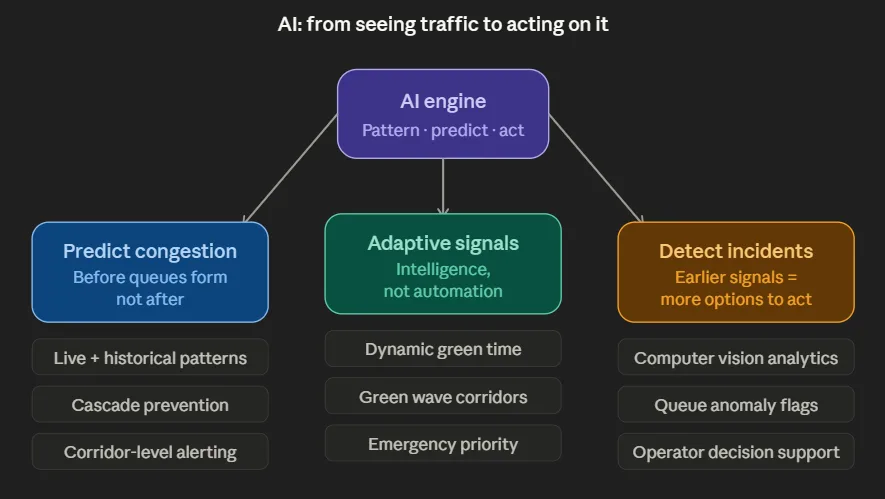
This is one of the most important uses of AI in smart traffic management.
A traditional control room reacts after queues become visible, while an AI-supported system can do more than that.
It can read live and historical traffic patterns together and flag where pressure is likely to build next.
That matters because congestion is rarely isolated.
One overloaded junction can affect:
Dubai’s traffic operations offer a useful reference here.
The city has been investing in predictive and AI-enabled signal control because the goal is not only to manage what is happening right now.
The goal is to reduce the chance that local congestion turns into wider corridor delay.
That is a much stronger operating model for any smart city traffic network.
This is where AI becomes visible on the road.
Instead of sticking to static timing plans, an AI-supported smart traffic control system can help adjust signal behaviour based on actual conditions.
That can mean:
This is especially important in cities where traffic behaviour is irregular.
Take Bengaluru.
The value of AI there is in helping the system respond to mixed traffic, uneven lane discipline, and rapidly changing demand patterns that fixed logic often struggles to handle.
That is the practical difference between automation and intelligent traffic management.
Automation follows rules while intelligence adjusts to reality.
A large share of traffic disruption begins as an incident, a breakdown, an illegal stop, a vehicle moving slowly in the wrong place, or a queue forming faster than expected.
Computer vision and AI-supported video analytics are helping cities detect these conditions earlier.
That changes what operators can do, as now, instead of waiting for a complaint, a field update, or a visible breakdown in flow, teams can get earlier signals from the network itself.
This is where smart traffic monitoring becomes much more useful.
It stops being passive observation and starts becoming operational support.
The earlier the city knows, the more options it has.
One thing I’m sure of is that the future of smart traffic management systems will not be defined by who installs the most devices.
It will be defined by who connects systems well, governs data properly, and creates room for the network to keep getting smarter over time.
That is already visible in how leading cities are evolving, and in the trends they’ve brought to light.
Traffic operations are moving beyond standalone signal systems.
They are beginning to connect with:
This matters because road traffic does not operate in isolation.
A modern smart city traffic management system works better when it can coordinate across agencies and services, not just intersections.
Digital twins are discussed as planning tools, but increasingly, they are becoming useful in live traffic strategy as well.
Cities can test scenarios, understand corridor-level changes, and model the likely impact of interventions before making them on the road.
That reduces risk.
It also helps leaders make better infrastructure and control decisions with more confidence.
The future is not edge or cloud.
It is both.
Cities need edge capability for fast, local decisions.
They also need central platforms for network-wide visibility, analytics, and control.
That hybrid model will define the next generation of smart traffic systems because it matches how traffic actually behaves in the real world.
As systems become more intelligent, governance becomes more important.
Cities will need clear thinking on:
This may sound less exciting than AI or digital twins, but it will shape long-term success.
The hard part is building a smart traffic management system that works in the context of real infrastructure, real constraints, and real operating pressure.
That is where Neuronimbus can help.
We approach smart traffic solutions as a digital transformation problem first and a technology deployment problem second.
That distinction matters, because cities do not need more disconnected tools.
They need systems that can bring field data, control logic, analytics, and operator workflows into one usable environment.
At a practical level, that can mean helping city and transport teams with:
The goal is not to force cities into a rigid template but to help them build a scalable smart traffic management system that matches their current infrastructure and future roadmap.
That is especially important for agencies working with a mixed estate of existing controllers, fragmented data sources, and multiple operating stakeholders.
In those environments, success depends on clarity.
That is the kind of thinking that turns a promising smart city initiative into a working operational system.
And in my view, that is the real opportunity in this space.
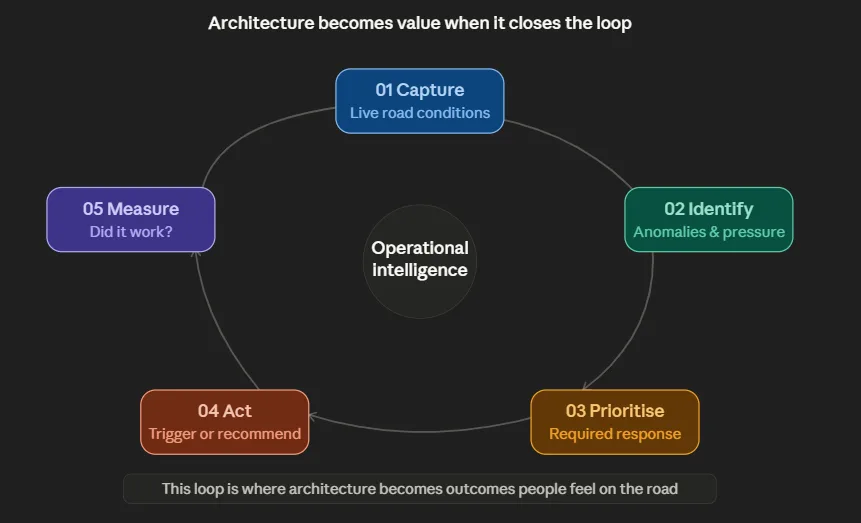
The cities that will get the most value from intelligent traffic management systems will be the ones that connect the right systems, build with architectural discipline, and stay focused on operational outcomes that people can actually feel on the road.
We're happy to start with a no-commitment discovery conversation. Reach out or email us directly.
A smart traffic management system is a city-wide platform that uses real-time data, connected infrastructure, and analytics to monitor, manage, and optimize traffic flow efficiently.
Traditional systems rely on fixed signal timings and limited visibility, while intelligent systems use AI, prediction, and real-time data to adapt traffic flow dynamically.
The system typically includes data capture (sensors, cameras), connectivity, central control platforms, analytics and AI, and execution systems like adaptive signals.
AI helps predict congestion, optimize signal timings, and detect incidents early, enabling faster response and smoother traffic flow across the network.
Common challenges include integrating legacy infrastructure, ensuring real-time data flow, balancing edge and central systems, and converting insights into actionable decisions.

Let Neuronimbus chart your course to a higher growth trajectory. Drop us a line, we'll get the conversation started.






Call Us

Schedule a Call


Your Next Big Idea or Transforming Your Brand Digitally
Let's talk about how we can make it happen.