
Let’s start with a simple definition.
A private LLM is a large language model deployed in an environment that is under the control of your organization, that allows you to govern where prompts, data, and model outputs are processed and stored.
A private LLM is a significant technological venture, and it makes sense when your requirements for data isolation, infrastructure control, offline availability, or sustained inference costs justify running the model yourself rather than relying on an external AI service.
But there are different ways of making an LLM private. And these differences matter because they determine how much control you have and what your team will need to manage.
Let’s clear up what “private” really means here, because people use the word for three fairly different setups.
The word points less at the model and more at two things: where that model processes information and who controls the infrastructure, access, and data flows.
In practice, enterprises use the term private LLM for three deployment arrangements:
There’s one point that I find worth settling early, because it derails a lot of budget conversations. Understanding public vs private vs enterprise AI models is really about deployment, not training.
A private deployment means running an existing model inside your boundary. It does not mean training a model from scratch.
You can take an off-the-shelf open-weight model and serve it privately without touching a single training step. Training is a separate and optional decision.
Most enterprises considering a private LLM for their applications are actually evaluating deployment and adaptation, and not foundation-model training.
So if a private LLM is mostly about deployment, the next question should be about how it compares to the alternatives you’re probably weighing right now.
That brings us to the alternatives.
Also read: LLM Integration for Digital Products: Enterprise Guide 2026
Before we compare private LLMs with their alternatives, it helps to be clear on what these alternatives are.
Here’s how they line up.
One thing worth clearing up, because it’s the most common misunderstanding I hear.
Using an API does not automatically mean your data trains the provider’s models. Many enterprise APIs explicitly keep your prompts and outputs out of their training. And the reverse is just as true. Hosting a model yourself doesn’t make it safe on its own. The moment it sits on your infrastructure, protecting it becomes your job.
Also read: How to Train an AI Model for Enterprise Success
As you work through your decision on whether you need a private LLM, which option is right for you, and how to go about implementing it, two terms are going to keep coming up: RAG and fine-tuning. People often mistake them for alternatives to a private LLM, so it’s worth knowing what each one is before it muddies the waters for you.
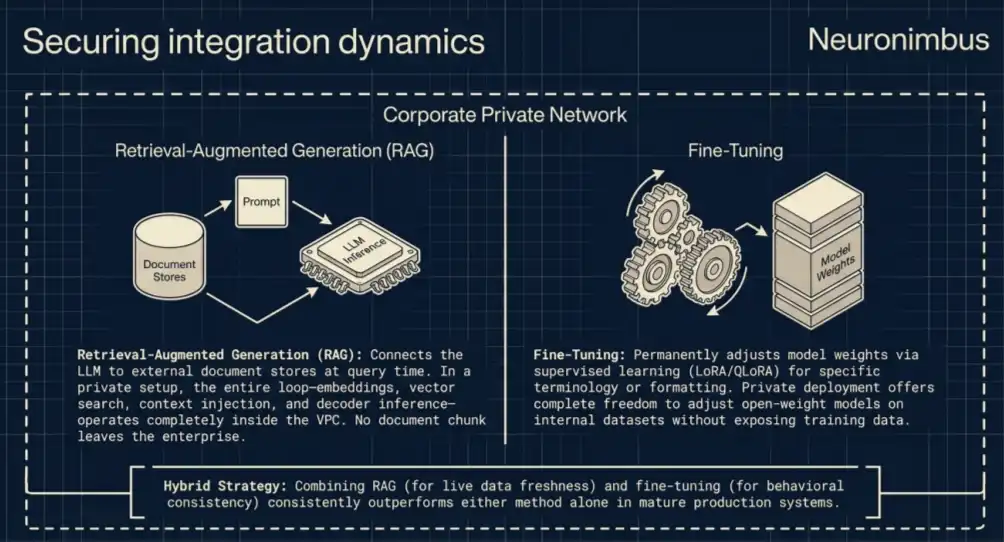
Retrieval-Augmented Generation (RAG) is a technique that allows the model to retrieve information from company documents when answering questions. For example, an HR assistant can look up the latest leave policy rather than relying on information learned during the model's original training.
Fine-tuning is a technique based on further training a model using examples of the tasks you want it to perform. A financial services company, for instance, might fine-tune a model to generate risk reports in a specific format.
Neither of these two approaches can determine whether an LLM is private.
You can use RAG with a public API, an enterprise API, or a privately hosted model. Fine-tuning is also possible where the model and service support it.
Now that we understand the available options, the next question is whether your business requirements actually justify deploying a private LLM.
Also read: How to Make an AI Model: Enterprise Development Guide
We’ve covered what a private LLM is and how it compares to the alternatives. That’s the easy part.
The harder question is whether you actually need one. And I’ll be honest with you. Most companies that ask me this don’t, at least not yet.
So rather than hand you a list of features, let me give you the five things I actually look at. If none of them apply to you, a private LLM is probably solving a problem you don’t have.
Suppose you are building an AI assistant for a financial institution. It needs to analyze customer transactions, internal risk reports, and confidential financial information.
Your security team may require that this information never leave infrastructure approved by the organization.
A private LLM for enterprise use can help meet that requirement because you control where inference takes place.
But there is an important distinction here.
Regulations such as GDPR or HIPAA do not automatically require private hosting. What matters is whether the particular deployment meets your regulatory, contractual, and internal security requirements.
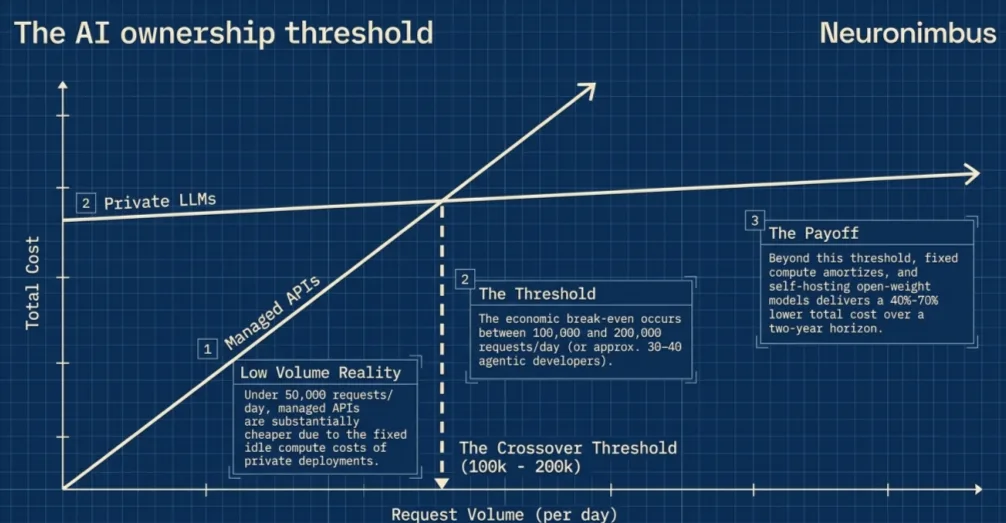
A managed LLM API generally charges according to usage. With a self hosted LLM, you pay for computing capacity whether the model is being used or not.
At low or irregular volumes, the API may be considerably cheaper.
But imagine your organization has thousands of employees using an internal AI assistant throughout the working day.
At that scale, running your own model might become economical because you can distribute infrastructure costs across a large number of requests.
The decision depends on token consumption, model size, GPU utilisation, and operational expenses.
Consider an AI-powered coding assistant.
When an engineer pauses while typing, the assistant should provide a useful suggestion quickly enough that it does not interrupt the workflow.
Hosting the model close to the application can reduce network delays and give you more control over inference performance.
However, private hosting does not automatically make a model faster. Its response time still depends on model size, GPU capacity, prompt length, and how many requests arrive simultaneously.
This is one of the clearest situations where an on-premise LLM makes sense.
Imagine a manufacturing facility where technicians use an AI assistant to troubleshoot machinery.
If the facility has limited external connectivity, the assistant should still be able to retrieve equipment manuals and help technicians identify possible faults.
When the model and its supporting systems are hosted locally, the application can operate without depending on an external API.
With private deployment, your organization can decide which model to use, how inference is configured, what information is logged, and how the application integrates with internal systems.
You also gain greater flexibility to change models without rebuilding around one proprietary API.
However, this freedom comes with responsibility for maintaining the infrastructure.
If your application has relatively low usage, requires advanced proprietary models, or needs to reach production quickly, a managed enterprise API may be the more practical option.
The objective should be to get the control your business needs, without taking on engineering work that delivers little additional value.
Note: What follows is accurate as of October 2026, and you should re-check it before you commit.
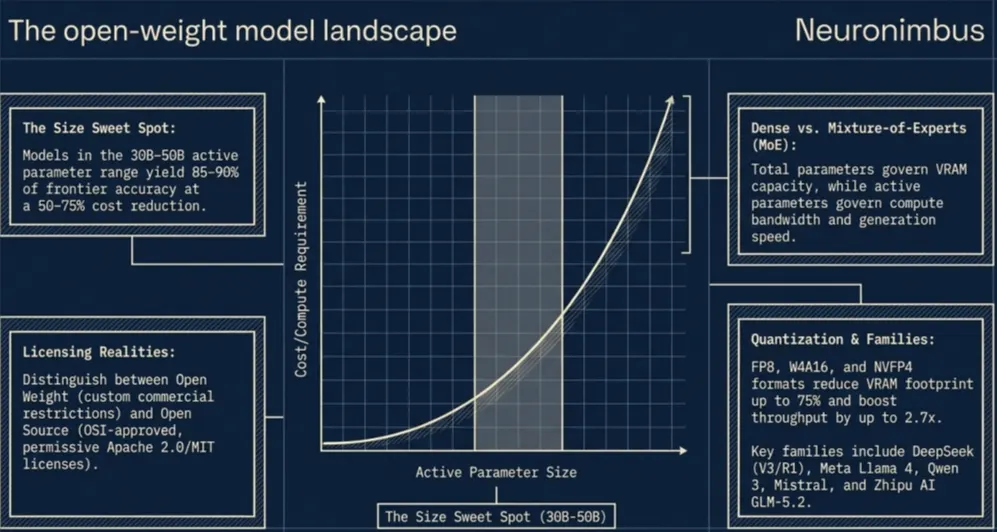
The good news is there's a real choice now. A handful of open-weight families cover most enterprise needs:
There’s one distinction here that matters commercially, because an open source LLM for business use isn’t always as open as it sounds.
Open-weight means you can download the weights. But the licence may cap your users or revenue. Open-source, under Apache 2.0 or MIT, carries no such limits.
Llama and Gemma are open-weight with conditions. DeepSeek and most of Qwen and Mistral are properly open-source. Read the actual license before you build on a model. It decides what you’re allowed to ship, and it’s a cheap mistake to avoid.
For an open source LLM for business, I would evaluate four things:
On size, here’s something that surprises people. You rarely need the biggest model.
A model in the 30-to-50-billion active-parameter range tends to reach 85 to 90 percent of frontier accuracy at a fraction of the cost.
I would therefore benchmark the exact model configuration you intend to run.
Once you have shortlisted the models, the next decision is where to deploy them.
There are three possible homes for a private LLM:
Let me tell you how I’d actually read that table.
For most mid-market teams, private cloud is the sensible middle. You get close to on-premise latency and data isolation, without racking servers or hiring someone to worry about power and cooling.
On-premise approach earns its place in two situations. When you’re genuinely air-gapped. Or when your volume is high enough that owning the metal beats renting it.
And dedicated management suits the team that wants the privacy guarantees but has no real appetite to run infrastructure at all. There’s no shame in that choice; sometimes it’s exactly right.
I’ll be straight with you, there’s no single number I can give you here. A private LLM has costs in layers, so understand the layers first.

Here’s the rule I’d hold onto: raw GPU compute is usually only half to 60 percent of the real bill. The rest is people and operations. If someone quotes you a cost that’s only GPU hours, they’ve shown you half the picture.
Now, let’s say the numbers work for you. How do you actually build this?
Let me walk you through this the way we run it internally at Neuronimbus. There are seven steps, and they go in order. The order is not arbitrary. Each step rests on the one before it.
Start with the job you need done. Be specific about three things.
These are not box-ticking questions. They decide everything that follows, from the model you choose to the hardware you buy. Without a clear target, you have no way of telling whether a model is good enough.
Now you choose a model against that target. Shortlist on two things first.
Then test that shortlist on your own data.
A model can top a public benchmark and still fall short on your specific tasks, simply because your tasks were never on that benchmark. The only test that really counts is the one built from your own work.
This is the ‘Should you deploy a private LLM in the cloud or on-premise?’ section of this guide, put into practice. You decide where the model will run, whether that is your own hardware, a private cloud, or a managed environment. You make that call based on your latency needs, your request volume, and your data rules.
One thing is worth planning for here. Real traffic is uneven, and it arrives in bursts. If you size your setup for the average load, the busy moments will overwhelm it. Size it for the peaks instead.
This is the step where the model starts to understand your business, and it is where most of the value lives. In practice, it comes down to the RAG and fine-tuning decision we talked about earlier. You use RAG to give the model fresh, citable facts from your own documents. You use fine-tuning to give it consistent behavior. And you use both together when both of those things matter.
If you get one step really right in this whole build, make it this one.
Being inside your own perimeter does not make you safe on its own.
You still face prompt injection.
You still have to stop data leaking between internal teams that share the same hardware.
And you still need to answer the ordinary question of who is allowed to access what.
So put the guardrails in before you launch. That means input checks, role-based access, and audit logging. Doing this work now is far less painful than doing it in the aftermath of your first incident.
Build a test set from the real situations your model will meet, rather than from generic examples.
Use automated checks to watch for two things in particular. Answers the model has simply made up, and quality that slips quietly over time. And on anything sensitive, keep a person reviewing the output. The model is a very capable assistant, but it is not the final word.
Finally, you put the model into production, behind a gateway, and then you watch it carefully.
Track your latency, your GPU use, your throughput, and the quality of what the model produces. A private model can degrade slowly and without any announcement. Good observability is simply how you notice that before your users do.
There are four recurring challenges I would pay particular attention to.
A private deployment solves certain data-control problems, but it does not remove the normal challenges of running a reliable enterprise application.
A private LLM can give your enterprise more control over sensitive data, model infrastructure, and how AI applications operate. But the additional control is valuable only when you actually need it.
I would begin by examining your data requirements, expected workloads, integration needs, and operational capabilities. Then compare private hosting against managed enterprise APIs before deciding.
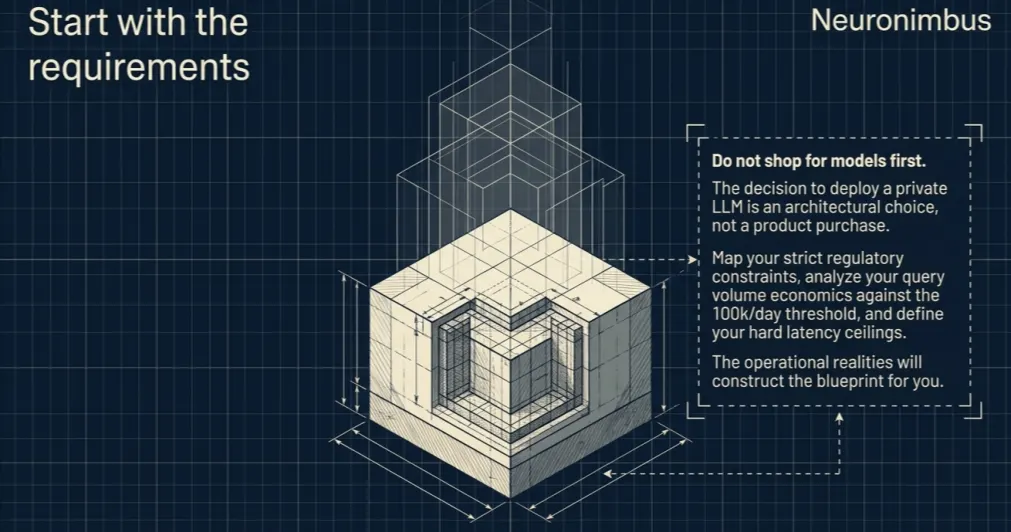
At Neuronimbus, this is how we approach industry AI solutions: by understanding what the business needs the system to accomplish before selecting the technology. If you are keen to evaluate the potential of a private LLM for your enterprise, we should talk.
Yes. An on-premise LLM can operate without internet connectivity when the model, required information, and supporting services are hosted locally. Some external integrations and updates may still require connectivity.
That depends on model size, precision, context length, and concurrent usage. Smaller quantised models may run on a single suitable GPU, while larger models and demanding applications can require multiple enterprise GPUs.
They solve different problems. A private LLM determines where inference runs, while RAG allows a language model to retrieve external information. You can use both together.
Not automatically. Private hosting gives you greater infrastructure control, but security depends on implementation. A well-configured enterprise API may be safer than a poorly secured private deployment.
A basic proof of concept may take only days with an existing model and available cloud infrastructure. A production deployment takes longer because integration, security reviews, performance testing, and operational controls must be completed.

Let Neuronimbus chart your course to a higher growth trajectory. Drop us a line, we'll get the conversation started.


Call Us

Schedule a Call


Your Next Big Idea or Transforming Your Brand Digitally
Let's talk about how we can make it happen.