Before we even scratch the surface of how to build an app like Hala taxi, let’s try to understand the scale of Hala Taxi.
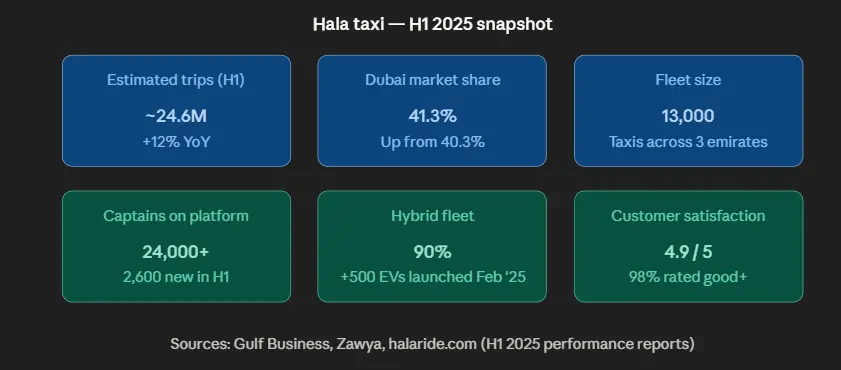
Hala processed an estimated 24.6 million trips in just the first half of 2025.
It holds 41.3% of Dubai's entire taxi market.
It runs 13,000 vehicles with 24,000 captains across Dubai, Ras Al Khaimah, and Fujairah.
And it doesn't own a single car.
Hala is a 51/49 joint venture between Dubai's Roads and Transport Authority (RTA) and Careem. It took an existing government taxi fleet and wrapped it in a modern ride-hailing app with real-time tracking, digital payments, and intelligent dispatch.
The point I’m getting at is that Hala Taxi is not an Uber clone. That's a fundamentally different model. And it's replicable in India, Saudi Arabia, Southeast Asia, Africa, or any city with a regulated taxi fleet that lacks digital infrastructure.
If you're evaluating whether and how to build a taxi booking app of this caliber, this is the guide.
Also read: Startup Mobile App Development: A Comprehensive Guide
It’s a mistake to treat Hala as just another ride-hailing app. It's not. The business model is structurally different, and those differences shape every architectural decision you'll make.
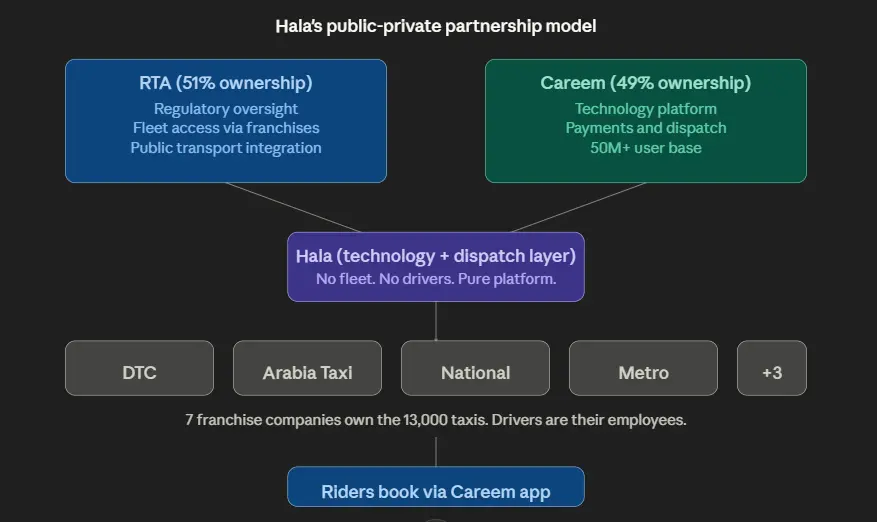
RTA owns 51%. Careem owns 49%. The partnership was announced in December 2018, and Hala officially launched in September 2019.
Hala doesn't have its own app. You book Hala exclusively through the Careem super-app.
Hala plugs into Careem's existing 50-million-plus user base instead of building a separate acquisition funnel from zero.
Uber and Careem can charge 2–3x during demand spikes. Hala doesn't.
Hala uses RTA-regulated metered fares: AED 8 base fare during regular hours, AED 9 at night, AED 12 during peak hours. Distance rate is AED 2.26/km. Time rate is AED 0.50/min.
The only "dynamic" element is at pre-announced event locations like DWTC, Expo City, Global Village where a maximum 1.3x multiplier applies with an AED 20 flag-down.
So, Hala's pricing engine is a rules-based system applying government-set tariffs, not a complex ML-driven dynamic pricing algorithm. Simpler to build. Easier to audit. But it must integrate with Salik (Dubai's toll system), which shifted to variable pricing in February 2025.
Hala's 13,000 taxis are owned and operated by seven franchise companies licensed by RTA — Dubai Taxi Corporation (the largest, ~6,200 taxis), Arabia Taxi, Cars Taxi (now Kabi), National Taxi, Metro Taxi, City Taxi, and others. Each is identifiable by roof color.
Hala is woven into Dubai's transport system.
This level of integration requires API-level partnerships with the transport authority. It's not something a standalone app can replicate without government cooperation.
Understanding this model shapes every feature decision. So let's look at what a CTO should actually be specifying.
Also read: Next-Gen iOS App Development for Business Growth
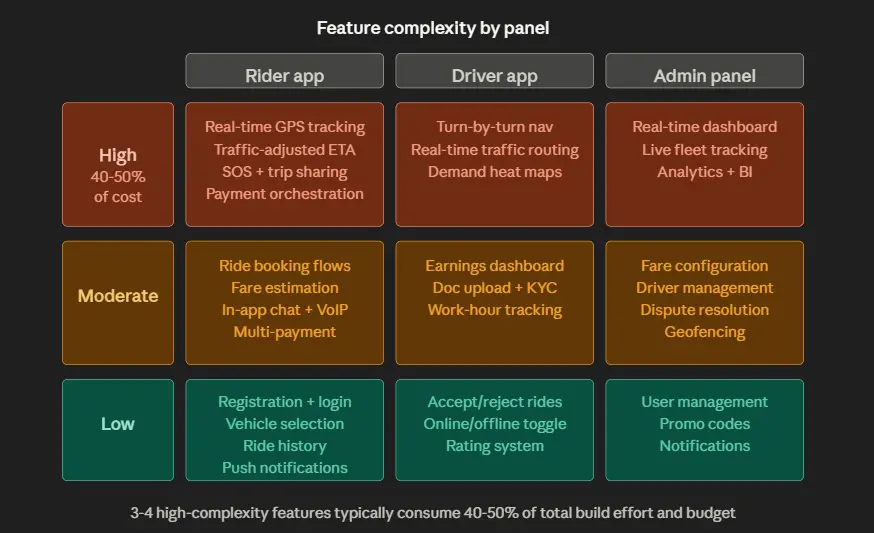
The platform has three pillars. Here's what goes into each:
Insight: This requires WebSocket connections, continuous API calls, driver GPS emissions every 2–5 seconds, and map rendering that stays responsive under load. SOS button with live trip sharing to emergency contacts and integration with local emergency services.
The driver app gets used 8–10 hours a day. It has to be fast and frictionless.
Also read: Convert Website to Mobile App: Complete Guide
The regulatory layer determines whether your platform launches or gets shut down.
Dubai Executive Council Resolution No. 6 of 2016 is the foundation. Any company offering passenger transport through smart applications must get a permit from RTA's Public Transport Agency.
One critical detail that comes from Al Tamimi & Company's legal analysis of the Resolution: operators cannot directly employ drivers in Dubai. You must contract with registered taxi franchise companies that supply licensed drivers and vehicles.
Abu Dhabi operates under the Integrated Transport Centre (ITC) with its own separate requirements. If you're targeting multiple emirates, you need independent compliance with each authority.
The UAE's Federal Decree-Law No. 45 of 2021 (PDPL) is the country's first comprehensive data protection law. For a ride-hailing app processing GPS locations, payment data, and personal information, the key requirements are explicit user consent, data subject rights including erasure and portability, a Data Protection Officer for high-risk processing, and cross-border transfer restrictions.
UAE's Federal Decree-Law No. 33/2021 caps driver hours at 8 per day and 48 per week. Drivers must be sponsored employees of registered companies.
The Labour Ministry has actively warned ride-hailing companies about violations. Both Uber and Careem implemented 12-hour platform caps in response.
Your architecture must include driver-hours tracking and compliance alerting. This is a legal requirement.
The core of what makes Hala work isn't Dubai-specific.
There’s a pattern to ride hailing app development: you take an existing regulated taxi fleet, add a technology layer for booking and dispatch, and partner with the government.
That pattern fits any city where traditional taxis exist but lack digital infrastructure. Two markets show how differently it can play out.
India's taxi market is worth $20.55 billion and growing. Digital penetration in urban mobility is still only around 5%. The opportunity is enormous and the government is actively building for it.
Bharat Taxi launched in December 2025 as India's first cooperative-owned digital mobility platform. It's backed by some of the country's largest cooperative institutions like IFFCO, Amul, NABARD, NAFED, with authorized capital of ₹300 crore (~$36 million).
The ride hailing app development partner is Moving Tech Innovations, the same team behind Namma Yatri. The model is radical: zero commission. Drivers pay a nominal membership fee instead. Within 10 days of launch, 51,000 drivers had signed up. Union Home Minister Amit Shah launched it personally.
Namma Yatri took a different path but reached the same destination. Built on India's Open Network for Digital Commerce (ONDC), it launched in Bengaluru in November 2022. Today it operates in 9+ cities with 430,000 registered drivers, 7 million users, and over 47 million completed rides. Google invested $11 million. It expanded as Mana Yatri in Hyderabad through a partnership with Telangana's T-Hub.
India's regulatory framework supports this.
The Motor Vehicle Aggregator Guidelines 2025 (updated July 2025) set clear rules:
Saudi Arabia's ride-hailing market hit $1.6 billion in 2024 with 80.5 million app-enabled trips. There are 332,000 registered drivers earning over SAR 1.1 billion collectively. Female driver participation surged 48% year-over-year to 22,000.
The infrastructure is moving fast.
Riyadh Metro launched in late 2024, which is the world's longest automated metro system at 176 kilometers with 85 stations.
WeRide's Robotaxi pilot started in Riyadh in July 2025.
NEOM invested $100 million in autonomous vehicles.
The regulatory environment is strict but clear.
The Transport General Authority (TGA) requires facial biometric verification for all drivers.
The new Road Transport Law imposes fines up to SAR 20,000 for unlicensed transport operations, with vehicle impoundment and deportation for non-Saudi violators.
A regulatory sandbox exists for new platforms, offering 12-month testing periods.
For ride hailing app development that targets Saudi, you'll need biometric SDK integration at the driver onboarding layer, Arabic-first UI with RTL layout support, and compliance with Saudi data localization requirements.
The Riyadh Metro integration opportunity mirrors what Hala did with Dubai Metro — first-mile/last-mile connectivity is a proven growth lever.
Both markets validate the same lesson: design your compliance engine as a configurable module, not hard-coded logic. Fare-split rules, surge caps, data residency, driver verification methods, and emergency integrations all vary by jurisdiction. If you build these as swappable policy layers rather than embedded business logic, expanding from one market to the next becomes a configuration task — not a rebuild.
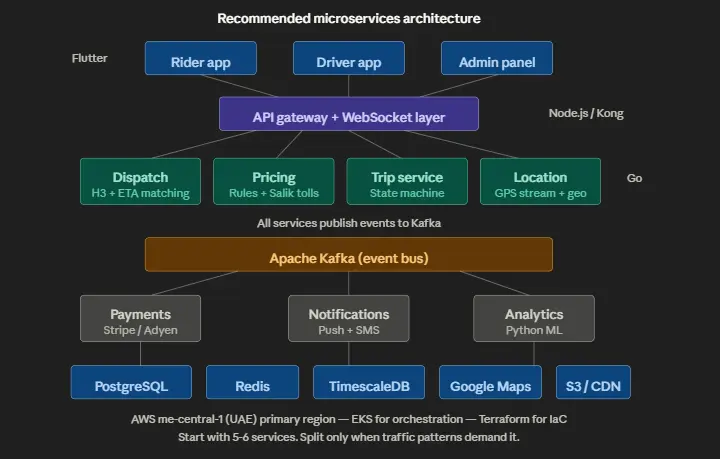
Here's the stack I'd recommend for an app like Hala Taxi — with the trade-offs behind each choice.
A ride-hailing platform needs 8–10 core services: trip gateway, matching and dispatch, pricing, trip state machine, payments, driver location, notifications, user profiles, map and routing, and analytics.
The backbone connecting them is Apache Kafka.
Uber processes billions of Kafka messages daily across topics like ride_requested, driver_location_updated, and trip_state_changed. Every state change in the system flows through this event bus — making the architecture auditable, replayable, and decoupled.
For the real-time layer, driver apps emit GPS coordinates every 2–5 seconds when active. That data flows over WebSocket connections.
For geospatial queries — "find me the five nearest available drivers" — use Redis with GEORADIUS commands for sub-millisecond lookups, and H3 hexagonal indexing for demand heatmaps and zone-based analytics.
One caution: don't over-engineer at launch. Uber's first version was a single dispatch-plus-API service. Start with 5–6 well-defined services. Split them as traffic patterns demand it.
For a GPS-heavy, map-intensive ride-hailing app, Flutter wins.
It compiles to native ARM code — no JavaScript bridge adding latency on every GPS update. Map rendering through the Impeller engine holds steady at 60 FPS. Battery impact is moderate with consistent memory usage. Startup is fast thanks to ahead-of-time compilation.
React Native's advantage is the JavaScript talent pool. But the JS bridge introduces measurable latency on continuous location streams, and in a ride-tracking app, that matters.
46% of cross-platform developers now use Flutter. For ride-hailing specifically, it's the stronger choice. Single codebase for iOS and Android, with 30–40% cost savings over native dual-platform builds.
Go handles 3–5x more requests per second than Node.js in production benchmarks. Its goroutines consume roughly 2KB each versus Node's single-threaded event loop. Uber migrated their geofence service from Node.js to Go specifically for performance.
Node.js is faster to prototype and has a massive ecosystem. It's excellent for API gateways and services that don't need raw throughput.
My recommendation is hybrid:
Insight: Google Maps charges roughly $5–$7 per 1,000 API requests after the free tier. At 10,000 rides per day, maps API costs alone can run $3,000–$10,000 per month. A hybrid approach is to use Mapbox for map display and Google for geocoding, which can cut that by 30–50%.
Let me be direct about something. If you search this question right now, you'll find answers ranging from $5,000 to $400,000.
Here's why the numbers vary so wildly, and how to think about cost as a decision-maker.
What You Get:
What You Get:
What You Get:
Anything quoted below $30,000 is almost certainly a reskinned template with limited customization. Anything above $400,000 usually bundles services beyond ride hailing app development and extends to fleet setup, marketing, operations consulting.
The $5K-to-$400K spread in the cost to build an app like Hala Taxi comes down to four things:
This is where I see the biggest gap in every guide on Hala taxi app development cost. They quote what it costs to build. They never mention what it costs to run.
Here's what Year 1 actually looks like after launch:
For a production-ready platform launching in the UAE market:
3-year total: $620,000–$2.1 million.
The critical insight here is that development is only 15–25% of the 3-year TCO. The remaining 75–85% is operations, marketing, driver economics, and infrastructure scaling.
Any conversation about the cost to build a taxi booking app that only covers the build is giving you a quarter of the picture.
Break-even benchmark: most ride-hailing platforms need 1,500–2,500 daily rides to reach profitability. That typically takes 12–18 months.
We've been building digital products for over 20 years. 5
00+ clients across 16 markets.
ISO 9001 certified.
AWS, Azure, and Google Cloud partners.
Teams across India, Australia, and the US.
Our client list includes names like KFC, Bose (where our redesign drove a 35% sales increase), Mahindra, Whirlpool, Panasonic, Jaguar Land Rover, and PwC.
Also read: KFC's Digital Recruitment Revolution by Neuronimbus
I'll be straightforward; we don't have a ride-hailing app in our portfolio today. What we do have is deep experience in the exact capabilities a platform like this demands:
Our CRUX UX methodology ensures the rider and driver interfaces are designed for retention, not just functionality. In a platform where user experience directly drives adoption and driver satisfaction, that discipline matters.
Here's how we'd engage on a Hala-like ride-hailing build:
Phase 1 — Discovery & architecture sprint (4–6 weeks): Market analysis, regulatory audit for your target geography, technical architecture design, feature prioritization, and a realistic cost-and-timeline roadmap. Deliverable: a build-ready technical specification you can take to any vendor — including us.
Phase 2 — MVP build (4–6 months): Core rider + driver + admin platform. Single market. Production-deployed. Iterative releases with real user testing from week 8.
Phase 3 — Scale & optimize (ongoing): Post-launch feature expansion, AI dispatch, multi-market rollout, performance tuning, compliance updates.
Each phase is independently scoped.
If you're evaluating a platform build, whether for the UAE, India, Saudi Arabia, or another market, we're happy to start with a no-commitment discovery conversation. Reach out or email us directly.
Hala Taxi operates on a government-backed model with regulated pricing, no surge charges, and integration with public transport, unlike typical ride-hailing apps.
The cost ranges from $50,000 for an MVP to $500,000+ for an enterprise-grade platform, depending on features, scale, and market requirements.
Key features include real-time ride tracking, fare estimation, multiple payment options, driver management, admin dashboards, and compliance systems.
Yes, it can be replicated in markets with regulated taxi fleets by partnering with government authorities and adding a digital booking and dispatch layer.
Major challenges include regulatory compliance, real-time GPS tracking at scale, driver onboarding, payment integration, and high operational costs post-launch.



Let Neuronimbus chart your course to a higher growth trajectory. Drop us a line, we'll get the conversation started.






Call Us

Schedule a Call


Your Next Big Idea or Transforming Your Brand Digitally
Let's talk about how we can make it happen.