Today, mobile apps are an important part of everyday life. People use them to shop, book services, communicate, and manage daily tasks. For startups, a well-built mobile app can become a powerful tool for business growth.
Imagine someone discovering your brand but having no simple way to connect with your business. A mobile app solves this problem by giving customers quick and easy access to your products or services anytime and anywhere.
A well-designed app improves the customer experience. It also helps build trust, increase engagement, and create long-term relationships with users.
This complete guide is designed for startup founders, CTOs, entrepreneurs, and business owners. It explains every stage of startup mobile app development, from planning your idea to launching and growing your application.
By following these best practices, you can create a high-performing mobile app that supports your startup's growth and helps you stay ahead of the competition.
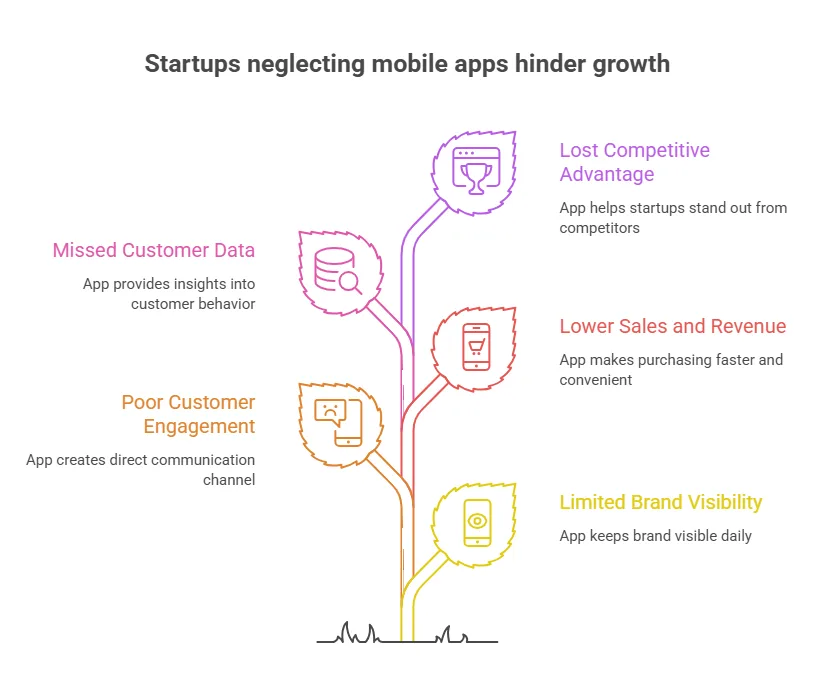
The numbers clearly show why mobile apps are important.
More than 6 billion people around the world use smartphones. Every day, users spend several hours using mobile applications for shopping, entertainment, banking, education, and communication.
For startups, this creates a huge opportunity to reach customers directly through their smartphones.
A carefully planned startup mobile app development strategy offers several business benefits.
A mobile app keeps your brand visible every day.
Instead of waiting for customers to visit your website, your business stays just one tap away on their phones.
This helps:
Mobile apps create a direct communication channel between businesses and customers.
They allow you to interact through:
These features help build stronger customer relationships and encourage repeat business.
A mobile app makes purchasing products or services faster and more convenient.
Features like:
can improve the buying experience and increase sales.
Many startups see higher conversion rates after launching a user-friendly mobile app.
Mobile applications provide useful insights into customer behavior.
You can understand:
This information helps businesses make smarter decisions and improve future updates.
A well-designed startup mobile app development process does more than create an application.
It helps startups:
For many startups, a mobile app becomes one of their strongest business assets.
Successful startup mobile app development always begins with careful planning.
Many startups rush into development without defining clear goals. This often leads to higher costs, delays, and products that fail to meet customer expectations.
Taking time to plan your app before development reduces risks and improves your chances of success.
Start by asking one simple question:
Your answer should clearly explain the value your app provides to users.
Next, identify your target audience.
Think about:
Creating a detailed user persona helps guide every decision during development.
Before building your app, study the existing market carefully.
Look at similar applications and understand:
This research helps you identify gaps that your startup can fill.
Offering a unique value proposition makes your app more attractive to users.
Every successful app starts with measurable goals.
Ask yourself what success looks like.
For example, do you want to:
Setting clear goals helps you measure your app's performance after launch.
It also keeps your entire development team focused on the same objectives.
Planning is more than having an idea.
A complete startup mobile app development strategy should include:
Having a clear roadmap reduces confusion during development and keeps your project moving in the right direction.
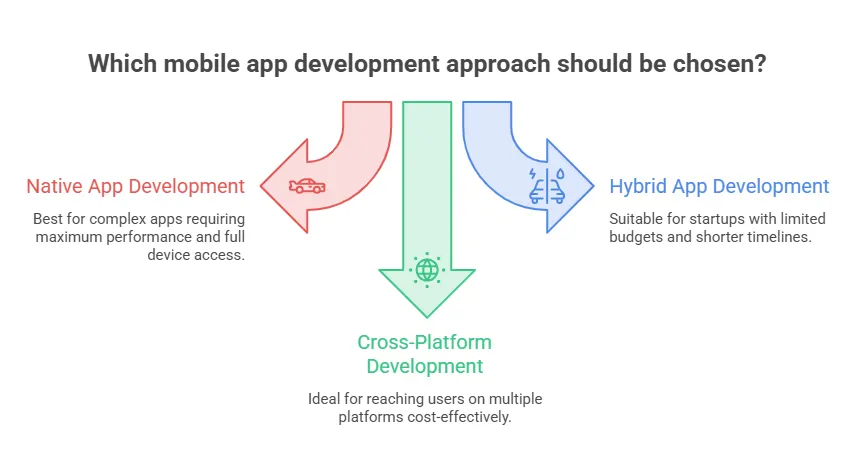
After planning your project, the next step is choosing the right development method.
This decision affects:
There are three main approaches to mobile app development.
Each has its own advantages and limitations.
Native apps are built specifically for one operating system.
For example:
Native development works best for complex applications that require maximum performance.
Hybrid apps combine web technologies with native features.
Developers usually use frameworks like:
Cross-platform development allows developers to build one application that works across multiple operating systems.
Popular tools include:
There is no single solution that works for every startup.
Your decision should depend on several important factors.
If yes, native development may be the better option.
Simple applications often work well with hybrid or cross-platform development.
Development costs vary significantly.
Hybrid and cross-platform development can reduce both costs and development time.
If most of your customers use only Android or only iOS, native development may provide the best experience.
If you want to reach users on both platforms quickly, hybrid or cross-platform development can be a smarter choice.
Choosing the right development approach can be challenging.
Experienced startup mobile app development professionals can evaluate your business goals, technical needs, and budget before recommending the best solution.
Making the right decision at this stage helps reduce future costs and improves your app's long-term success.
After choosing the right development approach, the next step is designing your mobile app.
A good design is more than attractive colors and modern layouts. It should help users complete tasks quickly and without confusion.
This is where UI (User Interface) and UX (User Experience) become important.
Together, they create an app that is both easy to use and visually appealing.
UI design focuses on how the app looks.
It includes all the visual elements users interact with every day.
Some important UI components include:
A clean and consistent interface makes your app look professional and improves user confidence.
Your app's design should also match your brand identity so users recognize your business easily.
UX design focuses on how the app works.
It aims to make every interaction smooth, simple, and enjoyable.
Good UX design includes:
Users should never feel confused while using your app.
Every feature should help them reach their goal with minimum effort.
Investing in user-centered design brings long-term benefits for your startup.
An app that is easy to understand creates a better experience.
Users can complete tasks faster without frustration.
This increases customer satisfaction and encourages positive reviews.
People continue using apps that are simple and enjoyable.
An intuitive design encourages users to:
Higher engagement often leads to stronger customer loyalty.
Fixing design problems after launch can be expensive.
Finding usability issues during the design stage saves both time and money.
Making improvements early also speeds up the overall development process.
Do not wait until the app is fully developed before asking users for feedback.
Instead, build simple prototypes first.
A prototype is a basic version of your app that shows how users will move between screens.
It helps you test ideas before writing large amounts of code.
Creating prototypes allows you to:
Invite real users to test your prototype.
Watch how they use the app.
Ask questions like:
Their feedback helps improve the final product before development begins.
The earlier you collect feedback, the better your final app will become.
The features you include will determine how useful your app becomes.
However, adding too many features can make the app difficult to use.
Instead of building everything at once, focus on solving your users' biggest problems first.
A successful startup mobile app development strategy always prioritizes value over quantity.
Start with the essential features your users need.
These are the features that support your app's main purpose.
For example, depending on your app, core features may include:
Make sure these features work perfectly before adding additional functionality.
Not every feature has the same importance.
Rank your features based on:
Building the most valuable features first helps you launch sooner and deliver immediate value to users.
Looking at successful apps can help you understand what users expect.
Study how leading companies solve customer problems through simple and effective features.
Here are a few examples.
Airbnb transformed the travel industry by creating a simple booking experience.
Some of its strongest features include:
These features make finding accommodation fast and convenient.
Duolingo keeps users engaged by making language learning enjoyable.
Its success comes from features such as:
The app combines education with game-like experiences to encourage daily learning.
Uber changed urban transportation through a simple mobile experience.
Popular features include:
The app removes many of the common frustrations of traditional taxi services.
Adding new features can make your app stand out.
However, too much complexity can overwhelm users.
The best apps are often the simplest ones.
They solve one problem very well instead of trying to solve everything.
Many successful startups begin with an MVP.
An MVP includes only the most important features needed to solve the user's primary problem.
Launching an MVP allows you to:
Users should understand your app within minutes.
Avoid:
A clean design helps users stay focused on their goals.
Your customers are your best source of improvement ideas.
Collect feedback through:
Use this information to improve existing features before adding new ones.
After planning your features and finalizing the design, development begins.
Many successful startups use the Agile development approach because it provides flexibility and faster progress.
Instead of building the entire app at once, Agile divides development into smaller stages called sprints.
Each sprint focuses on completing a small group of features.
Agile offers several advantages.
It helps startups:
Because development happens in small steps, problems can be identified and fixed earlier.
A typical Agile development process includes several stages.
The team decides which features will be developed during the next sprint.
Everyone understands the goals before development begins.
Developers write code and build the planned features.
Regular communication keeps the project moving smoothly.
Short daily meetings help the team:
These meetings improve communication throughout development.
At the end of each sprint, the completed work is demonstrated.
Stakeholders review the progress and provide feedback.
This helps ensure the project stays aligned with business goals.
After each sprint, the team evaluates the process.
They discuss:
Continuous improvement is one of Agile's biggest strengths.
Successful startup mobile app development requires teamwork.
Every member plays an important role throughout the project.
The project manager oversees the complete development process.
Their responsibilities include:
Developers turn ideas into working software.
Depending on the project, they may specialize in:
Their technical expertise brings your mobile app to life.
Designers focus on creating an attractive and user-friendly experience.
Their work includes:
Good design helps improve customer satisfaction and app usability.
QA testers examine the app before launch.
They identify:
Their testing ensures users receive a reliable and high-quality application.
Security should never be treated as an optional feature.
Every startup mobile app handles valuable user information. This may include personal details, passwords, payment information, or business data.
If this information is not protected, users can lose trust in your business. A security breach can also damage your reputation and lead to financial losses.
Building security into your app from the beginning helps protect both your users and your business.
Data protection should be one of your highest priorities.
Your app should use strong encryption to keep sensitive information safe.
This includes:
Encryption makes it much harder for attackers to access private information.
Authentication helps verify that users are who they claim to be.
Adding secure login methods reduces the risk of unauthorized access.
Popular authentication methods include:
These methods improve security while making login easier for users.
Cyber threats continue to evolve.
Regular security audits help identify weaknesses before hackers can exploit them.
A security audit should include:
Finding problems early reduces future security risks.
Startups often work with limited budgets and smaller development teams.
Even with limited resources, security should never be ignored.
Here are a few simple ways to improve app security.
Choose a development company that has experience building secure mobile applications.
Experienced teams understand common security risks and know how to prevent them.
Technology changes quickly.
Keep your app updated with:
Regular updates help protect your app from newly discovered threats.
Security is a shared responsibility.
Help users protect themselves by encouraging them to:
Simple security tips can greatly reduce security risks.
Security should be included throughout the entire startup mobile app development process.
Instead of fixing problems after launch, build security into:
A security-first approach helps build customer trust and creates a safer application.
Building the app is only part of the process.
Before launching your mobile application, it must go through detailed testing.
Testing helps ensure your app:
Skipping testing can lead to poor reviews and unhappy users.
A complete testing strategy includes several types of testing.
Each one focuses on a different part of the application.
Unit testing checks individual parts of the application.
Developers test each feature separately to ensure it works correctly before combining it with other features.
Integration testing checks how different parts of the application work together.
It ensures all modules communicate properly without creating errors.
System testing evaluates the complete application.
The goal is to verify that all features work together and meet the project's functional and technical requirements.
User Acceptance Testing involves real users.
They test the application in real-life situations and provide valuable feedback.
This helps identify:
Testing with real users often reveals problems that developers may overlook.
Your users provide valuable insights.
Their opinions help improve the app before the official launch.
Gather feedback through:
Listening to users helps create an app that better meets customer expectations.
People use many different smartphones and operating systems.
Your app should provide a consistent experience across all supported devices.
Test your app on:
This helps prevent compatibility issues after launch.
Performance testing measures how well your app works under different conditions.
Important performance areas include:
Fast and reliable apps keep users satisfied and improve retention.
Quality should be part of every development stage.
Instead of testing only before launch, make testing an ongoing process.
To improve quality:
Continuous testing helps maintain high standards throughout the app's lifecycle.
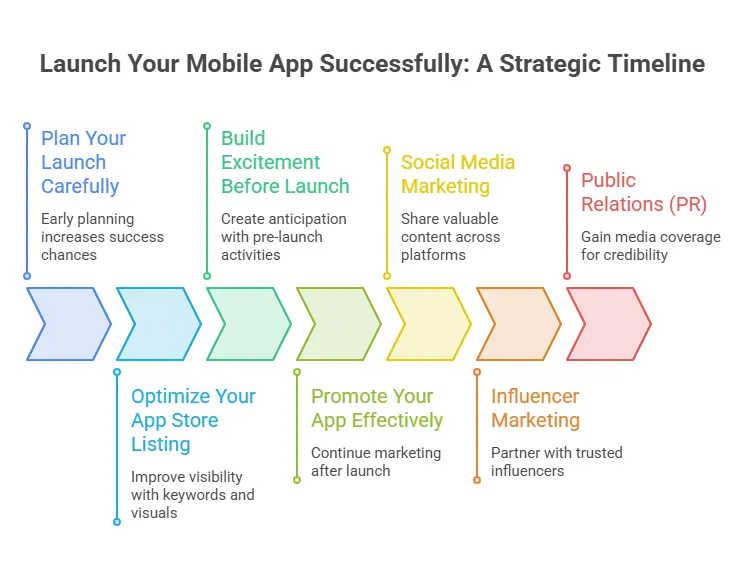
Launching your app is a major milestone.
However, building the app is only half the job.
A strong launch strategy helps your application reach the right audience and generate downloads from the beginning.
Planning your launch early increases your chances of success.
App Store Optimization (ASO) improves your app's visibility.
A well-optimized listing helps more users discover your application.
Focus on:
Better visibility usually leads to more downloads.
Start promoting your app before it becomes available.
Creating anticipation helps generate interest and attract early users.
Some effective pre-launch activities include:
Building awareness before launch can increase downloads on day one.
Marketing should continue after your app goes live.
Use multiple channels to reach your audience.
Share valuable content across platforms where your audience spends time.
Examples include:
Regular posting helps keep users engaged.
Partner with trusted influencers who already have your target audience.
Their recommendations can increase:
Choose influencers whose audience matches your ideal customers.
Media coverage helps increase credibility.
A strong PR campaign can introduce your startup to a larger audience.
Consider:
Product launch announcements
Positive media attention can significantly improve brand visibility.
Building a successful mobile app for your startup takes more than a great idea. It requires careful planning, the right development approach, user-focused design, strong security, thorough testing, and continuous improvement after launch.
Every stage of the startup mobile app development process plays an important role. From understanding your target audience to choosing the right technology and launching your app effectively, each decision can influence your app's long-term success.
Remember these key takeaways:
Most importantly, remember that a successful mobile app is not just about technology. It is about solving real customer problems and delivering value through a smooth and engaging user experience.
As your startup grows, your app should grow with it. By listening to user feedback, tracking performance, and adapting to changing market needs, you can build an application that remains useful, competitive, and scalable for years to come.
If you're ready to turn your app idea into a successful digital product, partnering with an experienced mobile app development we can help you accelerate your journey. With expertise in designing, developing, and scaling high-performance mobile applications, Neuronimbus can help transform your vision into a secure, scalable, and user-centric mobile app that drives long-term business growth.
Mobile app development helps startups build a stronger digital presence, improve customer engagement, increase brand awareness, and create new revenue opportunities. A well-designed mobile app also provides valuable user insights, helping businesses make better decisions and stay competitive.
The best development approach depends on your business goals, budget, and target audience. Native app development offers the best performance, hybrid development provides a balance between cost and functionality, and cross-platform development allows startups to build apps for multiple platforms using a single codebase.
Startups should focus on building a Minimum Viable Product (MVP) with essential features that solve their users' primary problems. Common MVP features include user registration, secure login, search functionality, push notifications, payment integration, and user profiles. Additional features can be added later based on customer feedback.
Startups can improve app security by using data encryption, strong user authentication, regular security audits, secure coding practices, and timely software updates. Testing the app for vulnerabilities and educating users about security best practices also helps protect sensitive information and build customer trust.
Launching the app is only the beginning. Startups should continuously monitor app performance, collect user feedback, fix bugs, release regular updates, and improve features based on customer needs. Ongoing optimization helps increase user satisfaction, improve retention, and support long-term business growth.



Let Neuronimbus chart your course to a higher growth trajectory. Drop us a line, we'll get the conversation started.






Call Us

Schedule a Call


Your Next Big Idea or Transforming Your Brand Digitally
Let's talk about how we can make it happen.