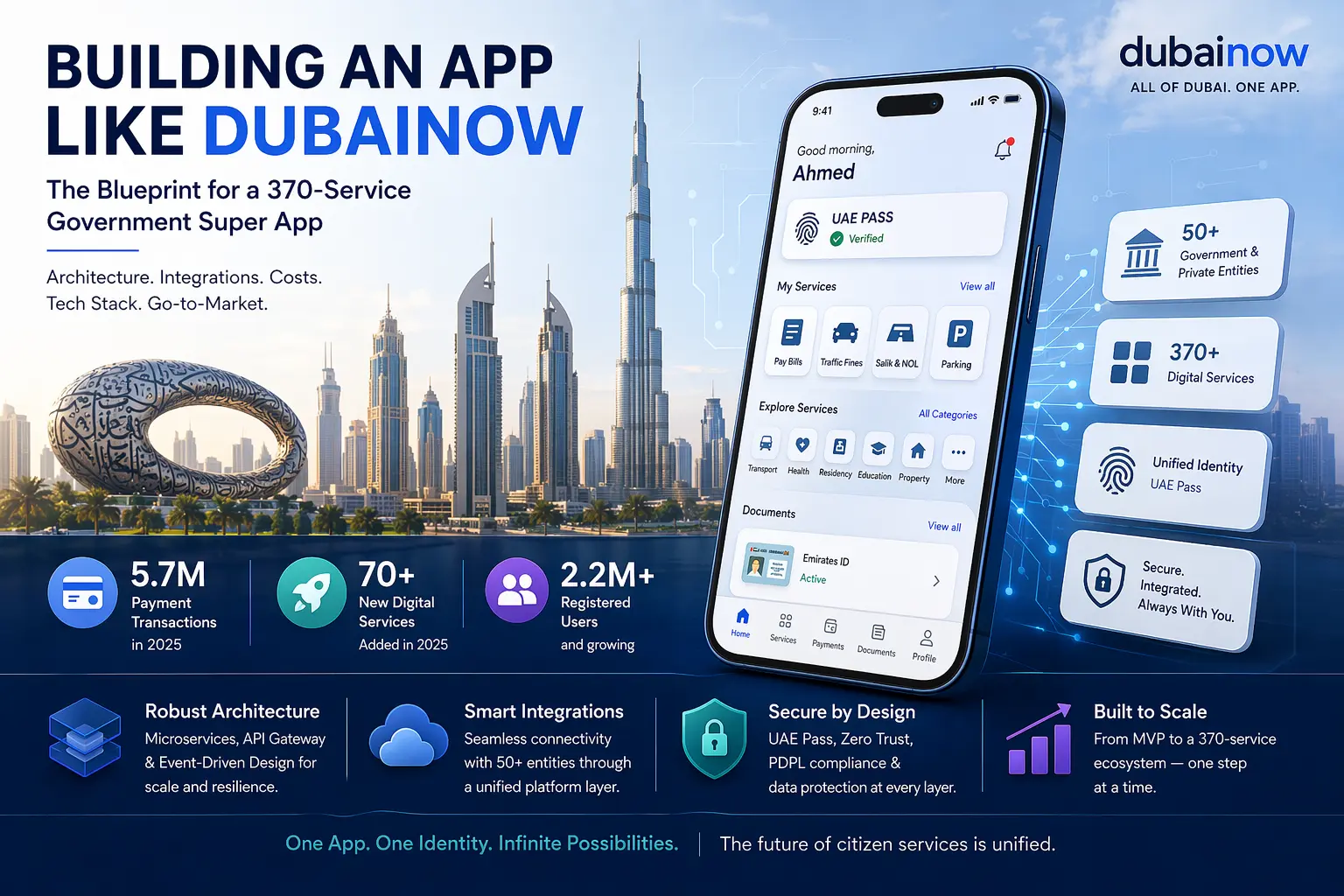
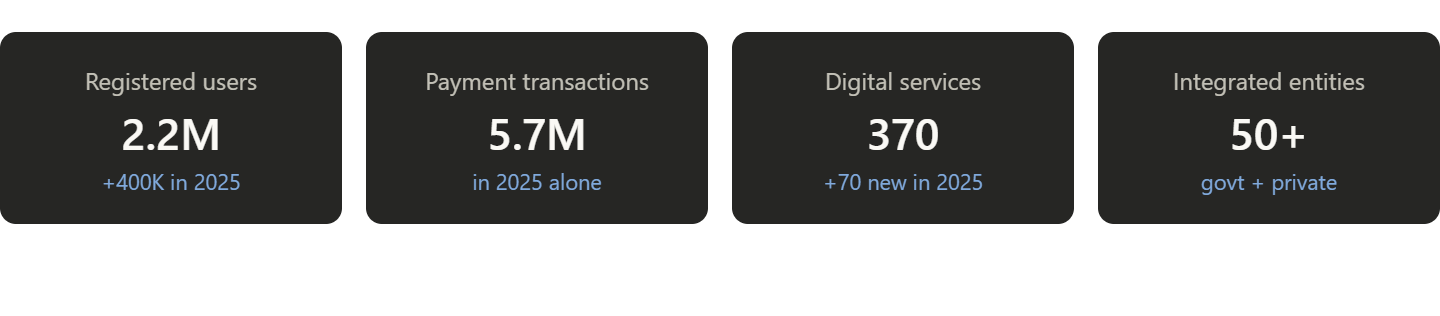
In 2025, the DubaiNow app processed 5.7 million payment transactions, added 70+ new digital services, and crossed 2.2 million registered users.
So, at some point, a digital asset can become as big as a city’s operating system.
What started in 2015 as a basic bill payment tool is now a unified platform connecting 370 services from 50+ government and private entities in Dubai. The app covers everything from paying your DEWA bill to renewing a residency visa to booking a public park.
And this is exactly why CTOs and IT leaders across the Middle East, South Asia, and beyond are asking the same question: how exactly do you build an app like DubaiNow?
The first step is to stop looking at DubaiNow as an app, and look at it as a platform play that took a decade of engineering, government coordination, and architectural iteration to reach its current scale.
We'll walk through the core features of DubaiNow, the architecture that makes it all work, the tech stack choices that matter, real cost breakdowns by phase, and a go-to-market approach that doesn't require you to build 370 services on day one.
Let's start with understanding what DubaiNow actually is, because most people underestimate it.
Also read: Startup Mobile App Development: A Comprehensive Guide
DubaiNow is described as a government services app. But I feel that undersells it.
To me it’s a unified digital platform that lets citizens and residents interact with 50+ government and private entities through a single interface and a single login called the UAE Pass.
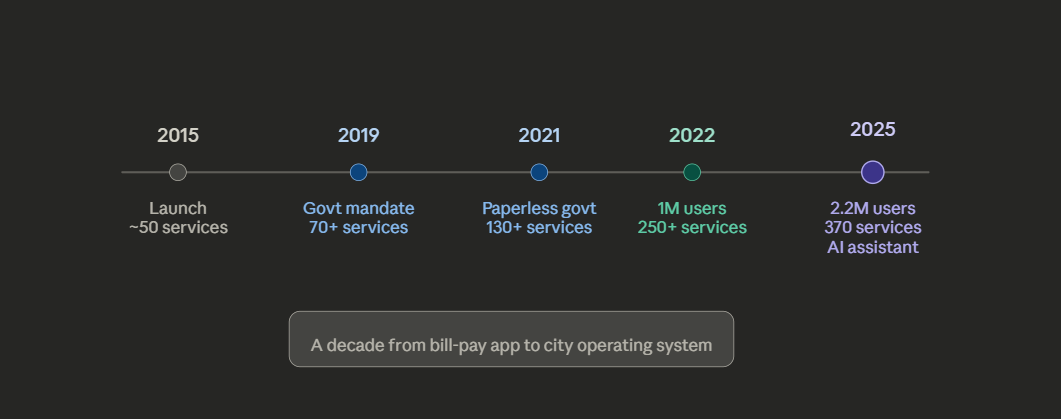
Here's the timeline that puts DubaiNow’s scale in perspective:
Two things have made this growth possible.
First, UAE Pass, which is a national digital identity system serving 11 million+ users. It provides single sign-on across all government services with three verification tiers, from basic mobile verification up to full biometric authentication for legal digital signatures. Every service on DubaiNow authenticates through this one identity layer.
Second, the platform model itself. DubaiNow doesn't just list services from different departments. It transforms department-centric processes into customer-centric ones. A user doesn't think "I need the RTA portal." They think "I need to renew my car." The middleware underneath handles which entity serves what, and it does so invisibly.
That middleware (let’s call it the integration and architecture layer) is where the real complexity lives. The way DubaiNow handles this middleware is why it’s able to deliver 370 crucial services.
Also read: Next-Gen iOS App Development for Business Growth
Most articles on this topic give you a random list of 20 features. That's not useful.
What's more useful is seeing how the features of DubaiNow map to the actual user journey, from sign-up to daily use. Here's how they break down:
Everything starts with UAE Pass, which encompasses biometric verification, Emirates ID-based registration, multi-factor authentication. This identity layer is foundational. Without it, nothing downstream would work. If you're building for a different country, you'll need an equivalent national ID integration or a custom identity solution with similar trust guarantees.
370 services is a lot. DubaiNow handles this with a personalized "My Services" dashboard, AI-powered search, and 12+ service categories. Users can customize favourites with drag-and-drop. The interface runs in both Arabic and English. The AI digital assistant (added in 2025) helps users find the right service without manually browsing categories.

This is the heartbeat of the app. Bill payments (DEWA, Etisalat, du, FEWA, Empower), Salik and NOL top-ups, traffic fines, parking, ENOC fuel — all through multiple payment gateways. The "Pay All" feature lets users settle multiple bills in one transaction. Automatic recurring payments handle the rest.

Insight: DubaiNow’s 5.7 million transactions in 2025 confirm what we see in every super app — payments are the anchor feature that drives daily usage.
The "Documents" section turns DubaiNow into a personal government records vault. It holds Emirates ID, driving licences, residency permits, "Proof of Status" certificates from Dubai Courts. This is the feature that shifts user behaviour from "I use this app sometimes" to "I can't function without it."
"My Vehicles" covers ownership transfers, registration renewal, insurance, plate management, and EV registration. On the property side there are RERA rent calculator, title deed verification, Ejari tenancy contracts, land grants.
Doctor search and appointment booking through DHA, vaccination tracking, prescriptions, lab results. KHDA school directory searchable by rating, fee, and curriculum. Dubai Calendar events, park bookings, pet adoption, fishing licences.
Push notifications for payment deadlines, visa status changes, government announcements. The "Benefits" feature displays programs like Esaad and Bunyan. A Happiness Meter collects satisfaction feedback.
Obviously, you don't build all of this on day one. DubaiNow didn't either.
But you do need to understand the architecture that makes 370 services from 50+ entities work as one seamless experience. That's where most projects either get it right or fall apart.
Also read: Convert Website to Mobile App: Complete Guide
A DubaiNow-style app isn't a monolithic application with a big database behind it. It's a distributed system where dozens of independent services talk to dozens of independent government backends, and the user sees one smooth interface.
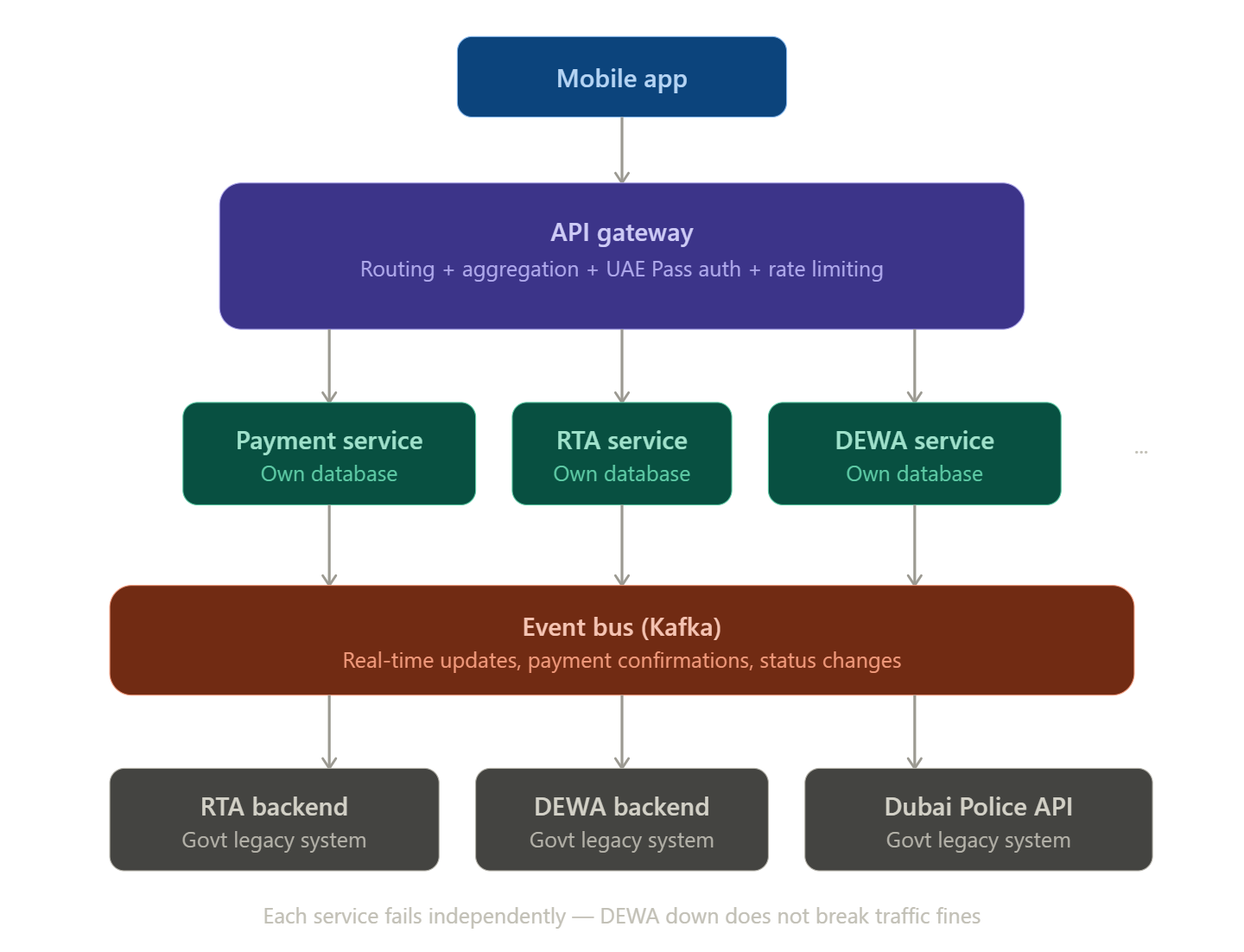
Three architectural pillars make this work.
Every integration such as DEWA, RTA, Dubai Police, GDRFA, Dubai Courts runs as an independent microservice with its own database.
Why this matters: if the DEWA integration goes down for maintenance, traffic fines still work. Health appointments still work. The failure is isolated.
Key patterns that matter at this scale:
A practical note: you don't start with 50 microservices.
Gojek — one of the most successful super apps globally — started with a modular monolith and decomposed as domain boundaries became clear. That's the smart path.
The gateway does three things:
The gateway also normalises wildly different API standards across 50+ entities into one consistent internal contract. This is where the real integration work lives.
Visa application status changes. Payment confirmations. Document verification completions. These need real-time delivery — not polling.
An event-driven architecture using Kafka or RabbitMQ as the message broker handles this through publish-subscribe patterns. WebSockets maintain the live connection to mobile clients.
Dead letter queues capture failed transactions that can't be lost. A payment that fails mid-processing must be retried and not allowed to silently drop.
The code is the straightforward part and the integration architecture is where the real engineering challenge lives. This architecture is what separates a $50K MVP from a $500K platform.
And the tech stack you choose to implement matters. Let's get into that.
Picking a tech stack is about matching each layer of the system to a specific job it needs to do well.
Here's what we'd recommend and why.
Both work. The choice depends on your situation.
Flutter gives you a custom rendering engine (Impeller) that handles complex Arabic RTL layouts and smooth animations across 370+ service screens. One codebase covers iOS, Android, and web.
React Native gives you the JavaScript ecosystem — 1.8 million npm packages and a much larger hiring pool. More importantly, it supports over-the-air updates that bypass app store approval. For a government app that might need urgent security patches or compliance fixes, that's a real advantage.
Our take: Flutter for greenfield builds where UI consistency is the priority. React Native if your team is JavaScript-heavy or regulatory speed matters.
A super app this complex doesn't run on a single backend framework. Different services have different performance needs:
AWS UAE Region (launched August 2022, three availability zones, $5 billion UAE investment through 2036) or Azure UAE North (launched 2019 in Dubai). Both offer local data residency — which is non-negotiable for UAE data protection compliance.
Amazon Payment Services (formerly PayFort) for government-grade trust. PayTabs for Shariah-compliant processing. Telr for 120+ currency support. All must meet UAE Central Bank regulations and PCI DSS.
OAuth 2.0 with UAE Pass integration. AES-256 encryption at rest. TLS 1.3 in transit. Biometric authentication. Service mesh (Istio) for mTLS between microservices.
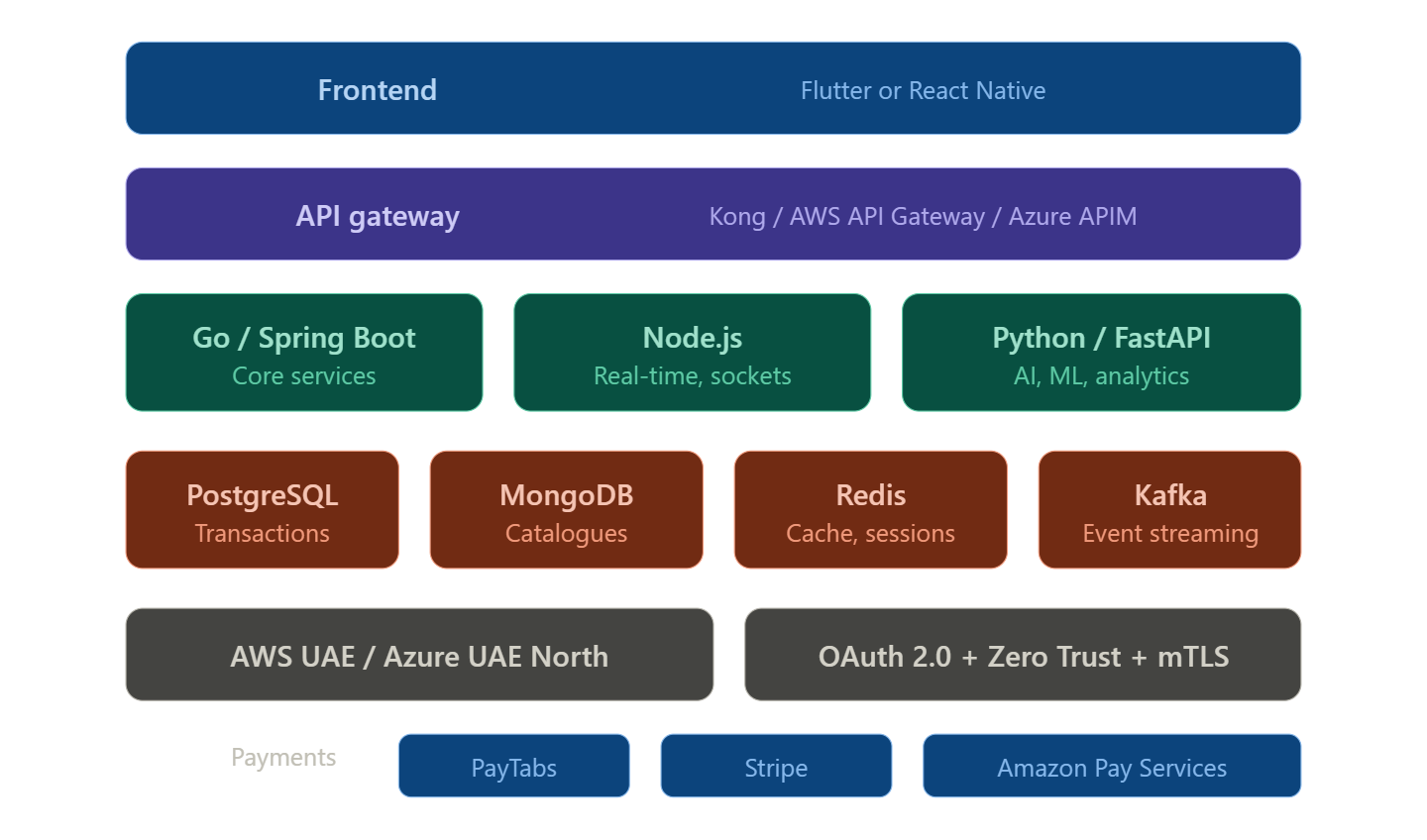
This is a good stack. But here's the thing: the hardest part of building a DubaiNow-like app isn't choosing the tech. It's connecting it to the real world.
Integrating with Stripe takes an afternoon. Integrating with 50 government entities takes years.
This is the part that every "how to build an app like DubaiNow" guide glosses over. So let's be honest about it.
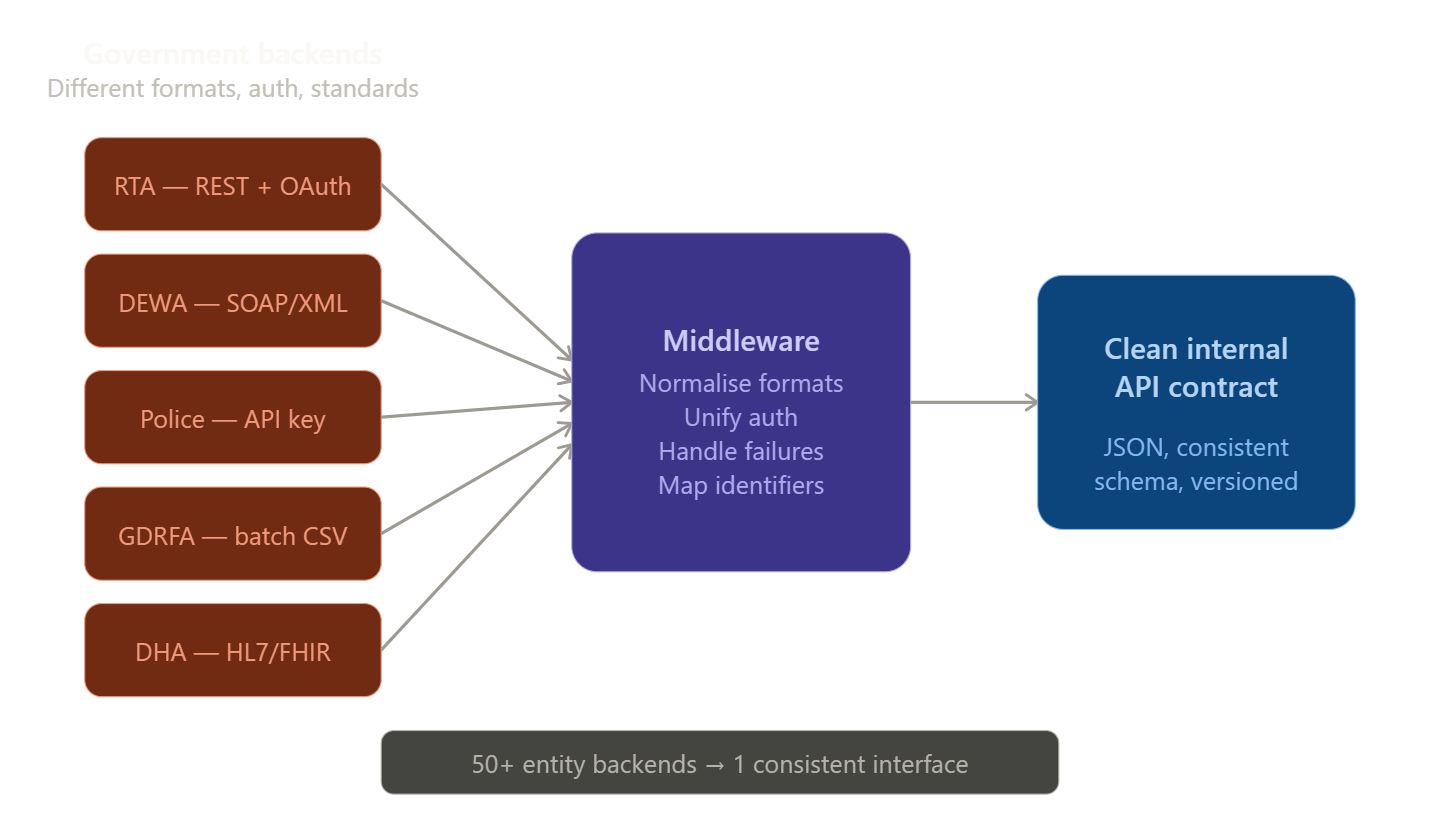
Documentation is incomplete or outdated.
Some entities offer modern REST APIs.
Others still operate on batch updates — CSVs transferred on a schedule.
Authentication varies wildly: one entity uses basic API keys, another uses OAuth 2.0, another requires UAE Pass verification.
Rate limits are tight because these systems weren't designed for high-concurrency mobile traffic.
And according to Deloitte, up to 75% of public sector IT budgets go toward maintaining legacy systems instead of building modern interfaces.
DubaiNow's integration with 50+ entities wasn't just a technical project. It was a multi-year coordination effort backed by a direct government mandate.
Each entity stores data differently. We see XML here, JSON there, proprietary formats elsewhere. Date formats differ. Arabic text encoding varies. A user's "vehicle" in RTA's system and their "vehicle" in Dubai Police's fines database may use entirely different identifiers.
Your middleware layer must normalise all of this into one consistent internal data model. The anti-corruption layer pattern is your friend here as it protects your clean internal architecture from the messy realities of each entity's backend.
The Personal Data Protection Law (Federal Decree-Law No. 45 of 2021) requires full compliance by January 2027. Key requirements include consent management, data subject rights, and cross-border transfer restrictions.
Insight: An important nuance: the PDPL exempts government-to-government processing but it does apply to private developers building government-facing platforms.
On top of that, DIFC and ADGM have their own data protection regimes. The Cybercrime Law adds another layer.
This integration complexity is exactly why the cost to build an app like DubaiNow varies so dramatically. An MVP with 5 service integrations is a fundamentally different project than a platform connecting 50+ entities.
Let's break down what each phase actually costs.
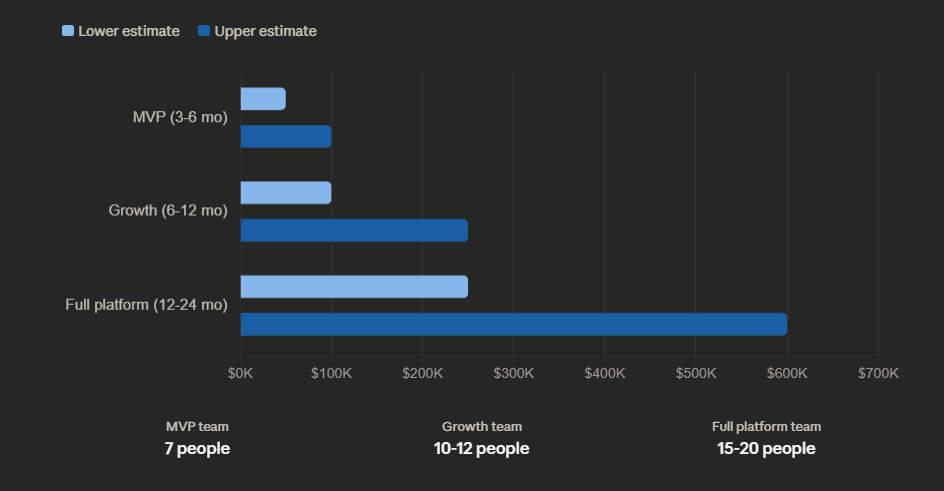
The actual cost to build an app like DubaiNow depends entirely on which phase you're building. Here's how it breaks down in practice:
What you get:
Team: 1 project manager, 1 UI/UX designer, 2 frontend developers, 2 backend developers, 1 QA engineer.
This is your "prove the concept" build. DubaiNow itself started here in 2015.
What you get:
Team grows to 10–12: add a DevOps engineer, a security specialist, and additional developers.
This is where the integration challenges from the previous section become your primary engineering focus.
What you get:
Team: 15–20 people.
For reference, DubaiNow at its current 370-service, 50-entity scale likely cost several million dollars across a decade of government-backed development.
For a platform serving 2 million+ users, expect $8,500–$24,000/month in cloud hosting, databases, CDN, API gateway, and monitoring. AWS reserved instances cut this by 30–50%.
Ongoing maintenance runs 15–25% of initial build cost annually. For a $300K build, that's $45,000–$75,000/year for bug fixes, security patches, OS updates, and API version management.
These numbers raise an obvious question: do you build everything at once, or phase it?
Phase it. Always.
Every successful super app in history started with one thing done well, and then expanded.
The pattern is universal: one high-frequency anchor service → payments → adjacent services → ecosystem.
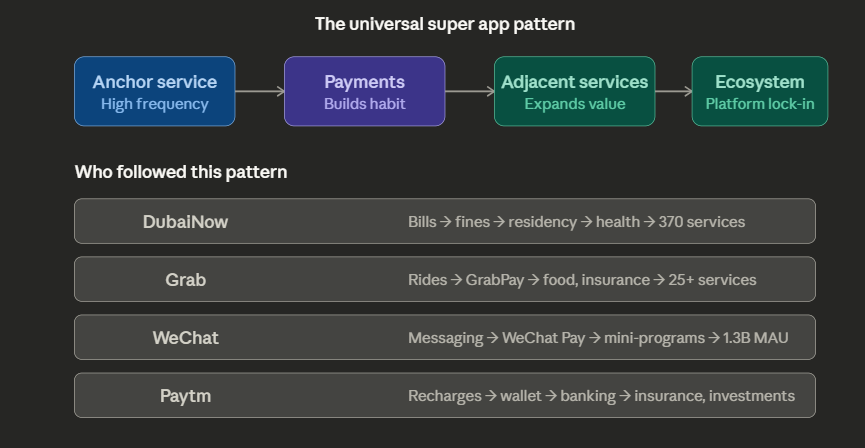
DubaiNow followed this exact path.
It launched in 2015 with utility bill payments. Then added transport (Salik top-ups, traffic fines). Then progressively more complex services — healthcare, education, property transactions.
The real acceleration came in 2019, when Sheikh Hamdan directed all government entities to deliver services through DubaiNow. That mandate pushed the platform from 70 services to 370 in six years.
Even with full government backing, it took a decade.
So what should your phasing look like?
Start with 3–5 services that people use daily or weekly. Bill payments. Fine payments. Parking. These drive the habit loop and become the reason users come back.
Build trust at that stage before you add sensitive services like health records, residency management, or legal documents. Users need to believe the platform is reliable and secure before they hand over that data.
Then let analytics decide what comes next. Don't guess. Look at what users are searching for, what services they're requesting, what they abandon. User behaviour data from Phase 1 should shape your Phase 2 roadmap.
Singapore's LifeSG offers a useful design principle here. Instead of organising services by the government department, they organized "moments of life" — birth registration was first, then other life events followed. The user doesn't care which department serves them. They care about the life event they're dealing with.
This phased approach also de-risks the investment. You validate demand at $50–100K before committing $500K+.
Building a government services super app is a compliance problem, a design problem, and an adoption problem — all at once.
Here are five challenges that consistently trip up teams, and how to handle each one.
The UAE doesn't have one set of rules. It has several.
Federal law (the PDPL). Free zone regimes (DIFC and ADGM each have their own data protection frameworks). Sector-specific rules from the Central Bank for payments and DHA for health data. Plus newer legislation the Child Digital Safety law (2025) and expanded fintech licensing.
No single compliance checklist covers everything.
The fix: engage UAE-based legal counsel before you write a line of code. Build compliance into the architecture.
A platform that aggregates health records, police certificates, financial transactions, and residency data is the highest-value target for cyberattack.
The PDPL requires consent management, data subject rights (access, portability, erasure), and cross-border transfer restrictions. But no adequacy decisions have been published yet, meaning international hosting decisions carry real uncertainty.
The fix: default to UAE-based cloud hosting (AWS me-central-1 or Azure UAE North). Implement Zero Trust architecture. Run regular penetration testing. Don't wait for clarity — build for the strictest interpretation.
Dubai's population is roughly 85% expatriate from over 200 countries. Digital literacy and language expectations vary enormously. Arabic and English are baseline but may not be enough.
The fix: invest in UX research across demographic segments. Implement progressive onboarding. Don't show 370 services on day one. Build trust through clear, transparent data handling communication.
Each new entity integration adds potential failure points. 370 services across 50+ backends means dozens of things can break at any given moment.
The fix: microservices isolation, circuit breaker patterns, comprehensive monitoring (Prometheus + Grafana), distributed tracing (Jaeger), and SLA agreements with every integrated entity.
More services means more complexity. But users expect simplicity.
India's UMANG app offers a cautionary example. It has 22,000+ services but only 20–25% of users engage regularly. Experts cite poor interface design as the reason.
The fix: AI-powered navigation. Abu Dhabi's TAMM platform solved this well. Its AI assistant handles 77% of user requests instantly. Pair that with progressive disclosure (show only what's relevant to each user's profile) and continuous usability testing.
These aren't hypothetical problems. They're the ones we see in every large-scale platform build. And navigating them well is what separates a platform that scales from one that stalls.
I’ve laid out what it takes to build an app like DubaiNow — the features, the architecture, the integrations, the costs, the challenges.
Now here's why this is a conversation we're well-positioned to have.
Neuronimbus has been building digital platforms for over 20 years.
4,200+ digital solutions delivered.
500+ clients across enterprise and startup — KFC, Nikon, Havells, Panasonic, GMR, Mahindra, among others.
Also read: KFC's Digital Recruitment Revolution by Neuronimbus
The closest parallel to a super app build in our portfolio is Havells One, which is a multi-brand eCommerce platform that unified diverse product lines under a single digital experience.
Different brands, different catalogues, different backend systems with one seamless customer interface. That's architecturally the same challenge as unifying 50 government entities under one app.
Here's how our capabilities map to what I explained in this guide:
Building a super app is a multi-year platform play. The right technology partner helps you make the architectural and strategic decisions that determine whether the platform scales to millions or stalls at thousands.
If that's the conversation you're ready to have — let's talk.
DubaiNow app is a unified digital platform that connects 50+ government and private entities, offering 370+ services like bill payments, visa renewals, and bookings through a single interface and login.
Building a DubaiNow-style platform typically takes 12–24 months for a full-scale version. However, a functional MVP with core services can be launched in 3–6 months if you start with limited integrations.
Key features include digital identity integration (like UAE Pass), service discovery, secure payments, document storage, real-time notifications, and integration with multiple third-party or government services.
Costs vary by scale: an MVP can cost $50,000–$100,000, while a full-featured platform with extensive integrations can exceed $500,000 due to complexity in architecture, compliance, and integrations.
The hardest part isn’t development—it’s integration. Connecting multiple legacy systems, normalizing data, handling inconsistent APIs, and ensuring compliance with regulations like PDPL are the real bottlenecks.



Let Neuronimbus chart your course to a higher growth trajectory. Drop us a line, we'll get the conversation started.






Call Us

Schedule a Call


Your Next Big Idea or Transforming Your Brand Digitally
Let's talk about how we can make it happen.