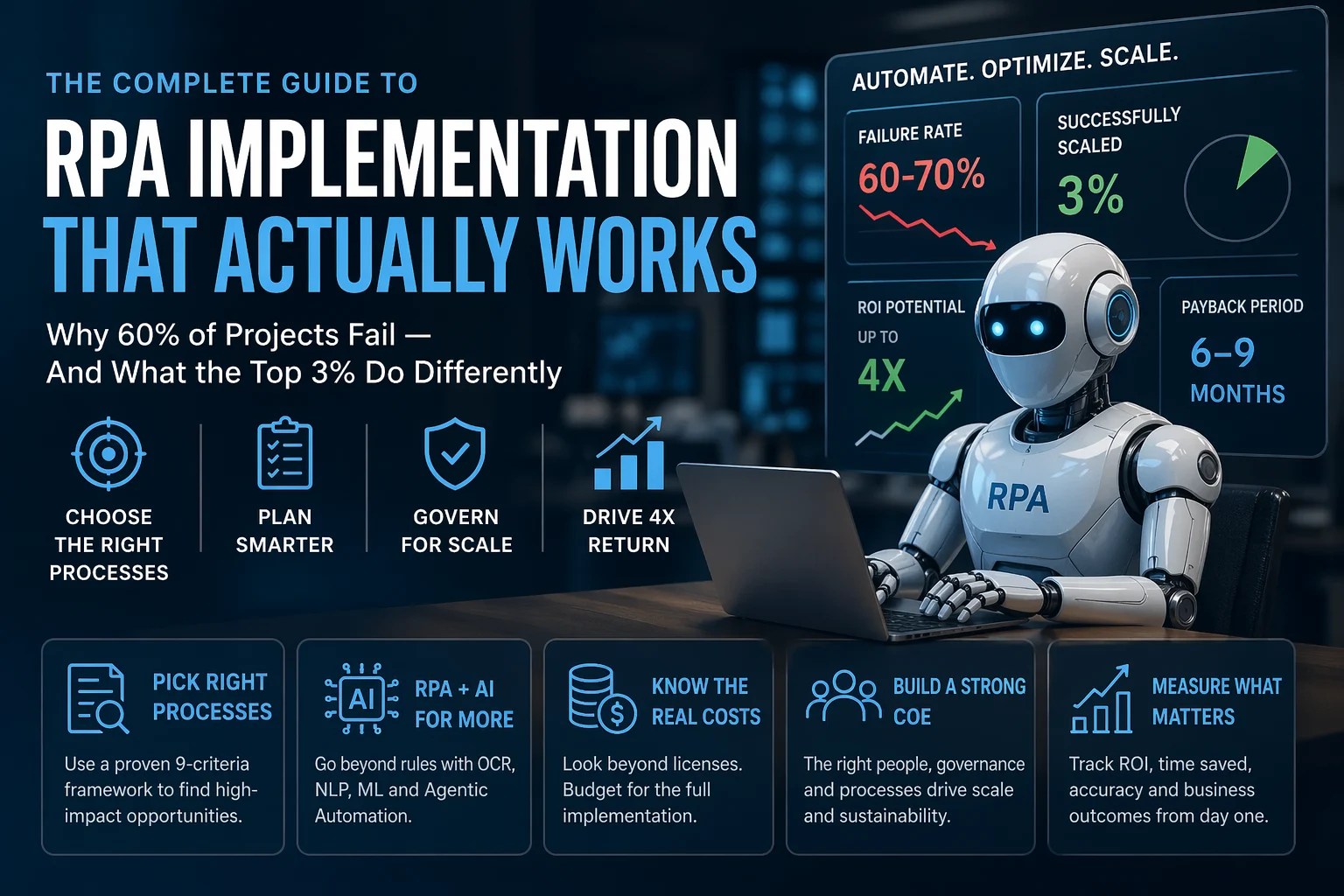
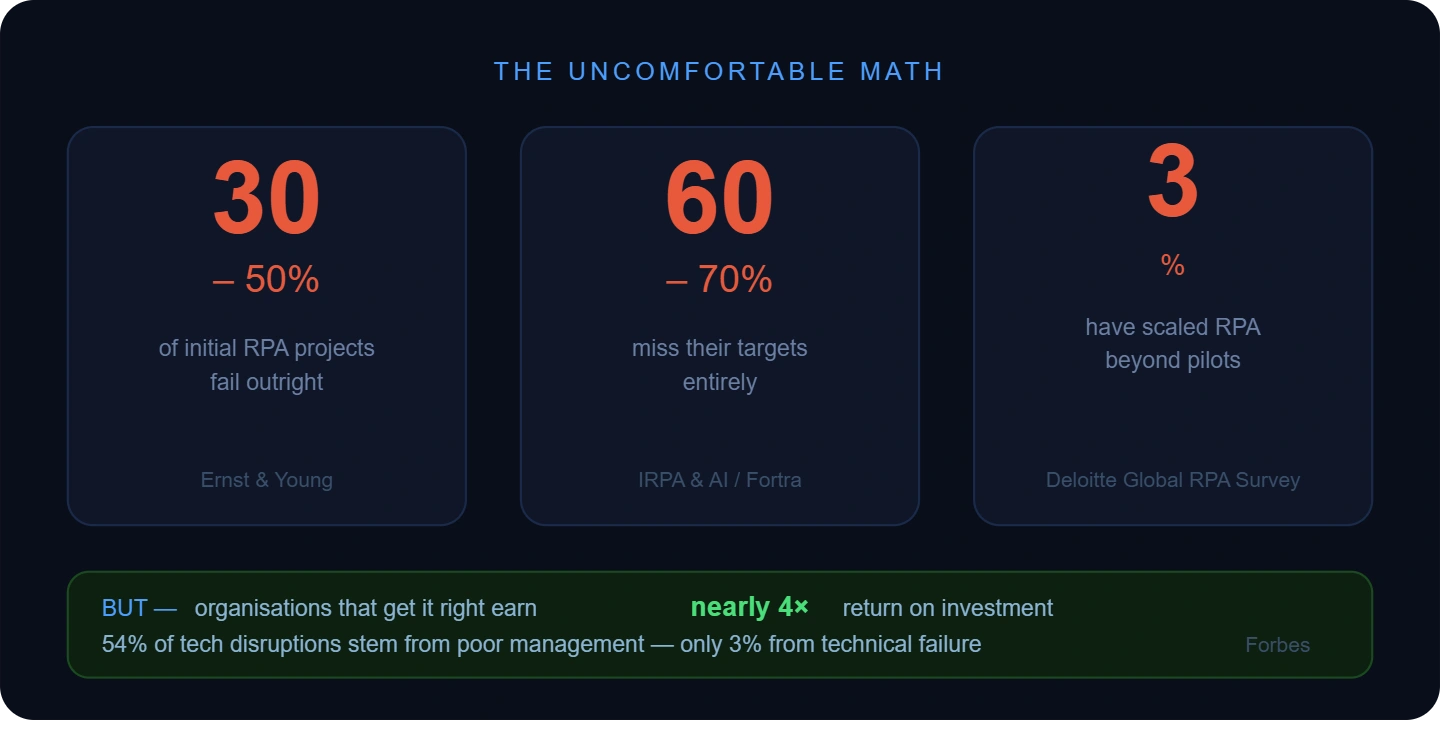
Ernst & Young estimates that 30–50% of initial RPA projects fail outright.
The Institute for Robotic Process Automation puts that number higher, at 60–70%.
Deloitte's Global RPA Survey found that only 3% of organisations have successfully scaled automation beyond isolated pilots.
Three percent.
Yet the same research shows that organisations who get it right earn nearly four times the return on their investment. So the technology works.
The question is everything around it:
This guide is built around what the successful 3% does differently, from identifying the right processes to scaling across the enterprise.
Also read: Future of RPA in 2025: Smarter, Faster Automation
If you're a CTO or IT Director evaluating RPA, you probably know the basics. But it's worth getting the vocabulary aligned before we go deeper into how to implement robotic process automation.
RPA uses software bots to mimic human actions (such as clicking, copying, entering data, moving information between applications) across digital systems.
There are three types worth knowing:
Attended bots work alongside a human. For example, customer service rep triggers the bot during a live call; the bot pulls account history while the rep keeps talking. The human stays in the loop.
Unattended bots run on their own. They are triggered by a schedule or a system event, operating 24/7 without anyone watching. Invoice processing, payroll runs, compliance reports. This is where most back-office automation lives.
Hybrid bots combine both. A human inputs data at the front end; an unattended bot handles the bulk processing; results come back to the human. Useful for workflows that need both judgment and volume.
Where RPA works well:
Where it doesn't:
One more thing worth saying directly: RPA is not AI. Basic RPA follows fixed rules. It doesn't learn, adapt, or reason. That distinction matters when you're deciding what to automate and with what tool.
We'll cover how to implement robotic process automation with AI in a later section.
Also read: AI-Driven Digital Transformation | Future-Proof Your Business
Before anyone evaluates vendors or draws up timelines, the first question is: does the investment make sense?
Here's what the data shows.
The RPA software market was valued at $3.8 billion in 2024 by Gartner, growing at 18% year-on-year.
Gartner estimates the total software enabling hyper-automation will reach $1.04 trillion by the end of 2026.
Worth noting: Gartner also flagged that generative AI slowed RPA market growth from 22.1% in 2023 to 14.5% in 2024. I think that’s not a decline but maturation. AI is becoming part of automation, not a replacement for it.
On ROI, the numbers are consistently strong:
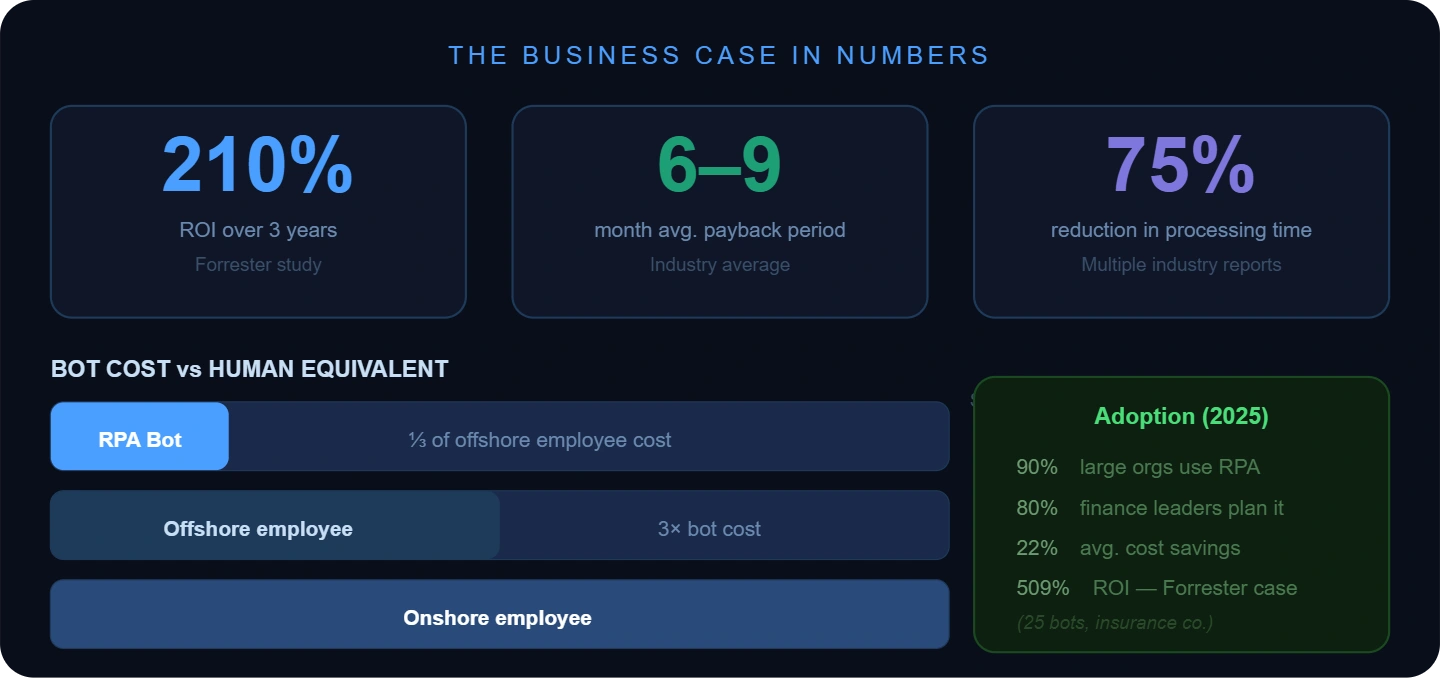
A Forrester study documented 210% ROI over three years, with payback under six months.
A peer-reviewed study across 247 organisations in 15 industries found a median first-year ROI of 150% for financial processes.
Gartner puts the cost comparison simply: an RPA bot costs roughly one-third of an offshore employee and one-fifth of an onshore one.
On adoption, the pressure is already there:
But there’s a counterpoint worth sharing: PwC's 2025 CEO Survey found a 20-percentage-point gap between CEOs reporting efficiency gains from automation (44%) and those seeing measurable profit impact (24%).
So adoption is widespread. Doing it well is not.
That gap is what the rest of this guide is about.
This is where the majority of RPA implementations run into trouble.
"Pick repetitive, rule-based tasks" is the advice every guide gives on how to implement robotic process automation. It's not wrong. But it's not enough to act on.
Here is a scoring framework you can actually use.
Rate each process 1–5 across these nine criteria. Processes scoring 35+ are strong candidates.
Once you've scored your candidates, plot them on a simple grid: Business Value on one axis, Implementation Effort on the other:
The roadmap in the previous section works. The organisations that follow it are the ones generating the success stories.
The ones generating the failure statistics are usually making the same mistakes.
Most of these failures have nothing to do with technology. They are organisational problems with organisational solutions. Keep that in mind as you plan.
Now, a related question that comes up at this stage: what happens when your processes are too complex for standard RPA to handle?
Pure RPA is powerful within its limits but there’s a limit.
The limit is structure.
RPA works on structured, predictable data — the kind that lives in spreadsheets and system-generated files. The problem is that 80–90% of enterprise data is unstructured: emails, scanned documents, handwritten forms, PDFs with variable layouts.
Standard RPA cannot read these reliably.
That's where AI comes in.
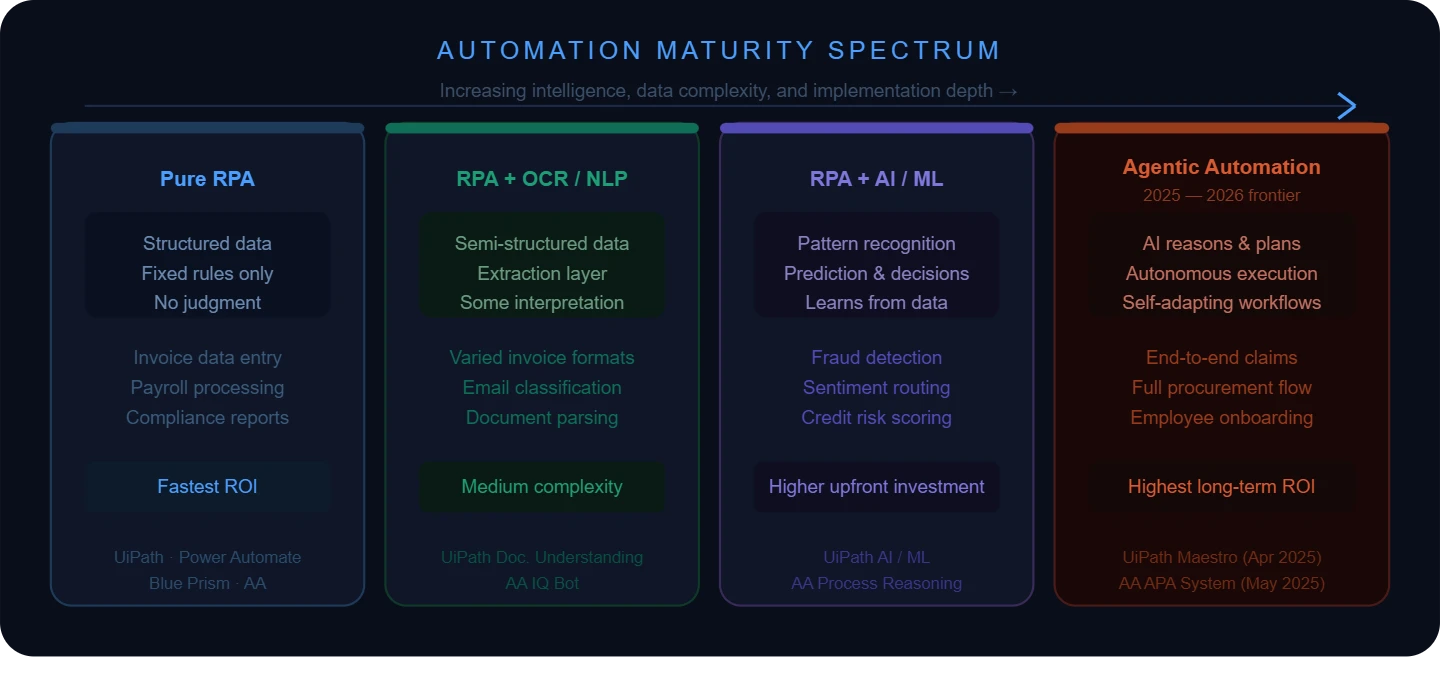
The practical question for most organisations is: where on this scale does your process sit?
If inputs are structured and rules are clear then pure RPA implementation is sufficient and faster to deploy. If you're dealing with documents that vary in format, data that requires interpretation, or decisions that depend on patterns rather than fixed logic, then you need AI in the mix.
Consider this example:
ABANCA, a Spanish retail bank, combined RPA with GPT-4 and NLP to handle customer inquiry processing and document validation. The result was 60% faster customer response times and 1.2 million hours returned to the business. That outcome wasn't possible with rule-based automation alone.
On agentic automation specifically, which is worth paying attention to now, even if you're not ready for it yet:
In April 2025, UiPath launched its Platform for Agentic Automation. Automation Anywhere followed with its Agentic Process Automation system in May 2025. Both platforms allow AI agents to reason and plan across complex workflows, while RPA handles the deterministic execution underneath. Gartner reported a 750% increase in client inquiries about agentic automation between Q2 and Q4 2024 alone.
Gartner has also introduced a new consolidated category called Business Orchestration and Automation Technologies (BOAT). It predicts that 70% of enterprises will consolidate to a single orchestration platform by 2030, up from 5% today. The fragmentation of having six or more automation tools across the organisation is becoming a recognised problem, and the market is responding.
For most organisations beginning their RPA implementation process today, the starting point is still pure or AI-augmented RPA. But the architecture decisions you make now should leave room for this evolution.
With the technology landscape clear, the next thing most decision-makers want to know is straightforward: what does this actually cost?
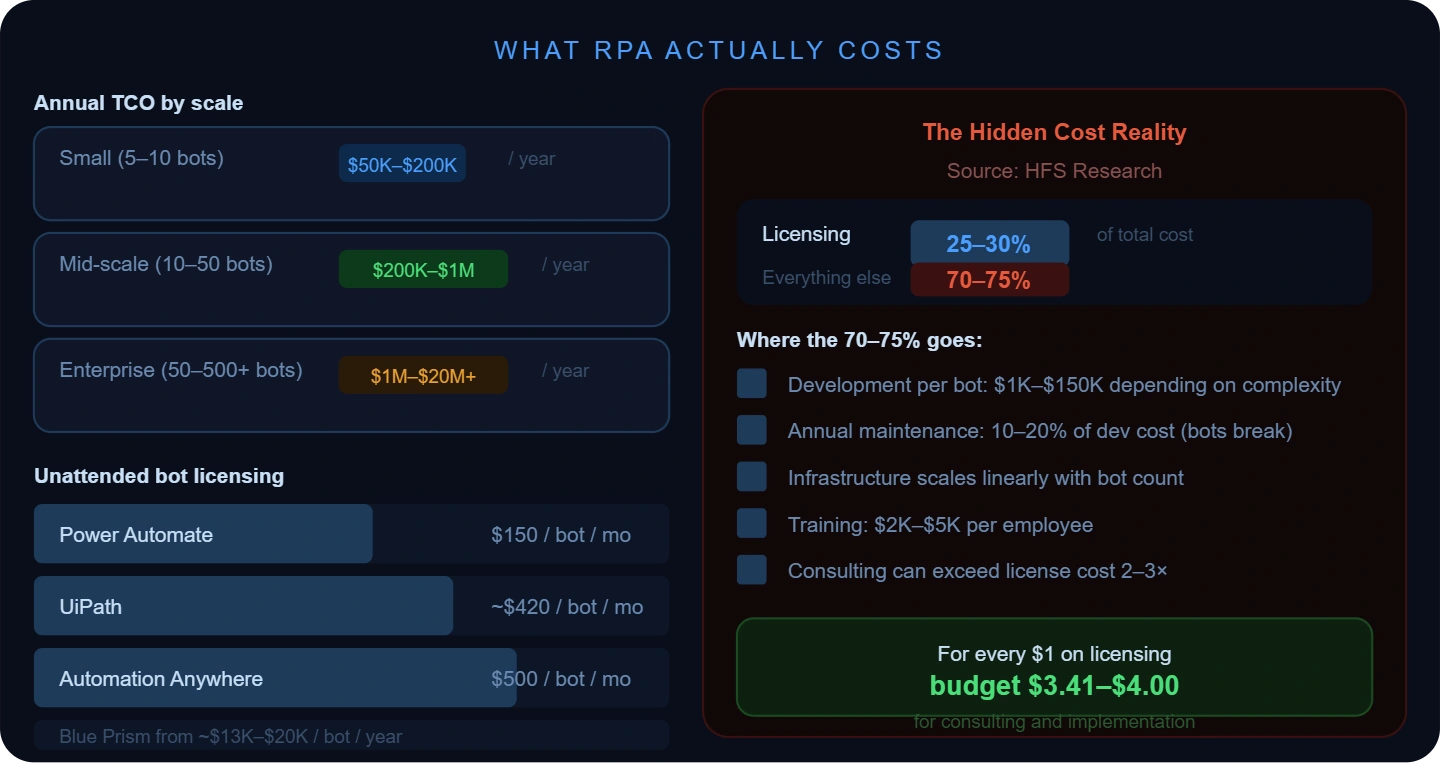
Here is what implementing RPA actually costs, broken down by scale:
Small
Mid-scale
Enterprise
On licensing specifically, the four major platforms sit at very different price points:
UiPath
Automation Anywhere
SS&C Blue Prism
Microsoft Power Automate
Now here is the number most organisations miss in their journey of implementing RPA.
HFS Research confirmed that licensing is only 25–30% of total RPA cost. The remaining 70–75% goes to:
So, for every $1 you spend on licensing, budget $3.41–$4.00 for everything else.
This is not a reason to delay. It's the input you need to build an honest business case; one that doesn't get ambushed by unexpected costs in year two.
On ROI, the payback is real and well-documented.
Industry average payback period is 6–9 months.
A Forrester case study documented 25 unattended robots at an insurance company ($236,000 annual spend) delivering 509% first-year ROI. Top-performing organisations consistently achieve nearly four times their investment.
The organisations that struggle financially with RPA are almost always the ones that budgeted for licensing and forgot to budget for everything else.
Go in with accurate numbers. The returns justify the investment but only if the investment is properly understood upfront.
The fundamentals of RPA implementation are consistent across industries. The processes that work best are always rule-based, high-volume, and structured.
But where the ROI lands highest varies significantly by sector.
Here are five verticals where the results are clearest.
This is the most mature RPA vertical, and the results reflect that.
ICICI Bank started with 10 automated processes. They now run 1,350 processes operated by 750 bots, processing over 2 million transactions daily, with a 60% reduction in execution time across retail, treasury, forex, and trade operations.
Core processes worth targeting: reconciliation, KYC and AML compliance, loan processing, regulatory reporting, account opening.
CareSource, a US healthcare payer serving over 2 million members, now handles 90% of invoices automatically and cuts manual work for clinical management teams by 50%, using the same RPA principles applied to claims processing and prior authorisation.
Core processes: claims processing, patient data management, appointment scheduling, government scheme compliance reporting.
Walmart operates 500+ bots handling over 200 million invoices and managing payroll for 2.3 million employees. Their VP of Shared Services invested in RPA specifically to eliminate back-office costs and redeploy that capacity into customer-facing operations.
Core processes: order processing, inventory updates, accounts payable, returns handling.
Schneider Electric reduced order processing time from 4 hours to 2 minutes using UiPath (a 99% reduction) when standing up a PPE supply chain during COVID-19. Speed of implementation mattered as much as the automation itself.
Core processes: purchase orders, vendor management, bill of materials updates, quality reporting.
Santander reduced employee onboarding from 6 weeks to 2 days for 50–100 new joiners per month. IBM saved 12,000 hours in a single quarter processing promotion data for 15,000+ employees.
Core processes: onboarding, payroll processing, employee records, leave management, expense processing.
The pattern across all five is consistent — high volume, structured data, clear rules, significant manual effort. If your operations in any of these areas still run on manual processing, that's where the RPA conversation should start.
And once that conversation moves from pilot to programme, you need one thing in place before you scale: governance.
Only 3% of organisations have scaled RPA enterprise-wide, according to Deloitte.
The technology isn't what holds the other 97% back. It's the absence of a structure that can manage automation as it grows across teams, across departments, across geographies.
That structure is called a Centre of Excellence, or CoE.
A CoE is a centralized function that sets the standards, governance, and delivery framework for your entire automation programme. Without it, you end up with bots scattered across the organisation.
Three ways to structure it:
The minimum team you need at launch:
Executive Sponsor
CoE Lead / Programme Manager
Business Analyst(s)
RPA Developer(s)
Change Manager
Infrastructure Engineer
You don't need all of these as full-time dedicated hires from day one. But you do need each function covered because each one addresses a failure mode that will materialise if it's ignored.
The governance framework covers:
The intake pipeline deserves particular attention. Without it, automation requests arrive ad hoc, get prioritised by whoever shouts loudest, and the programme loses its strategic direction.
A structured intake process means every automation candidate is evaluated on the same criteria, ranked against the same business value framework, and approved through the same governance gate.
That discipline is what separates programmes that scale from programmes that stall.
Which brings us to how Neuronimbus approaches this and what working with us actually looks like.
Twenty years of digital transformation work across enterprise clients (Whirlpool, Mahindra & Mahindra, Panasonic, Havells, KFC, Nikon) teaches you something that vendors don't always say clearly:
The technology is rarely the problem.
The problem is almost always in the approach. How a process gets selected. How the business case gets built. How the organisation is prepared for what comes after deployment. How the programme is governed as it grows.
That's the lens through which Neuronimbus approaches robotic process automation implementation, and it shapes everything about how we work.
We begin every engagement with process discovery and waste elimination, before any automation is designed or any vendor is selected. Automating a broken process is the most expensive mistake in RPA. We remove that risk at the start, not after something goes wrong.
Rule-based RPA is the foundation. It's rarely the ceiling. Where processes involve unstructured data, variable inputs, or decision points that rules can't capture, we layer in intelligent document processing, NLP, and ML-based decision support. The architecture is designed to grow, not to be retrofitted later.
We stay involved from strategy and process audit through vendor selection, development, deployment, and ongoing optimisation. The client relationship doesn't end at go-live, because that's when the real work of scaling begins.
KPI baselines are set before we build anything. Progress is tracked through deployment. Results are reported against those baselines throughout the engagement.
The organisations that get RPA right treat it as a programme, not a project. A continuous investment in operational capability, not a one-time technology deployment.
If you're evaluating whether RPA is the right investment for your organisation or trying to identify which processes to automate first, the best starting point is a conversation.
We offer a free digital transformation assessment for organisations at exactly this stage. No pitch, no obligation, just a structured look at where automation can deliver the most impact in your specific environment.
Start your free assessment with the Neuronimbus team.
Most RPA projects fail due to poor process selection, automating broken workflows, high exception rates, and lack of governance—not because of the technology itself.
The best candidates are rule-based, high-volume, stable processes with structured inputs and low exception rates. A scoring framework helps prioritize effectively.
RPA follows fixed rules and handles structured data, while AI enables interpretation, prediction, and decision-making for unstructured and complex processes.
RPA costs vary by scale, but licensing is only 25–30% of total cost. Development, maintenance, infrastructure, and governance make up the majority.
Successful scaling requires a Centre of Excellence (CoE), strong governance, clear ROI tracking, and treating RPA as a long-term program, not a one-time project.


Let Neuronimbus chart your course to a higher growth trajectory. Drop us a line, we'll get the conversation started.






Call Us

Schedule a Call


Your Next Big Idea or Transforming Your Brand Digitally
Let's talk about how we can make it happen.