The world of insurance first changed quietly, then all at once.
A few years ago, many insurers could still treat mobile as a nice extra.
Customers would call, email, or use a desktop portal to engage with the insurer.
Today that is no longer enough, and the numbers prove it.
Capgemini’s World Insurance Report found that more than 80% of customer interaction with insurers had already become digital, largely through websites and apps.
At the same time, EIOPA’s work on digitalisation showed that app maturity across insurers is still uneven, which means there is still room to win, not just catch up.
This is where insurance mobile app development becomes important.
When people say insurance app development, they picture a customer app with a login screen, policy card, and claim form. That is part of it, but enterprise-grade insurance application development goes much further. It has to solve for reliability, data security, role-based access, legacy integration, and a smooth user journey at the same time.
So we must treat insurance mobile app development as the process of building secure mobile experiences for policy purchase, servicing, claims, payments, and support, while integrating those journeys with the insurer’s existing systems.
The short answer is that mobile apps are more and more about business performance; here’s how.
Claims is where the impact shows up fastest.
McKinsey notes automation can reduce claims costs by up to 30%. When users submit FNOL in-app with photos and guided inputs, insurers get cleaner data, faster routing, and fewer follow-ups.
A large share of insurer workload comes from simple queries:
These are high-volume but low-value tasks.
Gartner-linked data shows self-service is far cheaper than assisted support. This is why insurance app development services directly reduce contact centre pressure.
Mobile apps improve how data is captured at the source. Instead of incomplete inputs and repeated clarification, insurers get structured, usable data early. This reduces manual handling and improves downstream workflows.
McKinsey links modernized insurance systems with higher policies per FTE and lower IT cost per policy. If the app is only a front-end layer, these gains do not materialize. When built right, insurance app development solutions improve both user experience and internal efficiency.
Insurance is judged during key events such as
If the app works well, trust increases. If it fails, the impact is immediate.
That is why insurers build apps to perform, not just to appear digital.
Not every insurer needs the same app. Insurance application development usually falls into a few distinct categories, and each one solves a different business need.
This is the customer-facing app used for everyday servicing. It includes policy access, digital documents, billing, renewals, claims initiation, status tracking, and notifications.
EIOPA has noted that premium payments, claims, and policy dashboards are among the most common services offered in insurer apps. This is the right choice when the insurer wants to improve self-service and reduce routine support dependency.
This app is more specialized. Its main job is to make claims intake faster and cleaner. A strong version includes guided incident reporting, photo and video upload, geolocation, repair or assistance coordination, and real-time status updates. This type of app becomes especially valuable when claims speed and efficiency are a major business priority.
This one is underestimated, but it can have a very direct operational impact. Agent apps support quoting, onboarding, customer servicing, document capture, and renewal support in the field. For insurers and distribution-led businesses, this can reduce delays, improve data capture, and make advisors more productive during real interactions with customers.
Here, insurance journeys are integrated into another ecosystem, such as automotive, travel, retail, or financial services. The customer may not even think of it as a standalone insurance app. Under the surface, though, APIs, identity, policy flows, and servicing capabilities still need to be built and managed properly. EIOPA’s findings on API use across the insurance value chain support how important this model is becoming.
In other words, the right app type depends on the business problem.
If the goal is better self-service, the policyholder app leads.
If the goal is faster claims handling, a claims-first experience may matter more.
If the goal is stronger distribution, agent enablement becomes central.
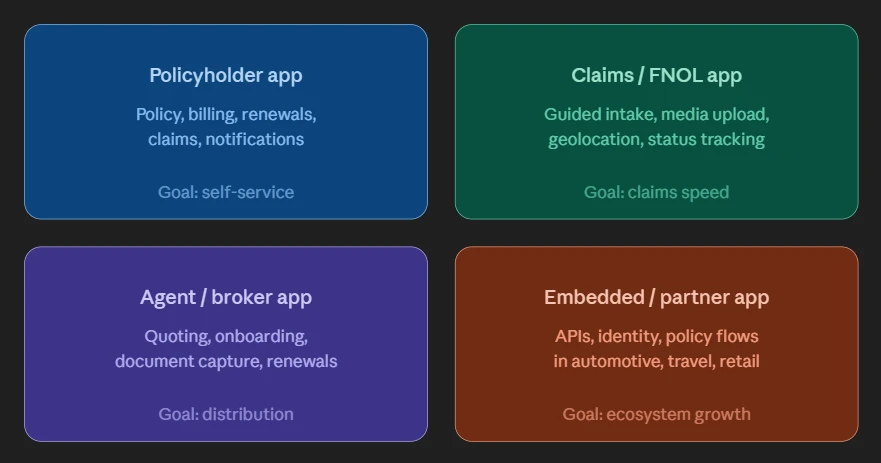
And if the goal is ecosystem growth, embedded journeys come into focus.
Once an insurer is clear about the kind of app it wants to build, the next question is more practical.
What should the app actually do?
This is where many insurance mobile app development discussions could become generic. You often see long feature lists with 20 or 30 items, but they are not prioritized, and they are not tied to real business use. That creates confusion.
In reality, the right feature set depends on one simple rule.
Every feature should reduce friction for the user or reduce workload for the business. The strongest apps usually do both.
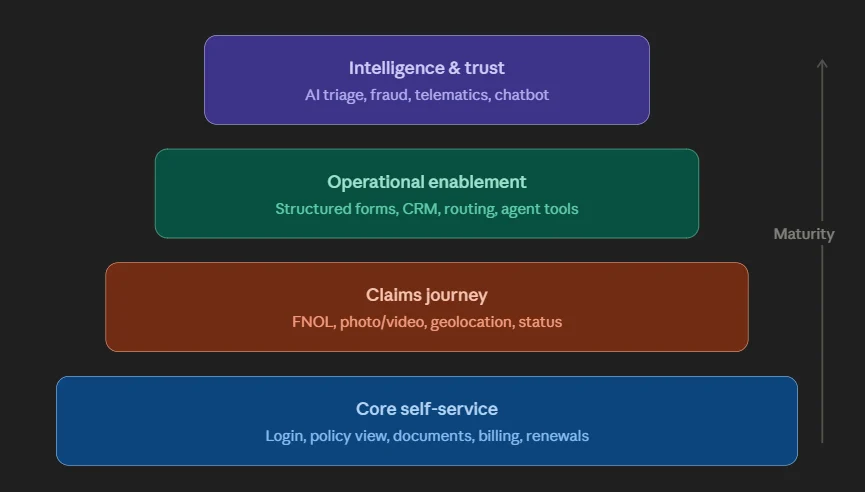
A useful way to think about features is to group them into four layers.
Let us start with the core self-service layer, because this is where most insurers see the quickest impact.
A customer opening an insurance app usually wants one of a few things:
If those tasks are hidden, slow, or broken, the app loses value quickly.
That is why the first set of must-have features in insurance app development is straightforward:
After self-service, claims become the next priority.
This is where mobile can create visible improvement on the ground.
A traditional claims journey often starts with confusion. The customer does not know what to do first. They are under stress. They may give incomplete details. The back office receives inconsistent information. Then follow-up begins, and the cycle gets slower.
A strong app fixes that by guiding the user step by step.
The claims feature set should usually include:
If the app captures the right photos, the right time stamp, the right location, and the right structured answers at the start, downstream teams can make decisions faster. McKinsey’s work on claims automation is relevant here because it shows why digital intake matters operationally, not just cosmetically.
A lot of insurance app development solutions fail because the mobile app looks polished on the outside but creates messy work inside.
For example, a customer submits a request, but the data reaches teams in an unusable format. An agent has to re-enter it. A claims handler has to chase documents manually. A service rep has to explain the same thing again.
That is why the app needs features that are not flashy, but are extremely important:
These features help the business absorb digital demand without creating digital chaos.
For insurers with advisor-led models, there is another layer to think about. Agent and broker enablement.
In those cases, the app may need:
That can have a very direct effect on turnaround time and conversion, especially when advisors are working across fragmented channels.
This is where the app starts to become more than a service channel.
Advanced features include:
Lemonade is the obvious example here. It became well known for showing how low-complexity claims could move through an AI-supported workflow in seconds. The headline is impressive, but the real takeaway is deeper. That outcome only becomes possible when the app, claims logic, fraud controls, and payout process are designed to work together.
So, if I reduce this section to one practical point, it is this.
The must-have features of an insurance app are not the longest list.
They are the smallest set of features that make the most common customer and business journeys work cleanly from end to end.
And once you start thinking in terms of end-to-end journeys, one reality becomes impossible to ignore, which is that features are only as strong as the architecture underneath them.
A good architecture usually starts with an API-first approach.
That matters because the app should not connect directly to every core system in a brittle, one-off way. Instead, the insurer needs a cleaner integration layer that exposes the right services securely and consistently.
In practical terms, a sound architecture includes these building blocks:
Because a phone app should not receive raw, fragmented data from multiple enterprise systems and try to figure it out on the device. It needs responses shaped for the mobile journey.
For example, when a customer opens a claims screen, they do not need five disconnected data feeds.
They need one clear view:
That clarity is created in the architecture, not in the UI alone.
Most insurers are not starting from a blank slate. They already have core systems in place, across policy admin, claims, billing, and customer management. Some may be modern platforms. Some may be older systems that still matter deeply to the business.
So the real challenge in insurance application development is connecting old and new systems without creating instability.
Architecture Decisions That Prevent Failure
This is where good architecture choices matter:
A customer should be able to trust the app.
That trust does not come only from visual polish. It comes from consistent performance. When they pay, the payment should reflect correctly. When they upload claim evidence, it should be attached properly. When they get a notification, it should match the actual case status.
That reliability is architectural.
Business Impact of Good Architecture
A clean app architecture makes it easier to:
So when people talk about features, cost, or timelines, architecture should not be treated as a backend detail.
It is the delivery foundation.

And once that foundation is clear, the next practical question is the one every buyer eventually asks.
What does it cost to build this properly?
A lot of early discussions around insurance mobile app development stay at the level of features, user journeys, and product vision. That is useful, but eventually every serious insurer has to answer a harder question.
What will this actually cost to build properly?
The honest answer is that insurance apps do not have a fixed price.
The cost depends less on the app screens themselves and more on what sits behind them.
A simple customer-facing app with policy view, document access, payment, and basic claims initiation is one thing.
An enterprise-grade app that connects policy systems, claims engines, billing, CRM, document workflows, identity layers, notifications, analytics, and compliance controls is something very different.
That is why broad estimates can be misleading.
A better way to understand cost is to break it into delivery tiers.
These numbers are directionally more useful because they reflect how insurers actually buy technology.
They rarely buy “an app” in isolation.
They buy a digital servicing capability.
And that capability becomes more expensive when the app has to work reliably across real insurance complexity.
In most cases, cost is driven by a few core factors:

And once cost is on the table, the next issue naturally follows.
If the app is going to handle sensitive customer data and critical transactions, how do you keep it compliant and secure?
This is not the most exciting part of insurance application development, but it is one of the most important.
Insurance apps deal with personal data, financial information, policy records, claims evidence, and in some cases health-related data. That makes compliance and security a design issue from day one, not a review step at the end.
The first thing to understand is that “secure” is not a vague quality.
It has to show up in very concrete ways:
For insurers operating in the UK or Europe, GDPR remains a core baseline.
That means the app has to support principles such as data minimisation, appropriate protection, controlled access, and accountable processing. In practical terms, this often translates into encryption at rest and in transit, role-based access, secure session management, consent handling where relevant, and full audit trails for critical activity.
This has become much more important in the past few years because insurers are increasingly dependent on external technology vendors, cloud services, API platforms, and digital ecosystems.
For EU-regulated firms, DORA has raised expectations around ICT resilience and third-party oversight. In the UK, similar thinking appears in outsourcing and third-party risk requirements. For a mobile app program, that means the insurer has to think beyond code quality.
It also has to ask:
Payment flows add another layer.
If the app handles card payments, PCI DSS scope becomes relevant. This is one reason many insurers prefer architecture choices that reduce direct payment-data exposure, such as hosted payment pages or tokenised workflows.
If the product touches health insurance or health-linked data, the security bar rises further.
What matters here is not just regulation by name, but practical control.
A good insurer app security model usually includes:
This is where a lot of vendor conversations become revealing.
A vendor can say they offer insurance app development services.
A better question is whether they can explain how they handle secure architecture, third-party risk, incident readiness, and release governance in a regulated environment.
That difference matters.
Because a polished app is useful.
A trusted app is what an insurer can actually scale.
And once compliance and security are built into the foundation, the best way to understand what good execution looks like is to look at the market.
The easiest way to make this topic concrete is to look at what leading insurers have actually built.
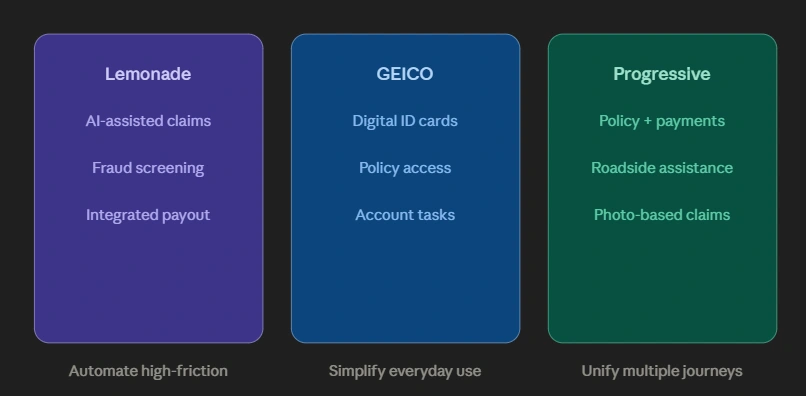
Lemonade is often mentioned because of its AI-assisted claims experience.
What makes that example useful is not just the headline speed. It shows what happens when claims intake, verification logic, fraud screening, and payout workflows are designed as part of one connected system. That is a strong lesson for any insurer exploring advanced insurance mobile app development.
GEICO offers a different lesson.
Its app is not built around novelty. It is built around practical utility. Digital ID cards, policy access, and simple account tasks may sound basic, but they solve real customer needs. That matters because insurance apps are often used in brief, important moments. The best apps respect that.
Progressive is a good example of a broader servicing model.
Its app brings together policy detail access, payments, roadside help, and claims initiation with photo-based input. That kind of multi-journey structure is useful for insurers that want one app to support both customer convenience and operational efficiency.
Taken together, these examples show three different maturity paths:
That is a helpful way to think about your own roadmap.
And once the market picture is clear, the final question is not what features are possible.
It is who can help you build the right thing, in the right way.
At Neuronimbus, we look at insurance mobile products the way decision-makers inside insurers have to look at them:
That changes how the work gets done.
Instead of starting with screens alone, we start with journeys, business logic, system dependencies, security needs, and future scale.
That means we can help insurers think through:
The result is an app that can support real servicing, real claims, real users, and real growth.
That is what strong insurance app development solutions should do.
And that is the standard we believe insurers should expect.
Talk to our solution architects. We'll help you figure out which path actually fits your business.
Insurance mobile app development is the process of building secure, scalable mobile applications that allow users to purchase policies, manage accounts, file claims, make payments, and access support—while integrating with backend insurance systems like claims, billing, and CRM.
Because mobile apps directly impact business performance. They reduce claims processing time, lower customer support costs through self-service, improve data accuracy, and enhance customer experience during critical moments like claims and renewals.
Common types include policyholder apps for customer self-service, claims or FNOL apps for faster claims processing, agent or broker apps for field operations, and embedded insurance apps integrated into partner platforms like travel or automotive services.
Core features include secure login (MFA/biometric), policy dashboards, digital documents, payments, claims submission, and status tracking. Advanced apps may include AI-driven claims processing, fraud detection, and personalized notifications.
Costs vary based on complexity. A basic app may cost $75,000–$200,000, while mid-scale apps range from $200,000–$500,000. Enterprise-grade solutions with deep integrations and advanced features can exceed $500,000 to $2M+.

Let Neuronimbus chart your course to a higher growth trajectory. Drop us a line, we'll get the conversation started.






Call Us

Schedule a Call


Your Next Big Idea or Transforming Your Brand Digitally
Let's talk about how we can make it happen.