Let’s start with a stat.
Airlines collectively spent $37 billion on IT in 2024.
That number is climbing and 74% of airlines say they plan to increase IT investment further over the next two years.
The reason is not hard to find.
McKinsey estimates that $45 billion in additional EBITDA is within reach by 2030 for airlines that execute airline digital transformation well.
The average airline earns $7 in profit per passenger, which means the margin for inefficiency is essentially zero.
That’s where digital transformation for airlines is the wrench that can twist the stuck tap knob and let the revenue flow freely.
But what does digital transformation for airlines mean?
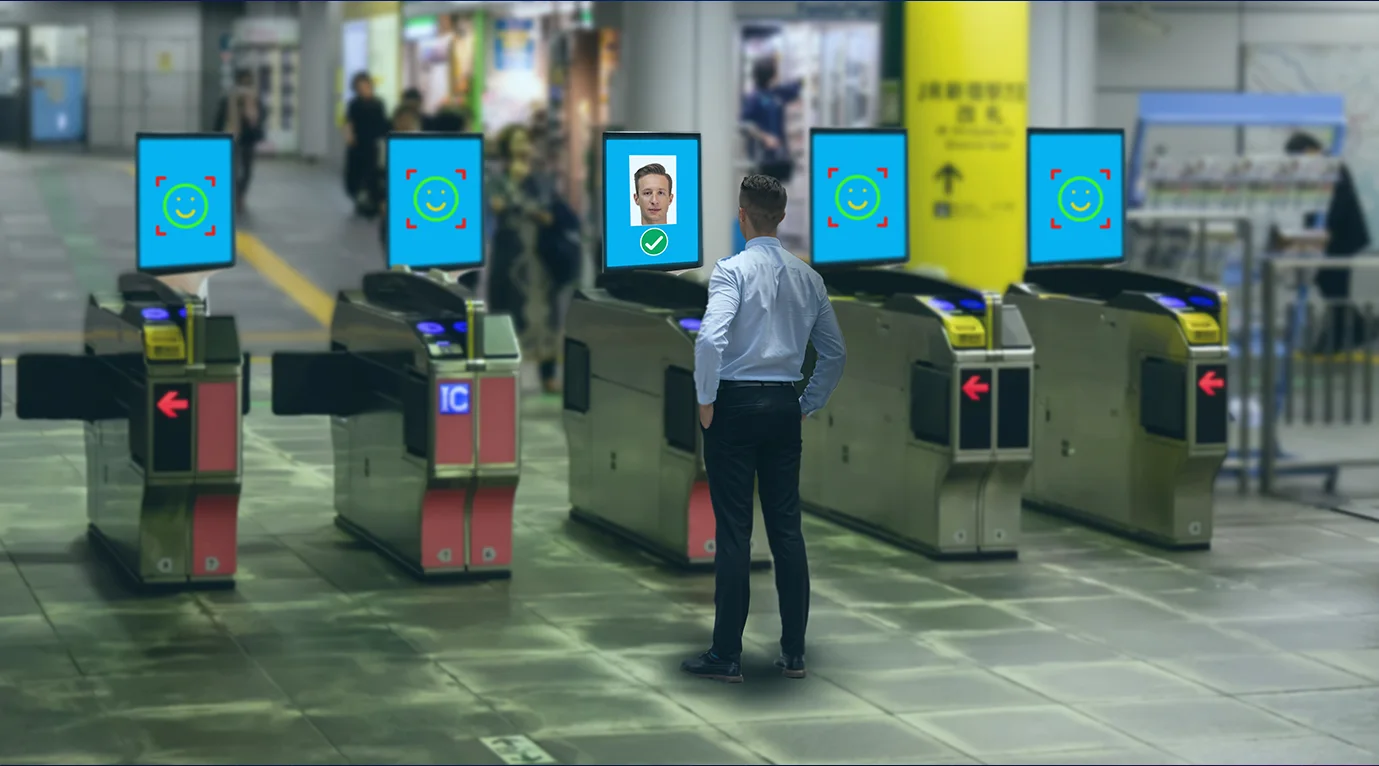
Airline digital transformation is the integration of AI, cloud, biometrics, and connected infrastructure across operations, distribution, and customer experience, with the aim to drive efficiency, unlock revenue, and compete in a fierce market.
Also read: Digitization vs Digitalization: Key to Digital Transformation
Let’s start with the scale of what airlines are now managing.
IATA confirmed 2024 as a record year for global air travel.
In 2025, passenger numbers are expected to cross 5.2 billion for the first time, with 40 million aircraft departures projected across the year. For context, that is more than double the traffic from 2003.
The fact that most passengers don’t ever realize is that the vast majority of that traffic is being processed by systems that were designed decades before it existed.
.webp)
Most airline Passenger Service Systems trace their core logic back to IBM's Transaction Processing Facility, which is technology developed in the 1960s.
McKinsey, in their 2023 report on airline IT, put it plainly: many airlines depend on systems that have been running "at least 20 years, some closer to 50."
In fact, the six-digit booking code you receive when you buy a flight today is a format that was standardised roughly 70 years ago.
This is absolutely not a criticism. These systems were built to be reliable, and they are. But reliability and agility are different things… and right now, airlines need both.
Passenger expectations have moved significantly.
SITA's 2025 Passenger IT Insights surveyed 7,500 travellers across 25 countries and found:
These numbers represent a passenger base that has already internalised digital-first expectations from every other consumer industry and is now measuring airlines against that standard.
The competitive pressure is well and truly on from the new-age airlines.
Ryanair has an 800-person digital team.
It generates €4.72 billion in ancillary revenue, which is 34% of its total revenue, from AI-driven pricing, digital upsells, and a fully direct distribution model that has no GDS costs embedded.
AirAsia has built a super app with 53 million monthly active users, a digital unit valued at $1.2 billion, which is more than the airline itself.
IndiGo completed a full cloud migration in under 18 months and holds 64.5% of India's domestic market.
Legacy carriers watching these numbers understand the pressure.
The question is not whether the airline industry digital transformation is happening. It is whether your organisation is positioned inside it or outside it.
Also read: Craft a Winning Cloud Transformation Strategy
Digital transformation in aviation is not a technology category. It is a business strategy that runs through every part of how an airline operates, sells, and serves passengers and the industry's most credible institutions have been mapping its structure for years.
IATA's Modern Airline Retailing Program, established in 2022, organises this transformation around three interconnected pillars:
The IATA Airline Retailing Consortium (which includes American Airlines, Air France-KLM, British Airways, Emirates, Lufthansa, Singapore Airlines, and Qatar Airways) is actively implementing this model.
McKinsey's 2023 analysis of 15 global airline CIOs identifies five elements of transformation:
The critical insight from McKinsey is the sequence.
Data architecture and cloud infrastructure come before AI and personalisation, not after.
That’s why airlines that deploy AI on fragmented data foundations get fragmented results.
Accenture's aviation reinvention study, which surveyed 300 aviation CXOs, found that 92% of aviation leaders believe their digital experiences already match or exceed online retailers. Consumer research shows a meaningful gap with that perception but the confidence signals that leadership intent is there. The execution is the challenge.
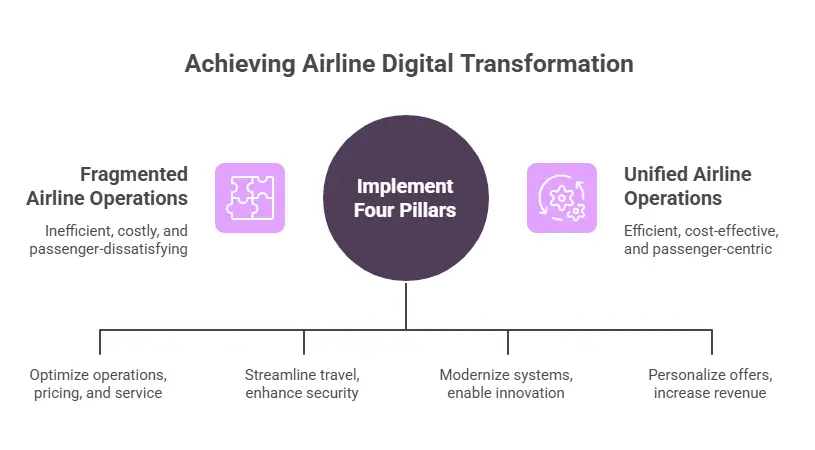
When you synthesise across these frameworks, four pillars consistently surface as areas where transformation delivers the most measurable value:
Data & AI
Digital Identity & Biometrics
Cloud & Modern Architecture
Distribution & Retail
Each one addresses a different constraint that limits revenue or increases cost:
They are interconnected. Progress on one creates headroom for the others.
Across the globe, airline innovation has moved from pilot programmes to production deployments.

Delta Air Lines (North America) is probably the most comprehensive example of transformation at scale.
They have fully migrated to cloud, deployed a GenAI travel assistant called Delta Concierge — which saw 1.3 billion app interactions in 2024 — and are running AI-driven dynamic pricing on a growing share of their global network.
Underneath all of this, their APEX predictive maintenance system has taken annual maintenance cancellations from 5,600 to 55.
Lufthansa Group (Europe) has taken a platform approach. Their AVIATAR predictive maintenance system, built on Google Cloud, has cut infrastructure costs by roughly 50% and is now used by airlines worldwide.
Their AI-powered turnaround monitoring system, developed with Fraport at Frankfurt, watches ground operations in real time and flags bottlenecks before they affect departure times. NDC is live across all five group airlines, covering 140 million passengers per year.
Emirates (Middle East) invested $23 million in end-to-end biometric infrastructure at Dubai Terminal 3 in late 2025. They are also fitting their entire 232-aircraft wide-body fleet with Starlink connectivity, and saving $100 million annually through predictive maintenance on their Skywise platform.
Singapore Airlines (Asia-Pacific) has built what is arguably the most deliberate innovation capability in the industry. 250+ GenAI use cases developed, roughly 50 in production, across 18 months. The first major airline to partner with OpenAI. A dedicated innovation lab (KrisLab) has been running since 2019.
Ryanair deserves its own mention, not just as a low-cost carrier but as a benchmark for digital discipline. An 800-person digital team, €4.72 billion in ancillary revenue from AI pricing, and a direct distribution model that legacy carriers are still trying to match.
The pattern across all of these is the same: outcomes first, then scale. No one is running experiments. They are running businesses on top of digital infrastructure.
That said, getting here was not straightforward for any of them. And for most airlines, the hard part is not the technology.
The technology for airline digital transformation exists. The business case is clear. And yet, McKinsey estimates only 35% of digital transformation projects meet their original goals. BCG puts it even lower.
So what is actually getting in the way?
Legacy lock-in is the most immediate barrier.
Airlines spend 60–80% of their IT budgets on maintaining existing systems. A full PSS migration can exceed $100 million and take three to five years, with the airline running two systems in parallel the entire time.
Southwest Airlines' operational meltdown in December 2022 is the clearest illustration of what deferred modernisation costs: 16,700 flight cancellations, $825 million in losses, a $140 million DOT fine. Their crew scheduling system traced back to the 1990s.
The solution is not always a full migration; it is often a modernisation layer that creates a path forward without a full cutover.
Data silos are the second barrier, and a quieter one.
Airlines maintain three to five redundant copies of core reference data across disconnected systems. SITA found that while 90% of airlines have adopted data platforms, only 25% are actively integrating that data with AI. You cannot build intelligent systems on fragmented foundations. The data architecture has to come before the AI layer.
The talent gap is real.
McKinsey noted that decades of IT outsourcing left most airlines with minimal in-house digital capability. The product manager role, which is the person who connects technology to business outcomes, is rare in airline organisations. CAE's 2025 forecast projects 1.465 million new aviation professionals needed over the next decade. The competition for digital talent from fintech, cloud, and AI firms is intense.
The pilot trap is perhaps the most frustrating barrier. Promising proof-of-concepts that never scale because change management receives only 10% of transformation budgets while the technology gets 90%.
The barriers are real. But they are not insurmountable, and none of them are new problems for teams that have solved them before.
The gap in aviation is rarely the vision. Most airline technology leaders know exactly what they need to build. The gap is in moving from a roadmap to a live system, from a proof-of-concept to a production deployment that performs under operational conditions.
That is where we come in.
At Neuronimbus, we have worked with enterprises across industries on the exact problems this guide has been describing:
The reason competent transformation programmes fail is not usually technical. It is the handover between strategy and engineering, between what was designed and what gets built. We close that gap.
Airlines are not consumer apps. They operate under regulatory scrutiny, safety requirements, and operational constraints that most technology firms have never touched. The teams we put on aviation engagements have seen these environments before.
If you are working through a transformation decision, whether it is a legacy modernisation, a cloud migration, or an AI implementation, and you want to talk through what the path forward looks like practically, not theoretically: Let's have that conversation.
Airline digital transformation is the use of technologies like AI, cloud, biometrics, APIs, and connected systems to improve airline operations, customer experience, pricing, maintenance, and revenue generation.
It has become essential because airlines operate on very thin profit margins, passenger volumes are growing fast, and customer expectations now demand seamless, digital-first travel experiences across booking, check-in, boarding, and support.
The core pillars include data and AI, digital identity and biometrics, cloud and modern IT architecture, and distribution and retail modernisation through tools like NDC and ONE Order.
Major barriers include legacy systems, disconnected data silos, lack of in-house digital talent, high migration costs, and pilot projects that fail to scale into full production systems.
Airlines can succeed by focusing on business outcomes first, modernising data and cloud foundations before deploying AI, building cross-functional teams, and using phased implementation strategies instead of trying to replace everything at once.

Let Neuronimbus chart your course to a higher growth trajectory. Drop us a line, we'll get the conversation started.






Call Us

Schedule a Call


Your Next Big Idea or Transforming Your Brand Digitally
Let's talk about how we can make it happen.