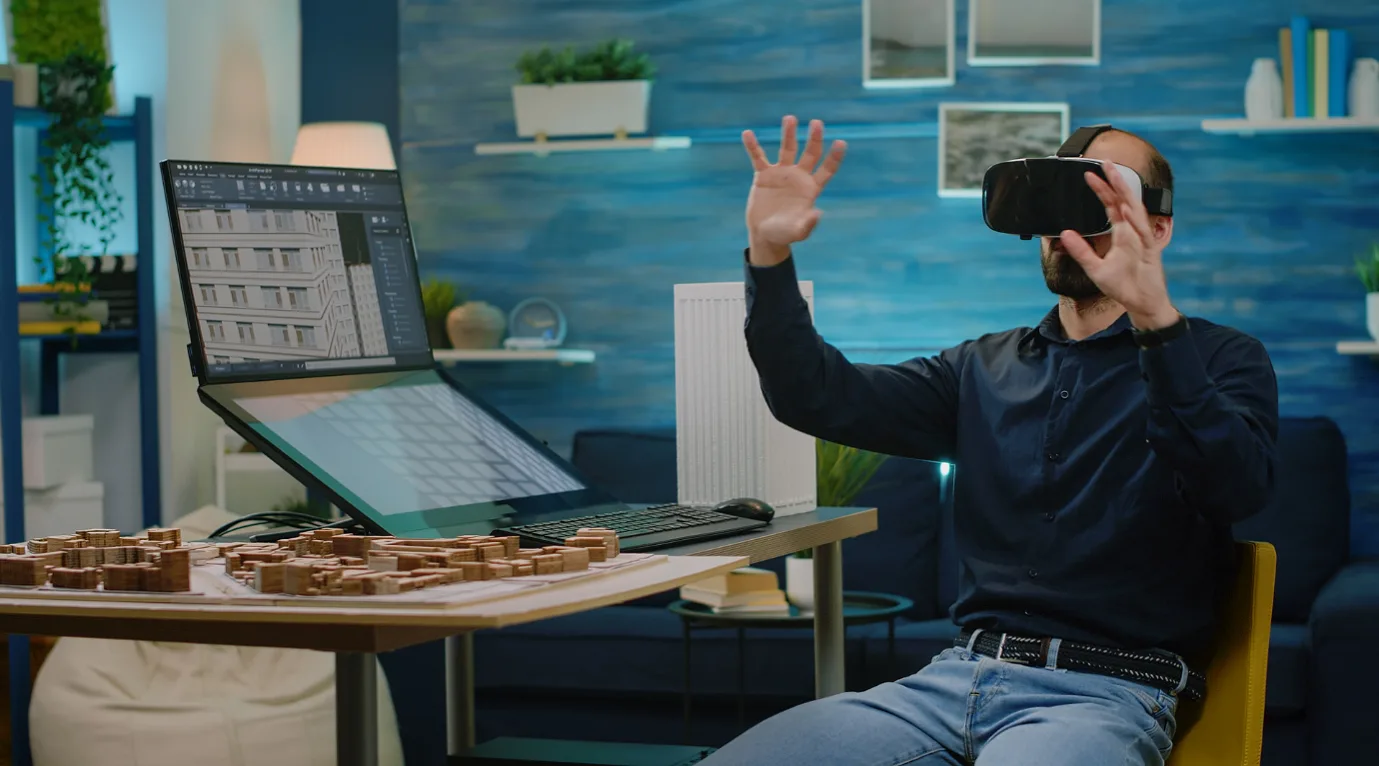
Virtual reality (VR) and augmented reality (AR) are no longer futuristic concepts; they are rapidly transforming industries worldwide. With the AR & VR market projected to reach $46.6 billion in revenue by 2025 and an expected annual growth rate of 7.42% (2025-2029), these technologies are proving to be more than just tools for gaming and entertainment. From retail, where AR enhances the online shopping experience, to healthcare, where VR is revolutionizing medical training, extended reality (XR) is reshaping how businesses operate.
One of the industries experiencing a major shift is architecture, engineering, and construction (AEC). Despite its traditionally hands-on nature, AEC is increasingly integrating XR to bridge the gap between physical and digital workflows. With AR & VR user penetration projected to reach 54.1% by 2025, construction companies are leveraging these immersive technologies for enhanced project visualization, safety training, and real-time collaboration. Teams can now explore 3D models in full scale, identify design flaws before construction begins, and reduce material waste—ultimately cutting costs and improving efficiency.
As the AR & VR market grows—especially with AR software leading at an expected $14.0 billion market volume in 2025—construction businesses that adopt these technologies early will gain a competitive edge. This article will explore how XR is revolutionizing the construction industry and why its adoption is becoming a necessity rather than an option.
In the past, the construction industry was known for its reliance on manual processes, physical blueprints, and hands-on work. But times are changing, and construction is evolving with the help of digital technologies that are reshaping how projects are designed, managed, and executed. At the forefront of this transformation? Augmented Reality (AR) and Virtual Reality (VR).
These technologies, commonly associated with gaming or entertainment, are now breaking ground in the construction industry, bringing enhanced visualization, precision, and safety to worksites. Let’s dive into the ways AR and VR in construction are making waves and explore how they can add value to modern projects.
Before we get into the benefits, let’s clarify what we mean by AR and VR in construction. These two technologies serve different purposes but, when used together, they’re game-changers in the field.
Augmented Reality (AR) overlays digital information—such as models or instructions—onto the real world. Imagine workers looking at a building site through an AR device and seeing a digital version of the final structure superimposed on the site. AR helps construction teams visualize designs directly in the physical environment, ensuring accuracy and improving decision-making on-site.
Virtual Reality (VR), on the other hand, immerses users in a completely digital environment. In VR construction, stakeholders can walk through a 3D model of a building long before any physical work begins. VR helps teams experience designs at full scale, identify potential issues, and align on the project vision early on.
Both AR and VR bring valuable capabilities to the construction process, enhancing not just visualization but also collaboration, accuracy, and training.
AR and VR technologies allow architects and engineers to present detailed 3D models of building designs to clients before actual construction begins, ensuring early feedback and necessary approvals.
These tools enable stakeholders to explore multiple design variations, material selections, and layout configurations within a virtual environment, enhancing decision-making and reducing costly mid-project changes.
Virtual simulations help construction teams identify potential conflicts between various building elements, such as plumbing, electrical, and structural components, in the early design phase.
Construction sequences can be simulated in advance to optimize workflow efficiency, minimize disruptions, and proactively address potential delays.

Augmented reality enables project managers to overlay digital blueprints and structural plans onto the physical construction site, ensuring that designs align with real-world implementation.
With AR and VR, project teams can track construction progress in real time, comparing site conditions to 3D models to detect discrepancies and maintain quality control.
Virtual reality facilitates immersive, risk-free training scenarios where workers can familiarize themselves with construction site safety protocols.
Simulated emergency situations allow workers to practice responding to hazards like fire outbreaks, equipment malfunctions, or structural failures, improving their reaction times and decision-making.
VR technology provides hands-on training for operating heavy machinery, such as cranes, bulldozers, and excavators, without exposing trainees to real-world dangers.
Workers can practice in a safe, controlled environment, reducing the risk of accidents and improving competency before handling actual equipment.
Instead of relying on traditional blueprints and static renderings, AR and VR allow clients to take a virtual walkthrough of the project, offering an interactive, immersive experience.
These technologies enhance communication between project teams and stakeholders, ensuring a clearer understanding of design concepts, spatial relationships, and project feasibility.
Virtual environments enable architects, engineers, and construction managers to collaborate in real time, regardless of their physical location.
Using AR/VR, professionals can review designs, suggest modifications, and troubleshoot issues together in a shared digital workspace, streamlining the decision-making process.
AR overlays provide step-by-step visual guidance to technicians performing maintenance and repairs on complex construction equipment.
This technology reduces downtime and improves efficiency by offering real-time data, instructions, and diagnostic insights to workers on-site.
Choosing the appropriate AR/VR headsets, wearable devices, and interactive tools based on specific construction applications is essential.
Ensuring compatibility with existing digital infrastructure is crucial for maximizing the benefits of these technologies.
AR/VR solutions should seamlessly integrate with existing construction software such as Building Information Modeling (BIM), project management platforms, and design tools.
A well-integrated system enables real-time updates, accurate data synchronization, and smooth collaboration across various project phases.
Comprehensive training programs are necessary to ensure that construction personnel can effectively utilize AR and VR technologies in their daily workflows.
Encouraging adoption across teams by demonstrating productivity gains, cost savings, and enhanced safety benefits can drive greater acceptance of these advanced tools.
By embracing AR and VR, the construction industry can reduce errors, enhance collaboration, improve safety standards, and increase overall efficiency. As immersive technology continues to advance, its role in transforming the construction sector will only become more significant.

Designing a building is one thing; building it accurately is another. AR and VR are proving invaluable tools for improving on-site execution and keeping projects on track.
On-Site Guidance with AR: Using AR, workers can see digital overlays of blueprints or instructions on physical surfaces, providing real-time guidance. This reduces errors in installation and assembly, as workers don’t have to rely on paper plans or memory. Instead, they see precisely where each component goes.
Accuracy and Error Reduction: With AR guiding workers on-site, the chances of costly mistakes decrease. When workers have precise, up-to-date visual instructions, rework is minimized, and components are installed correctly the first time around. This translates to better efficiency and fewer delays.
Remote Assistance and Inspections: AR enables remote experts to “visit” a construction site virtually, providing guidance and insights without physically being there. This is especially useful in inspections; supervisors can see what’s happening on-site and provide instant feedback, reducing the need for travel and speeding up the decision-making process.
Case Study: Skanska, a global construction company, leveraged AR for on-site coordination, resulting in a 7% reduction in project timelines. Implementing AR on-site can increase productivity by as much as 25%.
The construction industry is one of the most hazardous industries in the world. Ensuring worker safety is a top priority, and AR and VR in construction are now helping improve safety protocols and training programs.
VR for Safety Training: One of the biggest advantages of VR is that it allows workers to practice safety protocols in a simulated environment. Workers can train for hazardous scenarios, such as operating machinery or handling emergency situations, without putting themselves in harm’s way. This hands-on training approach is more engaging and effective than traditional classroom training.
AR for Hazard Identification: On a live construction site, AR can highlight potential hazards, such as exposed electrical wires or unstable structures, giving workers a visual cue to stay alert. With AR, risks are identified in real-time, helping workers make safer choices on-site.
Compliance and Knowledge Retention: VR simulations have been shown to improve knowledge retention significantly. For example, VR training helps workers remember safety procedures, leading to better compliance with protocols. This reduces the likelihood of accidents and keeps the project running smoothly.
Example: Bechtel, a major construction company, introduced VR into their safety training programs and saw a 32% reduction in safety incidents. VR training also enhances knowledge retention by 75%, compared to traditional methods.
While the benefits of AR and VR in construction are clear, adopting these technologies comes with its challenges:
Practical Tips
The use of AR and VR in construction is just beginning, and these technologies will only become more powerful and accessible in the future.
Industry Prediction: By 2030, about 70% of construction companies are expected to use AR and VR in some form.
The use of AR and VR in construction is revolutionizing the industry. From design visualization to on-site execution, safety training, and beyond, these tools are providing tangible benefits that enhance efficiency, accuracy, and safety. For construction companies looking to stay competitive, AR and VR offer a powerful way to deliver projects of higher quality and with fewer risks.
Ready to Transform Your Construction Projects? At Neuronimbus, we can help you explore AR and VR solutions that can align with your company’s goals. With the right investments and partnerships, you can turn these cutting-edge tools into invaluable assets, helping you build faster, smarter, and safer.



Let Neuronimbus chart your course to a higher growth trajectory. Drop us a line, we'll get the conversation started.






Call Us

Schedule a Call


Your Next Big Idea or Transforming Your Brand Digitally
Let's talk about how we can make it happen.