
Imagine a world where web development is no longer constrained by monolithic structures, and teams work independently to deliver seamless user experiences. Enter micro frontend architecture, a revolutionary approach transforming how modern web applications are built and maintained. As web applications grow more complex, traditional frontend strategies struggle to keep pace. Micro frontends provide the agility and scalability needed to overcome these challenges.
In this article we discuss the essence of micro frontend solutions, exploring their benefits, implementation strategies, and how they can redefine your development workflow. Whether you’re a developer or a business leader, understanding this approach is key to staying competitive in today’s dynamic digital landscape.
At its core, a micro frontend applies the principles of microservices to the frontend. Instead of developing one large, monolithic application, the frontend is divided into smaller, self-contained modules. Each module is responsible for a specific feature or function and can be developed, tested, and deployed independently.
For example, an e-commerce platform might have separate micro frontends for the product catalog, shopping cart, and user profile. These modules operate autonomously yet seamlessly integrate to deliver a cohesive user experience.
Traditional monolithic frontend architectures often result in bottlenecks. As applications scale, they become harder to maintain, with interdependencies between teams causing delays. Micro frontends address these issues by:
One of the most significant advantages of micro frontend architecture is the ability to develop and deploy modules independently. This reduces the risk of system-wide issues and accelerates the release cycle. For instance, a bug in the shopping cart module doesn’t require redeploying the entire application.
Each micro frontend should be self-contained, with minimal reliance on other modules. This autonomy extends to:
Clear API contracts between modules ensure smooth communication and integration. These contracts define how modules interact, what data they share, and the expected formats.
By dividing the application into smaller pieces, development teams can iterate quickly. This approach fosters innovation, as teams can experiment with new features without fear of breaking the entire application.
Micro frontends allow for lazy loading, where only the necessary modules are loaded initially. This reduces page load times and enhances the user experience. For example, the product catalog might load first, while the user profile loads in the background.
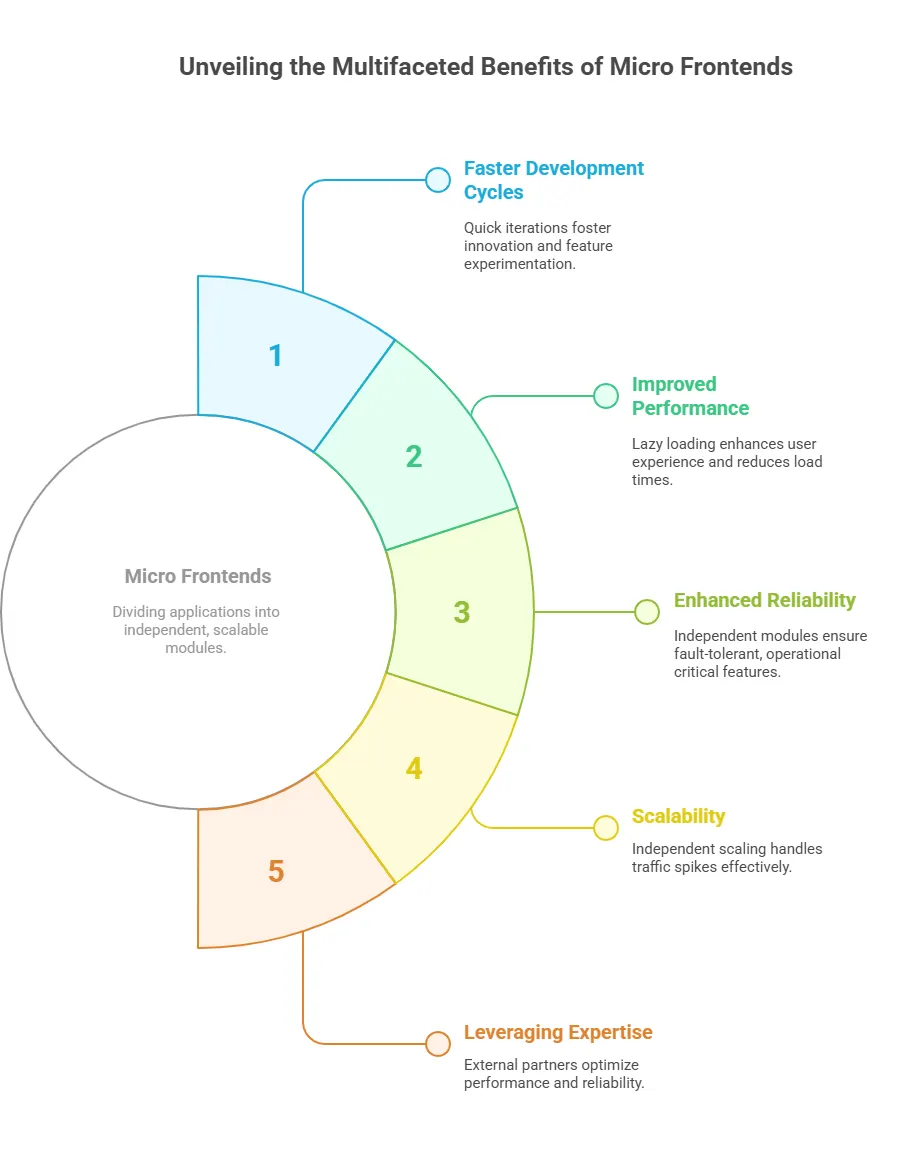
Because modules are independent, failures in one don’t affect others. This fault-tolerant architecture ensures that critical features remain operational even during issues.
Scalability is a cornerstone of micro frontend architecture. Each module can be scaled independently to handle traffic spikes. For instance, during a sale, the shopping cart module can scale up without impacting other parts of the application.
Organizations implementing micro frontend strategies often rely on external partners for advanced solutions. Services like cloud data integration, digital strategy, and quality assurance can ensure that these systems are optimized for performance and reliability.
Several frameworks support micro frontends, including React, Angular, Vue.js, and Svelte. The choice depends on your team’s expertise and project requirements. For instance, React’s component-based architecture aligns well with micro frontend principles, while Angular offers robust support for monorepos.
Consider an e-commerce platform transitioning to a micro frontend approach. The platform divides its application into modules for product browsing, checkout, and user accounts. By isolating these functions, the development team reduces downtime during updates and scales specific features during high traffic periods. Leveraging innovation consulting and product development services further streamlined their transformation.
While micro frontend architecture offers numerous benefits, it’s not without challenges. These include:
Adopting micro frontends doesn’t just require technical expertise; it demands a strategic mindset. Services such as application development, UX design, and cloud engineering play pivotal roles in ensuring successful implementation.
As technology evolves, micro frontend strategies are set to become even more sophisticated. Key trends include:
The adoption of micro frontend architecture marks a paradigm shift in web development. By breaking applications into smaller, manageable pieces, organizations can achieve greater agility, scalability, and resilience. Whether you’re managing a large-scale e-commerce platform or building a complex SaaS application, micro frontends can revolutionize your approach.
Neuronimbus, a leader in digital transformation, specializes in implementing cutting-edge solutions like micro frontends. With expertise in product development and cloud engineering, we help businesses unlock their full potential. Ready to future-proof your web applications? Let’s redefine your digital journey together.




Let Neuronimbus chart your course to a higher growth trajectory. Drop us a line, we'll get the conversation started.






Call Us

Schedule a Call


Your Next Big Idea or Transforming Your Brand Digitally
Let's talk about how we can make it happen.