
Selecting the right programming language is crucial for the success of any project. With numerous options available, two languages; Rust and Python – stand out for their unique strengths and use cases. While Python is known for its simplicity and versatility, Rust shines in performance-critical environments. In this article, we’ll delve into Rust vs Python, explore what Rust is used for, and provide actionable insights to help you make an informed choice for your next development challenge.
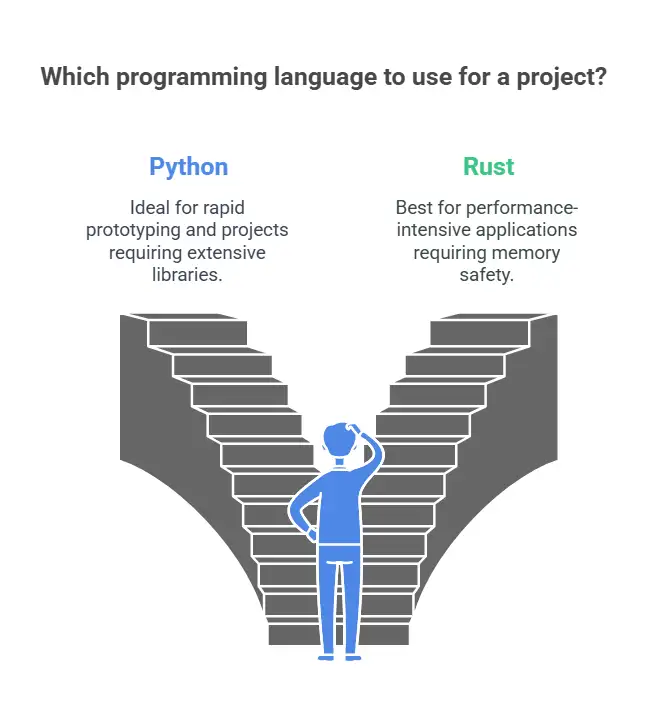
Python, introduced in 1991, has become one of the most popular programming languages. Known for its clean and beginner-friendly syntax, Python allows developers to focus on solving problems rather than wrestling with complex code structures.
Its versatility is amplified by a rich ecosystem of libraries like NumPy for numerical computations, Pandas for data manipulation, and Django for web development. This makes Python a preferred language for fields like data science, artificial intelligence, and automation.
For businesses seeking robust product design and UX services, Python’s ability to quickly prototype and iterate on applications is invaluable. It helps teams visualize and test ideas without incurring significant upfront costs.
Rust was developed to address the limitations of traditional system-level programming languages like C and C++. Released in 2015, Rust prioritizes memory safety, concurrency, and performance. Its unique ownership model eliminates issues like null pointer dereferencing and data races, making it ideal for resource-intensive applications. Although Rust has a steeper learning curve, its powerful type system and error-checking mechanisms ensure reliable and efficient code.
Rust’s low-level control is often leveraged in software engineering and digital transformation projects that demand precise resource management and robust security protocols.
When comparing Rust vs Python in terms of performance, Rust emerges as the superior choice for computationally demanding tasks. As a compiled language, Rust translates code directly into machine instructions, offering near-C-level speeds. This makes it the go-to language for applications such as real-time analytics, game engines, and blockchain development.
Python, as an interpreted language, sacrifices raw speed for flexibility. While Python’s performance might lag in resource-intensive scenarios, its extensive libraries often make it a more pragmatic choice for rapid prototyping. For example, in machine learning projects, Python’s libraries like TensorFlow and Scikit-learn accelerate development by abstracting away complex algorithms.
When scaling applications, development teams often employ cloud infrastructure management and data engineering services to optimize performance. Rust’s predictability and efficiency make it an asset in such scenarios.
Python’s garbage collection mechanism automatically manages memory allocation and deallocation. This convenience allows developers to focus on functionality without worrying about low-level details. However, garbage collection can introduce occasional delays, which may impact performance in real-time systems or large-scale computations.
Rust employs an innovative ownership model to manage memory without a garbage collector. This model enforces strict rules during compilation, ensuring that memory is used efficiently and safely. For example, in embedded systems or IoT applications, Rust’s deterministic memory management ensures optimal performance while minimizing runtime errors.
In enterprise application development, where resource constraints and reliability are critical, Rust’s ownership model provides a competitive edge. Developers can craft efficient, bug-free systems without compromising on safety.
Concurrency is a key factor in modern software, especially for systems that handle multiple tasks simultaneously. Python’s concurrency model, constrained by the Global Interpreter Lock (GIL), can limit performance in multi-threaded scenarios. While Python’s asynchronous libraries like asyncio offer some solutions, they are better suited for I/O-bound tasks rather than CPU-intensive operations.
Rust, on the other hand, is designed with concurrency in mind. Its ownership model ensures thread safety, allowing developers to build highly concurrent systems without risking data races. For industries relying on business process optimization and scaling, Rust’s concurrency capabilities can significantly enhance system throughput and reliability.
Aspect
Integration
Compilation vs Interpretation
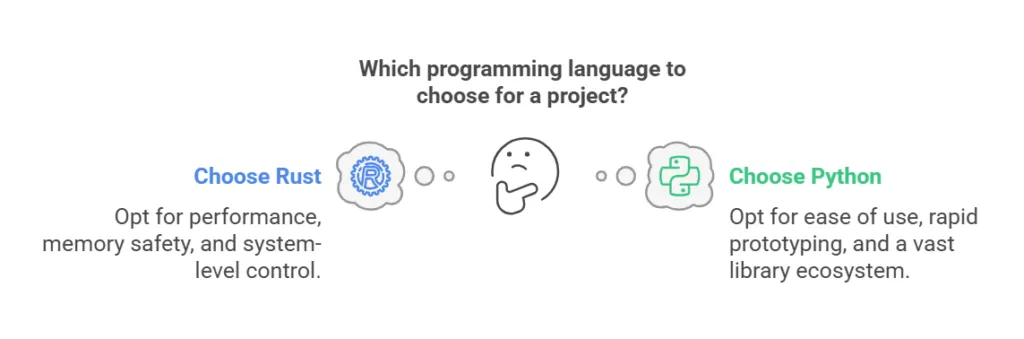
Rust is the preferred choice over Python when performance, memory safety, and system-level control are critical. Unlike Python, Rust is a compiled language that translates directly to machine code, making it significantly faster, especially for CPU-intensive tasks such as real-time analytics, game engines, and blockchain development.
One of Rust’s standout features is its ownership model, which ensures memory safety without the need for garbage collection. This prevents common issues like memory leaks and undefined behavior, which can be challenging in Python. Additionally, Rust offers fine-grained control over memory allocation, making it ideal for low-level systems programming and embedded applications.
Rust also excels in concurrent programming, as it prevents data races through its strict memory management, whereas Python’s Global Interpreter Lock (GIL) can limit true parallel processing. Furthermore, Rust’s static typing system helps catch errors at compile-time, improving code reliability.
In contrast, Python is better suited for projects that prioritize ease of use, rapid prototyping, and access to a vast library ecosystem, such as data science, web development, and automation. Choose Rust when performance and safety matter most, and Python when flexibility and development speed are key.
Python is the preferred choice over Rust when ease of use, rapid development, and access to a vast ecosystem of libraries are key priorities. With its simple syntax and clear structure, Python is significantly easier to learn, making it an excellent starting point for beginners in programming. Unlike Rust, which requires a deeper understanding of system-level programming concepts, Python allows developers to write and deploy code quickly without worrying about complex memory management.
Python also excels in rapid prototyping, enabling developers to iterate on ideas faster than Rust. This makes it ideal for startups, research projects, and industries that require frequent updates, such as web development, data science, and machine learning. Python’s extensive library support provides pre-built tools for nearly every domain, reducing development time and effort.
Another major advantage is Python’s strong community support, which ensures that developers have access to extensive documentation, tutorials, and third-party resources. Whether for automation, artificial intelligence, scientific computing, or backend development, Python remains the go-to language for projects prioritizing flexibility, simplicity, and development speed. However, for performance-critical applications and system-level programming, Rust may be the better choice.
Neuronimbus provides cutting-edge software development, digital transformation, and business process optimization services, making it the perfect partner for projects requiring expertise in both Python and Rust. Whether you’re building a high-performance system with Rust or a flexible, scalable application with Python, Neuronimbus offers tailored solutions to meet your needs.
For Python-based development, Neuronimbus leverages its deep experience in web development, AI, machine learning, and automation, utilizing Python’s extensive libraries and frameworks to accelerate development cycles. Whether it’s eCommerce platforms, SaaS applications, or enterprise automation, their UI/UX design, cloud engineering, and data integration services ensure seamless, user-friendly, and scalable solutions.
For Rust-based development, Neuronimbus focuses on high-performance applications, embedded systems, and secure backend infrastructure. With Rust’s memory safety, fine-grained control, and concurrency support, they develop reliable and efficient software for blockchain, IoT, and real-time computing. Their software re-engineering and DevOps services optimize applications for scalability and security.
By combining Rust’s performance with Python’s versatility, Neuronimbus delivers robust, future-ready applications that balance speed, security, and ease of development. Whether you’re a startup or an enterprise, Neuronimbus provides end-to-end development, cloud solutions, and digital transformation expertise, ensuring your business stays ahead in the ever-evolving technology landscape.
Both Rust and Python bring unique strengths to the table. Python excels in simplicity, rapid development, and a vast ecosystem, while Rust offers unparalleled performance, memory safety, and concurrency support. Together, they can address a wide spectrum of development challenges.
Organizations seeking expert guidance can benefit from partnering with Neuronimbus, whose expertise spans into multiple specialist domains. By integrating Python’s versatility with Rust’s robustness, Neuronimbus delivers solutions that are not only innovative but also highly scalable and efficient.




Let Neuronimbus chart your course to a higher growth trajectory. Drop us a line, we'll get the conversation started.






Call Us

Schedule a Call


Your Next Big Idea or Transforming Your Brand Digitally
Let's talk about how we can make it happen.