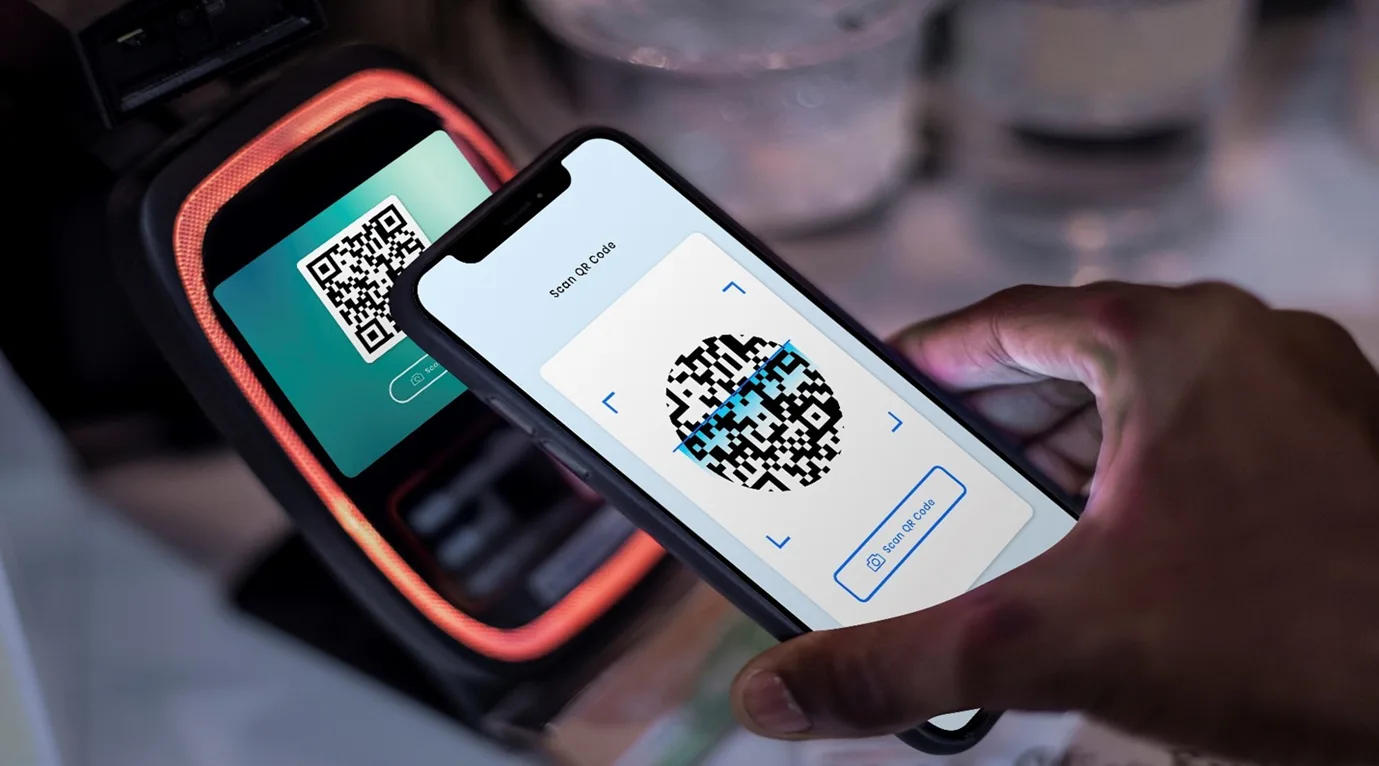
The way we manage our finances has undergone a dramatic transformation in recent years. The rise of peer-to-peer (P2P) payment apps has revolutionized the way we send and receive money, both for personal and small business transactions. Imagine a world where splitting a restaurant bill with friends, paying rent to your landlord, or reimbursing a colleague for coffee becomes an effortless digital experience. This is the power and convenience that P2P payment apps bring to the table.
This comprehensive guide is designed to equip app developers, fintech startups, and financial institutions with the knowledge and insights necessary to navigate the exciting world of peer-to-peer payment app development. Whether you’re a seasoned developer or just starting your journey in the fintech space, this deep dive will provide valuable information on the core functionalities, security considerations, technical aspects, and successful strategies for building a thriving P2P payment app.
Peer-to-peer (P2P) payment apps have fundamentally changed the way we exchange money. Unlike traditional methods that rely on physical cash, checks, or bank transfers, P2P apps leverage the power of mobile technology to facilitate instant and secure digital transactions between individuals.
Here’s how it works: Users download a P2P payment app onto their smartphones and link it to their bank accounts or debit cards. To send money, users simply select the recipient from their contact list or enter their phone number or email address associated with the app. The desired amount is then entered, and with a few taps, the funds are transferred electronically from the sender’s account to the recipient’s.
The convenience and speed offered by P2P apps are undeniable. Gone are the days of scrambling for cash or waiting for cumbersome bank transfers to clear. P2P apps empower users to manage their finances on the go, making everyday transactions seamless and efficient.
But the benefits of P2P apps extend far beyond convenience. Here are some key advantages that have driven their widespread adoption:
The simplicity, speed, and cost-effectiveness of P2P apps have made them a ubiquitous presence in our daily lives.
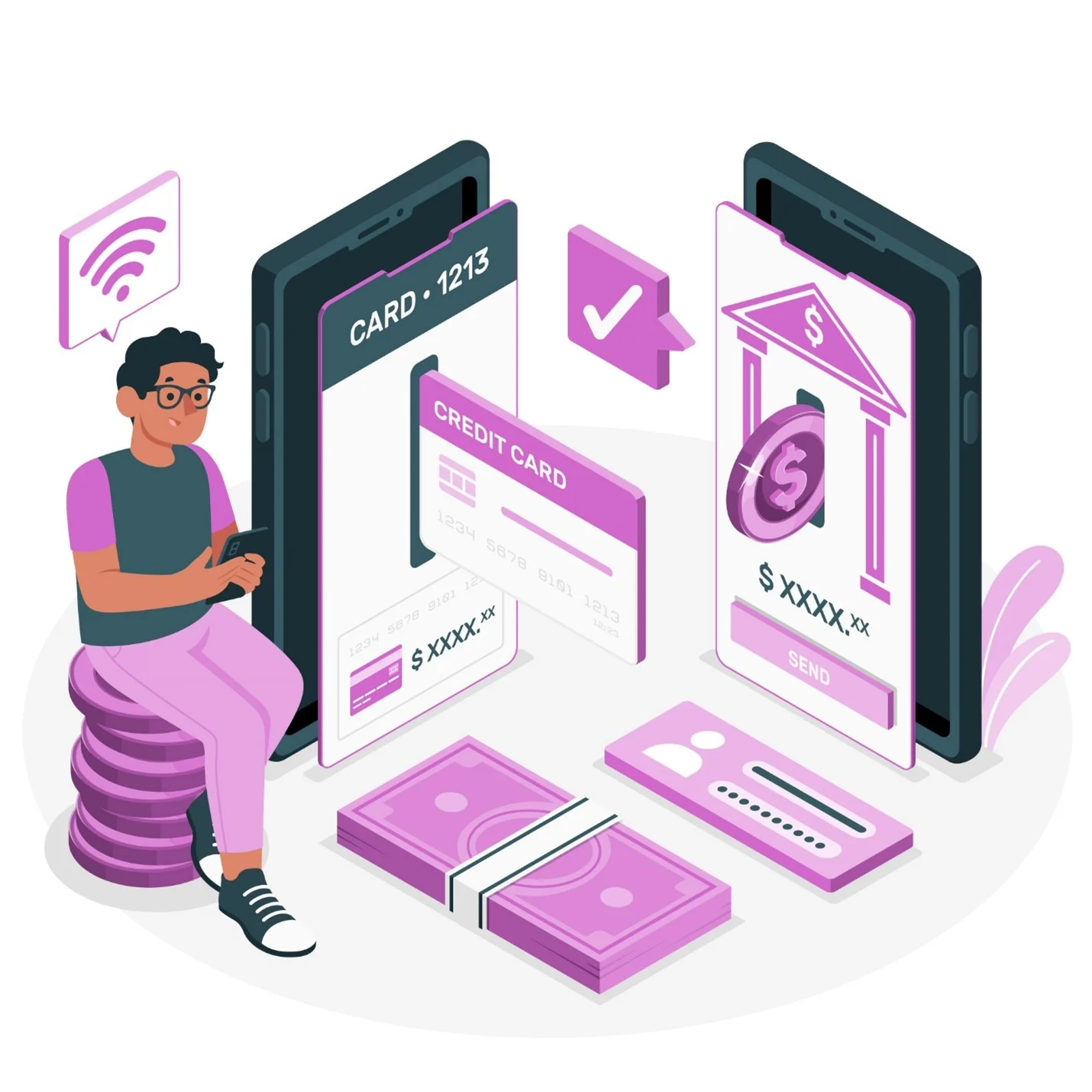
In today’s competitive landscape, a well-designed feature set is crucial for a peer-to-peer (P2P) payment app to stand out. Here’s a breakdown of the essential and value-added features that contribute to a successful app:
A user-friendly interface is crucial for any successful app, and P2P payment apps are no exception. The design should be intuitive, clear, and navigate easily. Simple icons, menus, and clear labeling ensure a smooth user experience for all, regardless of technical expertise.
By incorporating these essential and value-added features, along with a user-centric design approach, you can create a P2P payment app that caters to the needs of your target audience and fosters user adoption and retention.
Now that we’ve explored the features that make a P2P payment app tick, let’s shift our focus to the critical aspect of security in the next section.
Security is the cornerstone of trust in any financial application. When dealing with peer-to-peer (P2P) payment apps, where users entrust their sensitive financial data, robust security measures are essential. Here’s why:
Developing a P2P payment app requires adherence to various regulations depending on your geographical location. Here are some key areas to consider.
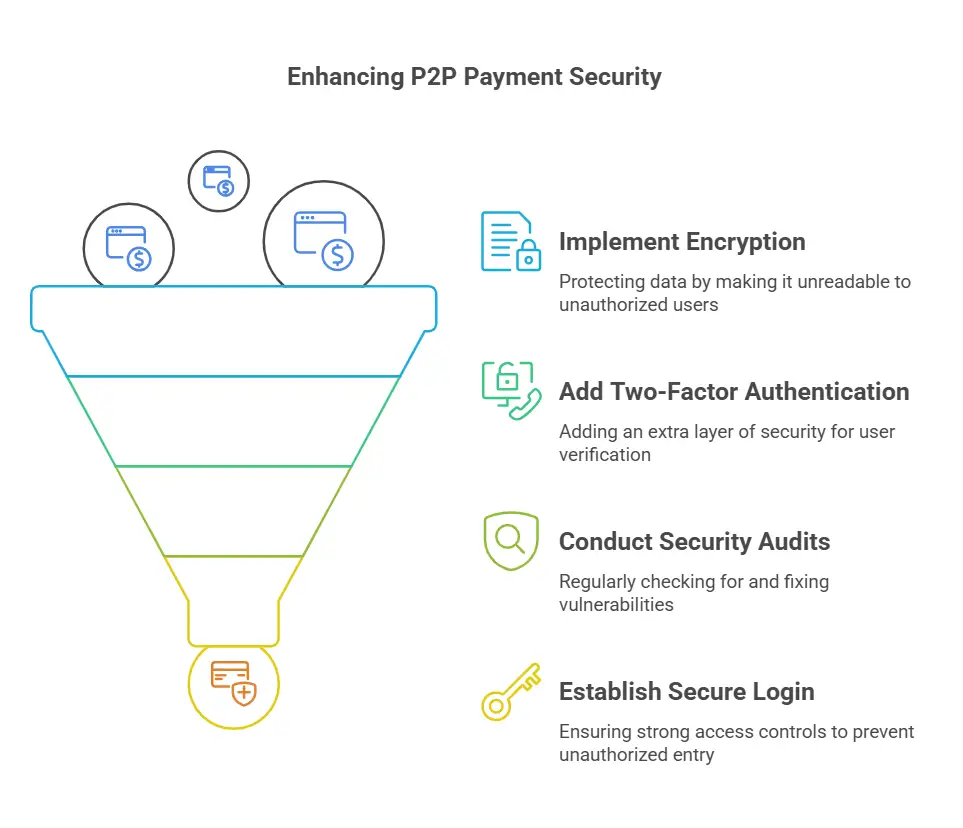
Here are some key security measures to implement in your P2P payment app:
Building a robust and scalable peer-to-peer (P2P) payment app requires careful consideration of the technical back-end. Here’s a breakdown of the key factors to address.
The technology stack you choose is very crucial aspect of app development as it forms the foundation of your app’s functionality, performance, and scalability. Here are some key considerations:
Popular choices for P2P app development include Java, Kotlin (for Android), Swift (for iOS), and JavaScript (for cross-platform development). Consider factors like developer expertise, desired functionalities, and long-term maintainability when selecting your programming languages.
Selecting a reliable database solution is crucial for storing user data, transaction history, and other critical information. Options like MySQL, PostgreSQL, or NoSQL databases like MongoDB can be considered based on your specific needs and data volume.
Integrating with banking APIs and third-party payment processors is essential for facilitating seamless money transfers. Research and choose reputable providers that offer secure and reliable API solutions.
Integration with Banking APIs and Third-Party Services
As mentioned earlier, integrating with banking APIs and third-party payment processors is vital for enabling core functionalities like money transfers and account verification. These integrations allow your app to connect with users’ bank accounts and facilitate secure transactions.
P2P payment apps need to be able to handle a high volume of transactions efficiently. Here are some strategies to ensure scalability and performance.
Breaking down the app into smaller, independent services can improve scalability and facilitate easier maintenance and updates.
Leveraging cloud platforms like AWS, Azure, or Google Cloud can provide a scalable and secure infrastructure to handle fluctuating user loads.
Implementing caching strategies can help reduce database load times and improve app responsiveness.
By carefully choosing the right technology stack, integrating with essential services, and prioritizing scalability, you can develop a P2P payment app that is robust, efficient, and capable of handling growth effectively.
In today’s competitive mobile landscape, user engagement and retention are paramount for the success of any application. Peer-to-peer (P2P) payment apps are no exception. Here are some strategies to keep users engaged and coming back for more:
Engaging User Experience (UX) and User Interface (UI) Design
A user-friendly and visually appealing design is crucial for fostering positive first impressions and encouraging continued use. Here are some pointers:
Ensure your app’s navigation is clear and intuitive, allowing users to perform actions quickly and easily.
A modern and aesthetically pleasing design can enhance user experience and make your app stand out from the crowd.
Allowing users to personalize their profiles or app experience can create a sense of ownership and increase engagement.
Implementing gamification elements can make the act of sending and receiving money more fun and engaging. Consider incorporating features like:
Awarding points or badges for completing transactions or achieving milestones can incentivize user activity.
Friendly competition through leaderboards can encourage users to be more active on the platform.
Introducing time-bound challenges or quests can add a layer of excitement and motivate users to participate more.
Loyalty programs that reward users for frequent usage can be a powerful tool for retention. Here are some program options:
Offer cashback incentives on transactions, encouraging users to choose your app over competitors.
Partner with businesses to offer exclusive discounts or promotions to app users, adding value to the platform.
Implement tiered loyalty programs with increasing benefits for high-volume users, promoting long-term engagement.
A smooth onboarding process that familiarizes new users with the app’s functionalities is essential for reducing churn. Additionally, providing responsive customer support channels ensures a positive user experience and addresses any concerns promptly.
By implementing these user engagement and retention strategies, you can create a P2P payment app that users find not only convenient but also enjoyable to use, fostering a loyal user base and driving long-term success for your app.
Developing a robust and successful peer-to-peer (P2P) payment app requires a sustainable business model. Here, we explore some common monetization strategies:
A common approach is to charge a small fee for each transaction processed through the app. This fee can be a flat rate or a percentage of the transfer amount. It’s crucial to strike a balance between generating revenue and keeping fees competitive to avoid deterring users.
Offering premium features or tiered subscription plans can be another source of revenue. These plans could provide benefits like increased transaction limits, priority customer support, or access to exclusive features.
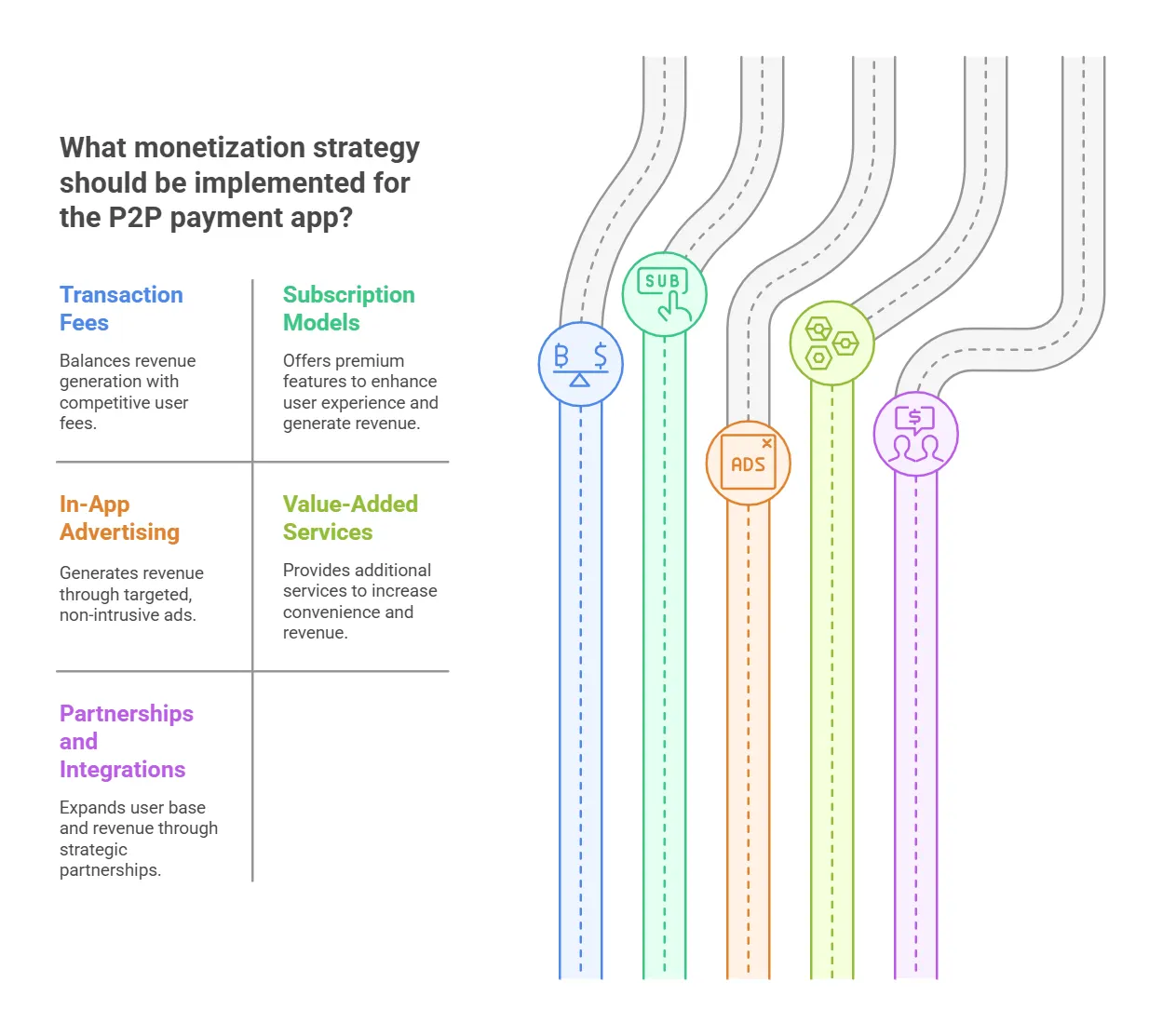
Implementing a non-intrusive in-app advertising strategy can generate revenue without significantly impacting user experience. The key is to ensure the ads are targeted and relevant to your user base.
Offering value-added services like bill payments, mobile top-ups, or micro-investments within the app can create additional revenue streams while promoting user convenience.
Strategic partnerships with financial institutions or other businesses can generate revenue through referral programs or co-branded offerings that expand your user base and market reach.
The optimal monetization model for your P2P payment app will depend on various factors such as your target audience, transaction volume, and competitive landscape. Carefully analyzing these factors and considering a combination of these strategies can help you develop a sustainable revenue stream for your app.
The cost of developing a P2P payments application varies widely, ranging from $25,000 for a basic app with limited features to $200,000 or more for a complex app with advanced functionalities. The final cost depends on several factors, including the app’s features, security requirements, and the location of the development team. On average, the cost for a standard P2P payment app falls between $100,000 and $150,000.
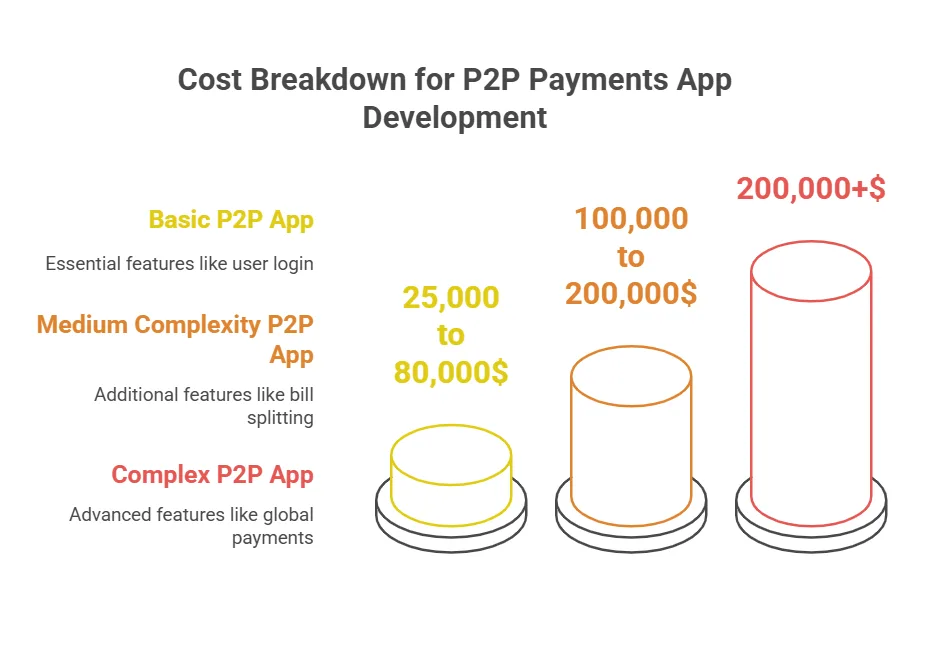
A simple P2P app with basic payment functionalities is more affordable.
Apps with additional features like bill splitting, international transfers, and investment integrations increase costs.
Implementing robust encryption, fraud detection, and multi-factor authentication adds to development expenses.
Hiring developers from regions with lower labor costs can reduce expenses.
Developers in North America and Western Europe typically charge more than those in Eastern Europe or Asia.
A sleek, user-friendly interface with custom animations and branding requires more development time and cost.
Includes:
– User registration and login
– Bank account linking
– Simple P2P payment functionality
– Transaction history
Includes all basic features, plus:
– Enhanced security protocols
– In-app chat for communication
– Bill splitting functionality
– Payment request feature
Includes all medium-complexity features, plus:
– Global payment gateway integration
– Advanced fraud detection
– Cryptocurrency transactions
– Detailed analytics and reporting
The final cost of your P2P payment app depends on your specific needs and priorities. Investing in a well-designed, secure, and feature-rich app can enhance user experience and ensure long-term success.
The future of peer-to-peer (P2P) payment apps is brimming with exciting possibilities. Here’s a look at some emerging trends and potential developments to keep an eye on:
P2P payment apps are poised to play an increasingly important role in our financial lives. By embracing innovation, prioritizing user experience, and staying ahead of the curve, developers and financial institutions can create a future where P2P payments are seamless, secure, and accessible to everyone.
Neuronimbus brings unparalleled expertise in product development, UX design, and digital transformation, making it the perfect partner for building a robust and scalable peer-to-peer (P2P) payment app.
From prototyping and MVP development to full-scale software engineering, Neuronimbus helps fintech startups and financial institutions create cutting-edge payment solutions tailored to market needs.
With a strong focus on business process optimization, Neuronimbus streamlines app performance, ensuring scalability, reliability, and compliance with industry regulations like KYC, AML, and data privacy laws. Their cloud and data engineering services provide secure infrastructure for handling high transaction volumes, while QA testing ensures flawless functionality. Whether launching a new P2P app or upgrading an existing platform, Neuronimbus empowers businesses with innovative, secure, and future-ready fintech solutions.
The world of peer-to-peer (P2P) payment apps is an exciting and rapidly growing space. Whether you’re a seasoned developer, a budding entrepreneur, or simply curious about the future of finance, this is the perfect time to get involved.
The future of P2P payments is bright, and with dedication and innovation, you can be a part of shaping this transformative landscape. So, are you ready to take the plunge and be a part of the P2P revolution?

Let Neuronimbus chart your course to a higher growth trajectory. Drop us a line, we'll get the conversation started.






Call Us

Schedule a Call


Your Next Big Idea or Transforming Your Brand Digitally
Let's talk about how we can make it happen.