Imagine walking into a virtual bank branch, exploring your financial options with a virtual advisor, or visualizing your spending patterns in 3D; all from the comfort of your home. This is not science fiction; it’s the reality brought to life by banking augmented reality tools. As financial institutions embrace technology, augmented reality finance is transforming how banks interact with customers and manage operations.
This transformation isn’t limited to improving customer experiences; it’s also driving operational efficiency and innovation, helping banks reduce costs and position themselves as leaders in the ever-evolving financial landscape.
The global augmented reality in finance market size was estimated at USD 83.65 billion in 2024 and is expected to grow at a compounded annual growth rate of 37.9% from 2025 to 2030. The technological advancements in augmented reality hardware and software is fueling this tremendous growth. This article delves into the impact of AR in finance, its practical applications, and the future it promises for the financial sector.
Augmented reality is revolutionizing the banking industry by bridging the gap between traditional financial services and cutting-edge technology. By integrating AR tools, banks can provide more intuitive, user-friendly solutions that simplify complex financial processes.
With customers demanding digital-first solutions, AR tools help financial institutions remain competitive while offering innovative solutions that redefine engagement.
AR and VR are unlocking new dimensions in finance, transforming how services are delivered and consumed. Let’s explore the key areas where these technologies are making a difference.
Traditional methods of analyzing financial data often fall short of delivering actionable insights in an intuitive manner. Augmented reality changes this by enabling:
Example: Salesforce’s data visualization tools, powered by Oculus Rift, showcase how immersive technology can simplify and enhance decision-making processes.
Online payments often interrupt immersive experiences like gaming or virtual shopping. AR and VR seamlessly integrate payment interfaces into these activities, offering:
Example: MasterCard and Visa Europe have pioneered AR payment systems, allowing users to shop and pay directly in virtual or augmented settings.
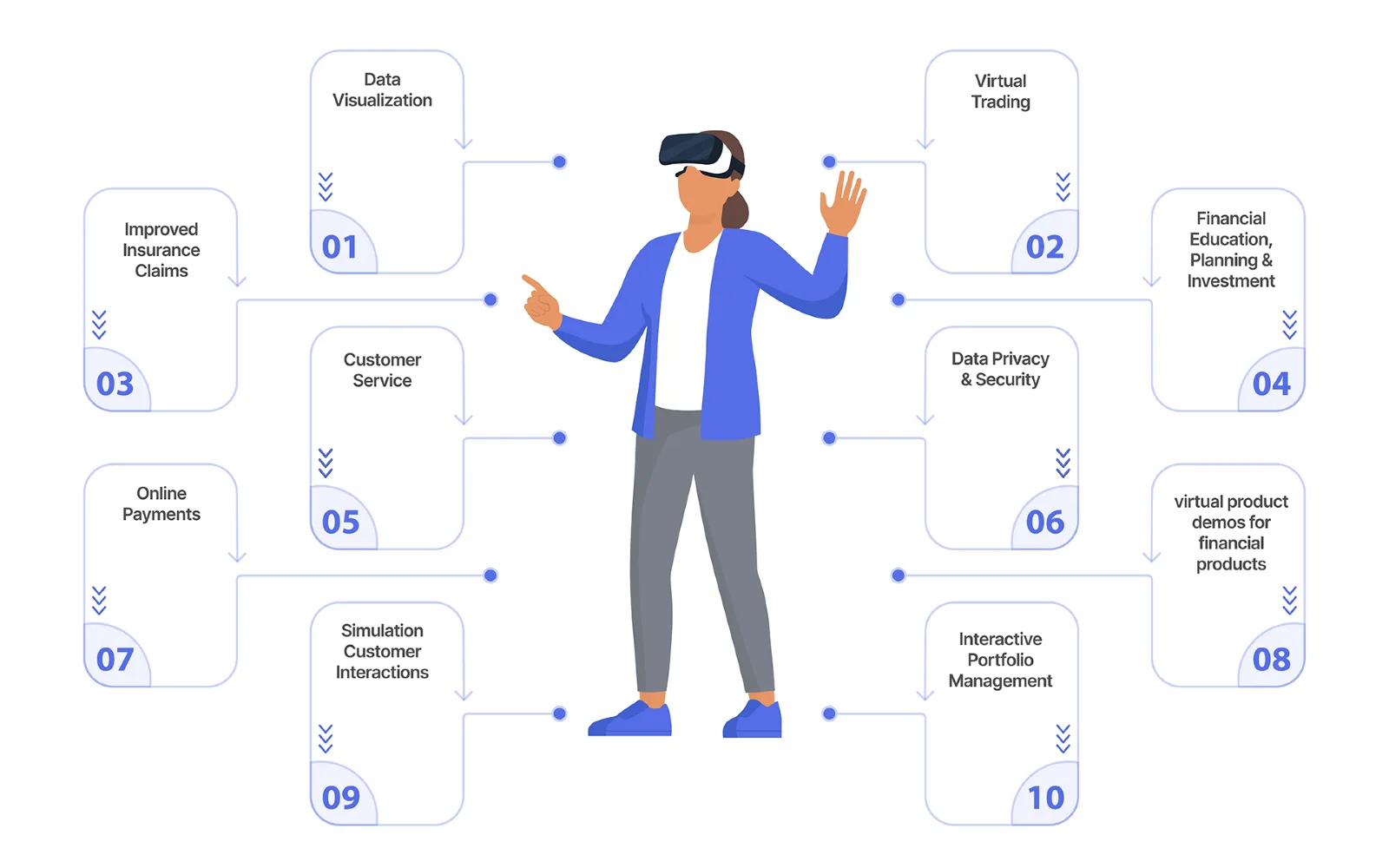
Physical bank branches have long been a cornerstone of traditional banking. However, AR enables banks to create virtual branches that address common challenges:
Imagine a virtual branch showcasing loan products where customers can explore customized offers with an interactive AR interface – all from their smartphones or AR glasses.
Customer engagement is a cornerstone of modern banking, and AR amplifies this in several ways:
Example: The Commonwealth Bank of Australia’s property search app leverages AR to provide real-time property insights, revolutionizing the home-buying experience.
Employee skill-building is critical for delivering exceptional customer service. AR and VR offer unparalleled opportunities for:
Example: Citigroup’s virtual trading desk uses AR to create a dynamic learning environment, equipping staff with tools to excel in high-pressure situations.
AR in financial services can be used for virtual trading. Asset management software can be integrated with AR to better enable customers using financial services to interact with trading algorithms.
Although processing insurance claims with AI is already facing some backlash from the general public for being highly inaccurate and being programmed for high rejection rates so that insurance companies can hit record profits, AR can be ethically used to process insurance claims for efficiently and humanly.
Adopting augmented reality finance tools yields numerous advantages for both banks and their customers.
Collaborating with partners who specialize in digital strategy and innovation can help banks seamlessly integrate AR tools, ensuring a robust, scalable platform for the future.
The trajectory of banking augmented reality indicates a future filled with exciting possibilities. Let’s explore what lies ahead:
The continued evolution of AR will redefine banking, pushing the boundaries of what’s possible in financial services.
The integration of banking augmented reality tools is not just a technological advancement – it’s a fundamental shift redefining how financial services are delivered. From enhancing customer interactions to revolutionizing operational efficiency, augmented reality finance is setting the stage for a more intuitive, accessible, and innovative banking experience.
For financial institutions ready to embrace this change, partnering with experts in digital transformation is crucial. With proven expertise in building scalable & innovative financial software, Neuronimbus, helps banks unlock the full potential of augmented reality, ensuring they remain at the forefront of this digital revolution. Together, we can transform the financial landscape, one immersive experience at a time.




Let Neuronimbus chart your course to a higher growth trajectory. Drop us a line, we'll get the conversation started.






Call Us

Schedule a Call


Your Next Big Idea or Transforming Your Brand Digitally
Let's talk about how we can make it happen.