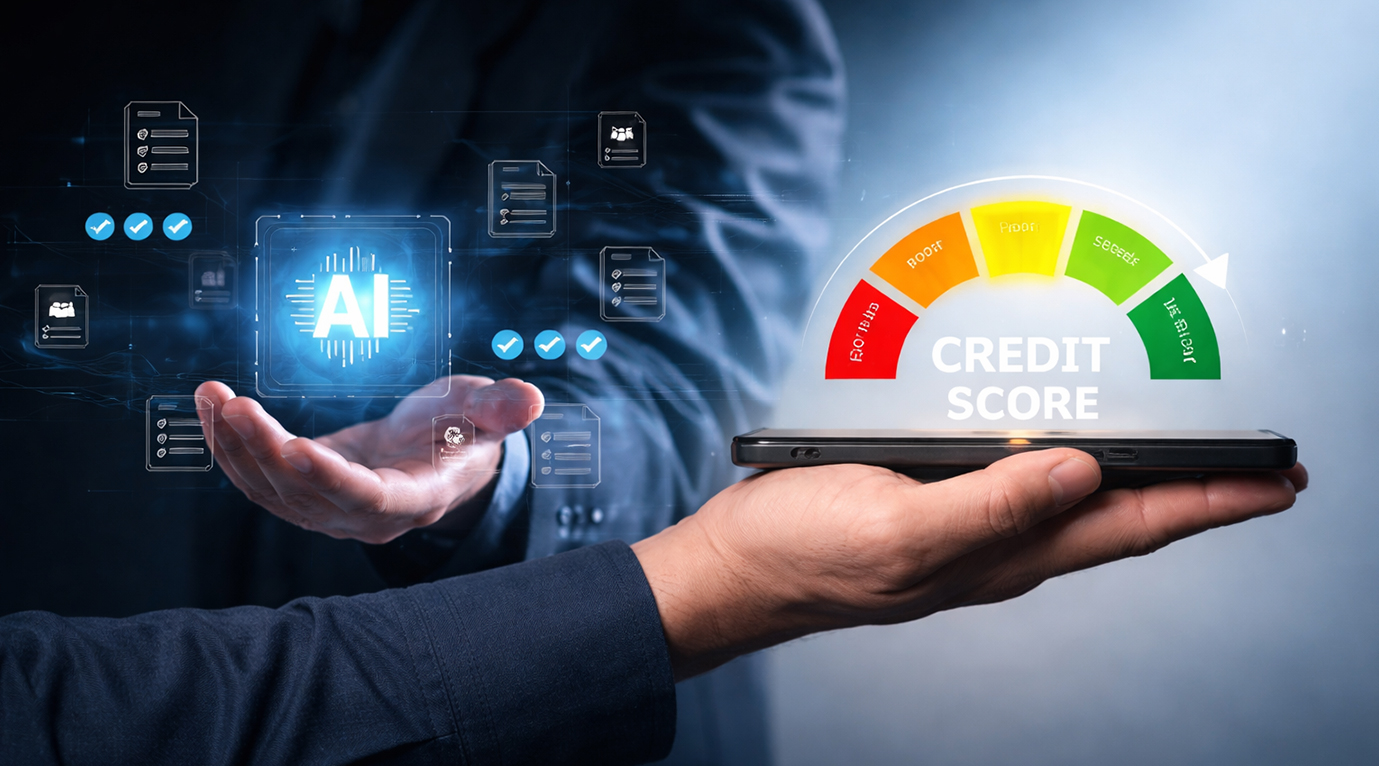
For decades, credit decisions have been built around a fairly simple question: Does this borrower look safe based on their past credit history?
That system worked reasonably well in a slower, more predictable financial world.
But lending today looks very different.
Digital lending platforms are issuing loans in minutes.
Fintech companies are approving credit cards in real time.
Consumers expect decisions instantly.
This is all because of AI-powered credit scoring.
Instead of evaluating a borrower using a handful of variables, AI systems can analyze thousands of data points simultaneously.
In many cases, these systems allow lenders to:
The result is a fundamental shift in how credit risk is assessed.
But to understand why this shift is happening, we first need to look at what AI-powered credit scoring actually means.
Also read: AI in Financial Services: Key Insights
To understand what AI credit scoring is, it helps to first understand what it replaced.
The modern credit score was born in 1989, when Fair Isaac Corporation released the first universal FICO score that any lender could access through the credit bureaus.
By the mid-1990s, Fannie Mae and Freddie Mac recommended it for mortgage underwriting. That sealed its dominance.
Today, over 90% of top US lenders use FICO scores. They are involved in more than 10 billion credit decisions annually.
But FICO is a logistic regression model running on roughly 15–20 input variables; all of them pulled from credit bureau data.
It looks at:
Even more crucially, FICO requires a minimum of six months of credit history to generate a score at all. Which means if you've never borrowed before, the model simply cannot evaluate you. You have to have credit to get credit. A perfect catch-22.
The result is a staggering number of people who are effectively invisible to lenders.
In the US alone, roughly 25 million individuals were unscorable as of 2020, despite many being financially responsible.
In India, over 160 million adults are credit-underserved.
Globally, the World Bank's 2025 Findex report found 1.3 billion people still lack basic financial accounts.
That’s why AI-powered credit scoring was long overdue.
Also read: AI Development Services: Choosing the Best Partner
An AI credit scoring system is fundamentally different in three ways.
Instead of 15–20 variables, ML models evaluate hundreds to thousands. This is evident in what fin-tech companies are doing today.
Upstart processes 1,600+ data points per applicant.
Zest AI runs approximately 300 variables from bureau data alone.
India's CreditVidya engineers over 10,000 features from alternative data such as banking transactions, mobile metadata, digital behavior patterns.
Traditional scoring uses linear logistic regression, which can only find straight-line relationships between variables.
ML models can detect non-linear patterns. They can learn, for example, that a certain combination of cash flow behavior and employment tenure predicts repayment far better than credit history alone.
AI models can incorporate what the industry calls alternative data, such as rent and utility payment history, UPI transaction patterns, GST filings for businesses, mobile usage behavior, even the velocity and timing of how someone fills out a loan application form.
The practical meaning of "AI score credit" then, is this: a numeric or tiered risk signal that reflects a far more complete picture of a borrower's financial reality and not just their bureau footprint.
And the evidence on what this does to lending outcomes is not ambiguous.
A 2024 peer-reviewed study published in MIS Quarterly tracked over one million underserved borrowers at a major bank.
AI models simultaneously increased approval rates and reduced default rates for this population.
That is the core promise of automated credit scoring.
Understanding the architecture of an AI credit scoring system allows you to ask the right questions.
So let's walk through how these systems are actually built.
Everything starts with data. AI credit models draw from far more than a credit bureau pull.
In India, the Account Aggregator framework is a game-changer here. With borrower consent, a lender can pull verified bank statement data from any AA-registered institution in seconds (instead of what used to take a week of document collection).
Raw data doesn't go directly into a model. It gets transformed.
A 200-row bank statement becomes hundreds of derived signals such as average monthly inflow, income volatility, end-of-month balance frequency, EMI payment velocity.
Lendingkart is a good example; it engineers over 5,000 features from GST, banking, and bureau data and scores an application in 3.5 seconds.
This is where most of the real work lives.
A data scientist who understands credit risk will build better features than one who doesn't.
For structured credit data, gradient boosting machines like XGBoost and LightGBM are the industry standard.
A 2022 benchmarking study confirmed GBM consistently outperforms deep learning on tabular credit data, with faster training and lower infrastructure cost.
Neural networks and LLMs are emerging for unstructured inputs like financial statements and business plans, but gradient boosting runs production credit scoring at most serious fintechs and challenger banks today.
A score by itself doesn't approve a loan. The score feeds into an AI credit decisioning engine that routes every application into one of three lanes:
Auto-approve (~60% of volume) — clear pass on risk thresholds, income verified, funds disbursed in minutes
Manual review — borderline cases, AI surfaces recommendation and evidence, human makes the final call
Auto-decline — clear knockout criteria, active defaults, fraud signals
This is why Upstart runs 91%+ of applications with zero human involvement. The model handles volume. Human judgment is reserved for cases that genuinely need it.
These are the two non-negotiables.
Explainability is a legal requirement. The CFPB, RBI, FCA, and EU AI Act all require lenders to give specific reasons for adverse action. The industry standard is SHAP, which generates per-feature contribution scores for every individual decision. These become the reason codes on your adverse action notices.
Model monitoring is an operational requirement. Credit models degrade over time. COVID proved this definitively.
Ongoing drift monitoring and champion-challenger testing aren't optional governance overhead. They are what keeps your model from becoming a liability.
Now that the architecture is clear, the natural next question is: what benefits do institutions that have actually deployed these systems see?
The business case for AI in credit doesn't rest on a single benefit.
Better risk decisions drive lower defaults.
Lower defaults improve portfolio quality.
Better quality allows more aggressive growth.
Faster processing cuts costs.
Alternative data expands your addressable market.
Soon, every lever moves in the same direction.
Upstart's 2024 FDIC-filed data shows 53% fewer defaults at the same approval rate versus traditional FICO models. JPMorgan Chase reports a 22% improvement in loan default prediction accuracy after deploying ML-based tools. A UK high-street bank working with Kortical found ML caught 83% of bad debt the traditional scorecard missed entirely.
PwC India found lenders using AI-based EWS experienced 30% less NPA slippage versus manual monitoring.
The RBI projects India's gross NPA ratio could rise to 3–5.6% by March 2026. That trajectory is a forcing function for institutions still running manual credit review.
Lendingkart: 3.5 seconds per application.
KreditBee: approval and disbursement in 10 minutes.
Indian MSME loans: down from one month to 3–5 days.
It’s obvious that when one platform responds in minutes and another in days, the first one wins the relationship regardless of rate.
Upstart approves 44% more borrowers than traditional models. These are not riskier borrowers, but borrowers who looked risky through a FICO lens and aren't.
Zest AI clients average a 25% increase in approvals with no added risk.
CreditVidya enabled credit access for 25 million individuals with thin bureau files while achieving 33% lower delinquencies at the same risk level.
McKinsey's 2025 banking review projects AI driving up to 20% in net cost reductions across banking operations.
OakNorth's 29–30% cost-to-income ratio versus an industry average of 60–70% shows what is possible when AI is baked into the credit process from the start.
Bajaj Finance serves 83.64 million customers at a gross NPA of just 0.85% (and it is reaching borrowers traditional models would decline).
A 2024 MIS Quarterly study of over one million underserved borrowers found AI models simultaneously increased approval rates and reduced defaults.
The benefits are real. But the path from intent to production is where most institutions run into trouble. There are five challenges that consistently trip up well-intentioned deployments.
Five challenges consistently trip up well-intentioned deployments. Worth knowing before you start.
Every credit decision needs to be explainable to the applicant, in specific terms, for that specific application.
The CFPB's Circulars 2022-03 and 2023-03 are explicit: black-box reasoning and generic reason codes are not compliant.
India's RBI draft circular (August 2024) requires decisions to be "consistent, unbiased, explainable and verifiable."
The EU AI Act classifies credit scoring as high-risk AI from August 2026.
Models trained on historical data inherit historical biases.
The Apple Card case (2019) is the clearest public example — a model producing 20× credit limit disparities that Goldman Sachs couldn't explain.
Done right, AI can actually reduce bias versus human underwriters. Upstart approves 116% more Black borrowers and 123% more Hispanic borrowers than traditional models. But that doesn't happen by accident.
75% of banks globally run on legacy core systems. The AI model is rarely the hard part. Getting it to receive real-time data from systems that weren't designed to share it, and that's where timelines slip. The fastest path is a modular decisioning layer that sits above the core, with clean APIs in both directions.
COVID broke models that had been well-validated. A model that was accurate in 2022 may be materially wrong in 2025. McKinsey found 40% of companies saw noticeable AI performance degradation within the first year.
67% of credit leaders cite capability gaps as the primary barrier. But the deeper issue is trust. Credit officers with twenty years of judgment don't hand decisions to a model easily, nor should they without governance structures that give them confidence.
Here is what I have seen repeatedly in conversations with credit leaders across banks and NBFCs.
The challenge is rarely "we don't know we need to do this."
It's one of three other things:
These are transformation problems. And transformation requires someone who understands both the technology and the institutional context it has to operate in.
Neuronimbus works with financial institutions to design, build, and deploy production-ready AI credit decisioning systems.
At Neuronimbus, we approach AI differently.
We start with the business problem, not the model.
We understand that financial institutions already operate complex ecosystems and introducing AI-powered credit scoring into this environment requires careful integration.
Our focus is on building practical AI systems that work inside existing enterprise workflows.
This typically involves several layers of implementation, and we have the experience, technology, and people to nail every layer.
That is where experienced digital transformation partners make the difference.
AI-powered credit scoring is a modern method of assessing borrower risk using machine learning and large volumes of data. Unlike traditional credit scoring models that rely mostly on bureau history, AI can evaluate thousands of variables such as banking behavior, income patterns, alternative data, and digital activity to make faster and more accurate credit decisions.
Traditional models like FICO depend on limited bureau-based variables and usually require at least six months of credit history. AI credit scoring goes much further by analyzing broader and more diverse data sources, detecting non-linear patterns, and helping lenders assess borrowers who may be new to credit or underserved by conventional systems.
AI credit scoring systems can use traditional bureau data, banking and cash flow data, alternative behavioral data, SME business data, and open banking data. This can include payment history, transaction trends, income regularity, UPI usage, GST filings, e-commerce sales, and permissioned account information.
AI-driven credit decisioning helps lenders reduce defaults, improve risk prediction, speed up approvals, lower operating costs, and expand access to credit for thin-file or underserved borrowers. It also supports better portfolio quality and allows institutions to process high volumes of applications with greater efficiency.
The biggest challenges include explainability, bias prevention, legacy system integration, model drift, and internal trust or capability gaps. Financial institutions need strong governance, compliance-ready model design, regular monitoring, and smooth integration with existing systems to successfully deploy AI in credit decisioning.


Let Neuronimbus chart your course to a higher growth trajectory. Drop us a line, we'll get the conversation started.






Call Us


Schedule a Call

Your Next Big Idea or Transforming Your Brand Digitally
Let’s talk about how we can make it happen.